Friday, August 1, 2008

Turning the Page

Disclaimer: The month of July was somewhat tumultuous for me on a personal level. Now at last, I feel enough at peace to write again. However, I’ve also debated at level of detail which I wish to write about my own private life in a domain as public as this blog. I understand that part of the point of a blog is to share one’s private life and indeed that is what I’ve been doing, but there are some things that I don’t think are right to put out so openly. The most I will say is this: the past month has made me more deeply aware of the beauty of life and the sorrow of death; the comfort of love and the pain of separation. Those of you who are my friends reading this will probably find out more detail about this past month from me at some point through a more private means of communication. Nevertheless, the private struggle of the last month has helped me focus more clearly on my public work as a volunteer. So, I apologize if this post seems to be high on philosophy and low on storyline but I want to share the upshot of the last month.

It’s now been over a year since I arrived in South Africa (September 21 will mark 1 year as an official Peace Corps Volunteer). I’ve been going through many transitions all at once. The main project that consumes my time at the moment is my library and literacy campaign. I’ve also found myself reading and writing a lot more recently. The cold winter is slowly warming to spring. Some changes are welcome, some are dreaded, but all seem to become more manageable when taken in the context of a bigger picture. Every change, no matter the size, is the turning of a page. Though the good ones may seem small and insignificant, they help move us forward bit by bit. Though the bad ones seem insurmountable, they too will be buried behind chapters with time.

The Family Book
July Holiday


My family and Kana came to visit for two weeks. We went to Zambia to see Victoria Falls and then traveled back to South Africa to see Kruger, my village, and a few other places along the way. It was an incredible time, though bittersweet at points.
When everyone arrived, we spent a day to allow them to get over jetlag and just hang out. We got dinner with a bunch of my volunteer friends in Pretoria one night. The next day we went to a mall and my parents insisted on getting me a new pair of shoes since the ones I was wearing had holes in them and had had their soles glued back on twice. We also saw Kung-Fu Panda, which was great (my second time seeing it…). Then we packed up and got on a plane to head to Victoria Falls.

Rainbows in the mist

Victoria Falls was incredible and the place we stayed, the Royal Livingstone, was something out of a fairy tale. It’s basically the epitome of luxury within my life’s experience so far, and probably will remain so for quite a while. At check in, they walk you into a spacious lounge, seat you on a couch, give you fresh juice and a hand massage, while taking your particulars. You then get on a golf cart and are driven to your room/cottage, equipped with its own butler. Outside, giraffes and zebras are roaming around on the banks of the Zambezi River, in which hippos wallow. You can see the mist rising from the falls, which are only a 10 minute walk away. The meals are exquisite and the staff, incredibly warm. When you return to your room after dinner, you find the bed turned down for you, covered in rose petals, bathrobes and slippers laid out nicely, and soothing light classical music playing. After a year of battling cock-roaches, baking under a corrugated iron roof, and subsisting on pap and peanut butter, it was almost too much to completely soak in. The falls themselves were magnificent, with a spray that would leave you doused just walking by it. It was quite different than Niagara Falls, with its sheer breadth enough to leave you in awe. With Victoria Falls, it was hard to take in the whole falls at once. It is more reticent to disclose its full splendor. There is also a surprising lack of guardrails at hazardous locations. One evening we went on a sunset cruise up the Zambezi River. It was very relaxing and we got a chance to see some more hippos and elephants from our boat.

It's a baby!

Soon though, the lazy days came to an end and we headed back to South Africa. We drove a little north of Pretoria and spent the night. The next day we headed to Magoebaskloof on our way to Kruger. Magoesbaskloof is a beautiful area, full of mountains and waterfalls. We did a short hike from our hotel to a waterfall and spent time just hanging out. The next day we headed into Kruger to Gomo Gomo Game Lodge. It is in the Timbavati Private Game Reserve which is part of the Greater Kruger, but technically not part of the national park. Every day at 5:30am we’d get a wake-up call. By 6:30am we were in our Land Rover with our ranger and tracker looking for wildlife. We’d come back at 10 and have breakfast before going for a nature walk where we’d learn about tracks, droppings, and flora. At 2pm we’d have lunch and then 3:30pm mount back up for an afternoon game drive. We’d be back by 7:30 and have dinner and be in bed by 9ish. During the night, we couldn’t go outside our rooms because there are no fences. One night, some lions walked through our camp. I don’t remember all the animals we saw but there were a lot. We saw all the big five: lion, leopard, elephant, water buffalo, and rhino. We also saw giraffes, zebras, hippos, crocodiles, a multitude of different antelope, eagles, cranes, chameleons, mongoose, bushbabies, baboons, monkeys, and more. I’ll let the pictures speak for themselves.

Grr


After Kruger, we drove up through the Blyde River Canyon and I got to share some of my favorite spots of South Africa with my family. We stayed in Graskop and I haggled with some street vendors to get two drums. One huge ornamental one that got sent home, and one djembe for me to play here. It was the last full day of the trip with Kana. The next day we drove to the airport and sent her off back to Japan. From there we continued on our way out west. The next day we went to Vryburg and got to do some major shopping for me. I still have tons of food I’m trying to finish. We then made our way up to Tsoe where I shared the people and places I’ve grown to love with my family. We even had time to make a small jaunt down to Perth to see Art. After a few days though, they had to head back and I had to prepare for getting back to work.
It was wonderful to spend time with my family and Kana, and to share my life here with them. At the same time, I realized that the life I return to a year from now will have little resemblance to the one I left last year. The care and affection for the important people in my life will remain, but the details, the locations, and the terms of all relationships changes with time.

Pages of a Troubled Past

Before, during, and after the vacation, I was busy trying to put together the 3rd PCSA Cultural Panel for the Pre-Service Training of SA18. The Diversity Committee started this panel, which brings together speakers from different racial backgrounds to share their life experiences with the trainees and give them a better understanding of the often complex racial subtext on which our service takes place. Unfortunately I was unable to lock down a white speaker and logistics ended up being a nightmare, but it was well worth it to get to befriend three amazing South Africans and help them share their stories with the trainees. While changing names to preserve privacy, I’d like to share some of the highlights that these speakers shared with me.

Mma Mabatho was raised in the townships but spent her adult life in a rural community. She was the last child of her parents and her father, who had so wanted a son, decided to raise her as one. He taught her that she was responsible fully to herself and should never let anyone, man or woman make her think she was less than them. When she got beat up by a boy in school, her father didn’t get angry; he gave her boxing lessons so that next time, she walloped the punk. Living out in rural South Africa, she defied traditions, wearing pants and driving trucks while she was pregnant. Still, she forged her image as a leader, developing her community and pushing education. She is a testament to the individual that doesn’t just fight against the restrictions of society, but transcends them in a way that makes them seem non-existent to an onlooker. In a world still dominated by males and tainted with chauvinism, her and her father are archetypes of a bright future.

Yvonne is a young colored woman from KZN. When going through high school, she approached her principal saying she wanted to go to tertiary school. He looked at her in disbelief and tried to convince her to just get a job like everyone else. After struggling for a year in a university for which her high school had not prepared her, she begrudgingly took his advice, working five years before deciding, to hell with them all, she was going to educate herself. She went back to school, studying by day, working by night, and finished her bachelors. She took some time off from education to be a mother and get a job but is ready to go back for further education now. She is an incredibly driven woman, very well read, and well spoken. She eloquently lays out the great contradictions of the colored identity. Kept at arms distance by the white government, they now find themselves kept at arms distance by the black government because they were seen as trying to be white when it was fashionable and now trying to be black. It was hard to fit them into the Apartheid system because they were the evidence that Apartheid didn’t really work. It was illegal for whites and blacks to have sex but somehow these colored babies kept popping up. Yvonne was raised in a household where her parents rejected the label colored saying, we’re all black and we’re all in this together. She is passionate about developing the human potential of South Africa, even taking in kids from bad home situations and helping to raise and educate them.

Mr. Chandra was born in the late ‘40s and lived through the lifetime of Apartheid. Growing up in a small hut in an Indian township in Durban, he’d read by candlelight until his eyes hurt, seeing education as his only way out of the system. When he got his first bicycle, he was so excited he biked 5km to the beach for the first time. He didn’t have much time to enjoy the view of the Indian Ocean as a crowd of white boys gathered and started stoning him for daring to wander onto a white beach. Later, Mr. Chandra became a teacher and worked his way up the education system. One day for lunch, he and some colleagues went out for lunch at the SA equivalent of Wendy’s, called Wimpy’s. As they sat down at the counter, the manager approached them and said, “You can’t stay here. If you want to get food, go order at the pigeon hole outside. If you sit here, no one will come in here.” Indignant they all left eventually. In 1996, after the fall of Apartheid, Mr. Chandra went back to the same Wimpy’s and sat down. The very same manager was still there and came, this time with a smile on his face and ready to serve. Mr. Chandra asked if the manager remembered him, which he did not. He reminded him of the incident and the manager looked mortified and begged his forgiveness for participation in the system. What struck me was that Mr. Chandra did not harbor ill feelings towards those people that slighted him, he realized that they were also manipulated by the system and so could not be fully blamed. Now, Mr. Chandra is the principal of a school in an Afrikaans town that is now integrated. He is known and respected by all people there and is the go-to man if anyone has any problem with anything. Chatting after the panel he was saying how speaking about these things was interesting to him because he usually didn’t talk about the past. So much is buried inside that stirring it up can make one uncomfortable. Yet, he said, it was necessary to confront and make peace with the past if we are to turn the page and begin writing a future.

Books for a Brighter Future

Back in my village, I’ve been busy at work preparing for 1000 books to arrive at my school. I apologize to all those who generously donated that I have not yet sent out the thank you letters I should have sent out long ago. The books will be arriving in two weeks. In the meantime I’ve been busy preparing for their arrival. Our library committee is revving up. We’ve recruited to student librarians and I’ve got about 6 teachers behind me. We’ve begun cleaning out the shelves and sorting through the books we currently have. I’ve set up Koha Integrated Library Software on a computer (www.koha.org) and been setting it up to catalog all our books so we can register library members and run circulation with the computer. This past week, I went to the tribal meeting to speak about the library and recruit community volunteers to be librarians. Before the meeting began, I met two young villagers on the Youth Council. They both are bright young people who want to build up more skills but don’t have a job. They both signed up to help and then helped me during the meeting to explain exactly what a library is and how it can be useful to the village. When I got up to speak, I gave my presentation in seTswana. After a few sentences, an old cantankerous man stood up, ignored the chairperson and began railing about how he couldn’t understand what I was saying and that I should have brought an interpreter. To my immense relief, villagers all around started yelling at him saying to shut up and sit down because they could hear me just fine. Deflated, he sat down and I continued after the crowd said they understood me perfectly and wanted me to continue. At the end of the presentation, I sat down and the crowd applauded. A couple of people asked me questions about what kinds of books they could find and what they could do. One of my newly recruited assistants stood up and added some further information.

The next day, my friend George, another old villager, came to me and said he was so sorry that other man had harassed me and that they all understood me perfectly and appreciated what I was doing. Then on Friday as I was sorting through old books and writing up instructions, an older man came to the library and asked to see me. He was interested in finding some books on agriculture, particularly about pigs. Since the library is not nearly set up yet, I guided him through the piles and hastily created a circulation log and explained the lending rules. He was very excited to see borrow the books and also wanted to sign up to help with the organization of the library. In a village where reading just isn’t done, seeing an older man excited to have some books in his hands fills me with confidence as I prepare myself for some grueling weeks of cataloging and book sorting. Of course, it will be a long and tiring journey to making a library that is not only functional but also utilized but page by page, we are going to get there.

Keeping the Narrative Alive

I’ve been thinking deeply about what the meaning of change is and what is the point of struggling and suffering. My own, comparatively petty, struggles aside, I look around me every day: seeing teenagers that can’t write their own names, seeing girls having babies in middle school so they can get a government check, seeing an endless line of funerals, seeing the few kids that have dreams find them strangled in a bureaucracy that doesn’t care about anything except its own politics. I ask myself, what can I possibly offer them? Society has already written their story for them. Am I making it worse to even try to give them a glimpse of something better if they may never escape this poverty? No. The thought itself is dangerously akin to the patronizing talk that built up Apartheid and the Bantu Education system in the first place. I am not here imposing “development” on anyone. I am here to help people realize they have choices. If they are willing to make some tough choices, they can take their lives in their own hands and reclaim their future. The choice is still theirs as it always has been. I am here to help them realize that they still have a choice and help them find all the information they need to make the choice they want to make. My thoughts go back to a prayer I remember from my childhood, “Lord, give me the courage to change what should be changed, the grace to accept what cannot be changed, and the wisdom to know the difference.” Theistic beliefs aside, striving for such courage, grace, and wisdom is key to any type of development work, whether it be civil development or personal development. When thinking of the dire situation some of my kids here are faced with, I think of Michael K from Coetzee’s book “The Life and Times of Michael K.” Whatever struggles we face, if at the end we can feel free and in control of our life. The end of that book, after so much despair and suffering, is to me, one of the most uplifting passages I’ve ever read. So this quote probably won’t make sense if you haven’t read the book and if you haven’t you may not want to read this, as it is the end of the book but I feel it is fitting to end on a final page:

“And if the old man climbed out of the cart and stretched himself (things were gathering pace now) and looked at where the pump had been that the soldiers had blown up so that nothing should be left standing, and complained, saying, 'What are we going to do about water?,' he, Michael K, would produce a teaspoon from his pocket, a teaspoon and a long roll of string. He would clear the rubble from the mouth of the shaft, he would bend the handle of the teaspoon in a loop and tie the string to it, he would lower it down the shaft deep into the earth, and when he brought it up, there would be water in the bowl of the spoon; and in that way, he would say, one can live.” – Closing of “The Life and Times of Michael K” by J.M. Coetzee


Sunset over the Zambezi


Saturday, June 21, 2008

Learning the Tswana Way

Tsoe Youth Day 2008


It was 10am on the 16th of June. The 150 person tent was mostly set up and I was working with some kids to get the sound system working. The Beauty Pageant coordinators were arguing that we set up the tent in the wrong place and had to move it. About 50 kids were running wildly about the school. The “Fun Walk” and games that were supposed to keep them busy from 8-10am had failed to occur due to one teacher’s ineptitude at organizing. About 10 village elders, women and men, were sitting outside the tent looking around curiously. We were supposed to have started the program by now. We were supposed to have a whole lot more people here if we expected to actually raise any money for the library with this event. We were supposed to have figured out all this stuff a long time ago. Looking at the chaos about me, I was ready to throw in the towel. I wanted to tell my teachers, “Look, this isn’t going to work, let’s call it off now and save ourselves the embarrassment.” A white pick-up pulled into the school and my good friend Fr. Tarimo stepped out. He’s a big jolly priest, originally from Tanzania, who arrived in the village about a year before me. He had asked to come out to bless the beginning of the event and lead the youth in a prayer. I was standing dejectedly in the almost empty tent trying to help explain to the Beauty Pageant organizers why we could not move the tent at this point. Fr. Tarimo walked up with his customary grin, greeting everyone and making jokes with the other teacher organizers. Finally, he came to me. “Father, I don’t know what to do. I guess we’ll start as soon as the tent is over. But no one is here and this is a mess.” He looked around and put his hands up dismissively, “Don’t worry Kabelo, this is how the Tswana people work. They will come, I’m sure of it. I’ve sat in an empty church many times wondering, where are these Christians. They will come, just on their own time.” I knew Father had a busy schedule that day so I told him it may be awhile and he could get going. He said he would return later to see if he could enter into the program then. With that he gave me a firm handshake and drove off again in his pick-up. I seriously wondered if anyone would be around when he returned…

This wasn’t really my idea in the first place…

Youth Day is a commemoration of the June 16, 1976 student uprising in Soweto. The children were protesting the government’s policy of teaching everyone Afrikaans. Schools were burned, teachers were chased out of classrooms, marches were held, students were beaten, and children were killed. Every year since independence in 1994, South Africa has used June 16 to honor those youth that died in the struggle for freedom and to celebrate the youth of today. In cities, big events are held. In my village, there had been events the first few years, but nothing for a long time. My friend and neighboring volunteer, Art, had been talking about doing some kind of event in his village, Perth, as early as February. I was game to go down and help him out on the day. Then in early May, I ran into a policeman friend, who suggested we try to organize a joint event with the school and the police. Seeing someone in my village take initiative, I soon got caught up in the excitement and was busy making plans to hold a celebration in my village. I had a meeting with my high school staff and had about a third of them on board. I made a draft program and passed around a sign-up sheet for events. Teachers signed up to lead and coordinate a Field Day/Games, a Speech Contest, Traditional Dance performances, Choir performances, a Beauty Pageant, food, and publicity. The program was in large part inspired by a Valentine’s Day event that my buddy, Adam Bohach, held in his village. Unfortunately, an incident in a neighboring village took the police away for several weeks, making their involvement non-existent. I knew that if this was going to work, I was going to need help from the teachers and community. I was going to be spending 10 days in Pretoria for a string of meetings and workshops. When I returned there would only be one week before the event. I packed my bags and hoped for the best.

It would be “in tents”

When I returned, I found that development for the event had been uneven. Some teachers had really gotten into the role and were doing a great job recruiting student participants. Others thought they were doing splendidly simply because they had thought about what they wanted to do rather than actually doing anything. I met with the main organizers and tried to get them all on the same page. I then went about doing publicity and soliciting donations from local shops and businesses since this had been neglected. I sent invites to all the parents, put up shops in stores, talked with the Kgosi (chief), and flyered the shops. Unfortunately, I got food poisoning which knocked me out for two days, limiting the publicity I could do. Fortunately, a couple of teachers picked up the torch and went to town to get the most of the food, supplies, and prizes we’d need.

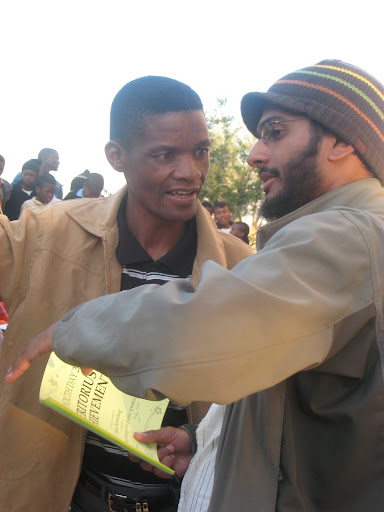
The keystone though was supposed to be the tent. Big tents are set up for most major village gatherings. Unfortunately, the majority of those tend to be funerals or tombstone unveilings but they are also used at weddings. If you see a big tent in a village, it usually means, there are lots of people there and maybe you should go too. I figured, if we had a big tent, people would come. Problem is, tents can be expensive so I needed to convince someone to “borrow me” a tent free of charge. With one of my teachers who is from the village, I set out to talk to one enterprising villager who runs a tent rental company. He works as a policeman in Vryburg so getting in touch was a bit tough. Finally, we phoned him and tried to plead our case. In the end he generously agreed to give us a tent for free provided only teachers set it up (worried about children getting injured) and that the school took responsibility to pay in the event of damage. I agreed to the terms and got him to throw in a microphone too. The plan was to pick up the tent at 8am (as the games began at the school) so that we could have it all set up by 10am for the main event to begin.

A little help from my friends

Feeling a little overwhelmed by the amount of things that had to come together. I sent out an invitation to other PCVs to come out and help with the event. In the end my friend, Megan Clapp (i.e. the talking zebra) answered my call and came out during the weekend. We spent the weekend checking in with teachers, making programs, making raffle tickets, and figuring out how exactly things were supposed to work out for Monday. When Monday morning came, Megan went to the school a little before 8am to help out with the games and set up. I went with my teacher Mr. Mphatwe to pick up the tent and sound system.

I had been under the impression that it would be very easy to get the tent and take it to the school. I had asked Mr. Mphatwe where the tent was to make sure we didn’t have to drive half an hour to get it. “It’s not far, it’s just around here,” he had said waving his hand in the air. We drove to about 4 different houses all around the village, asking where the tent was, where the key was, where the guy that was supposed to help us was, etc. Finally we drove out up over some hills to one end of my village and met some guys that worked with the tents. We loaded up and headed back, picking up the sound system and microphone along the way. By the time we arrived at the school, it was 9am. Apart from a few teachers coordinating the beauty pageant Megan, and a dozen kids, no one was there. I tried not to think about it and worked with my teachers to get the tent set up.

Keeping the Faith

By the time 10am rolled around, when the program was supposed to begin, things were not looking good. With a little encouragement from my friend, the priest though, I resolved to see the event through and braced myself to deal with minimal attendance and a big negative balance for the library.

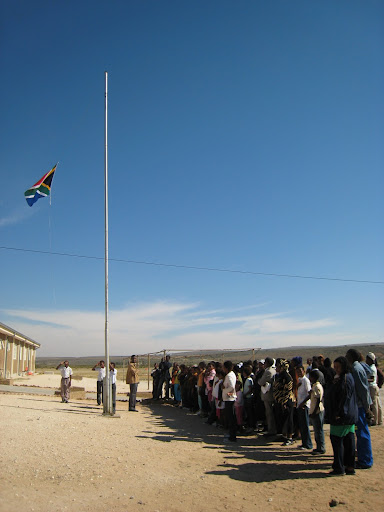
Mr. Mphatwe and one of the pageant coordinators, Mme Kekana, finally came up with a compromise for the pageant and went about slightly modifying the set up. I recruited students to help set up chairs. By 10:30am, Mr. Sepeng, my right hand man and the MC of the day came to me. “KB, you know there are some people who have a bad attitude and want to see this fail. We cannot let them be satisfied. We must begin the program now and deal with things.” With that he went to assemble the color guard for the flag raising and I herded all the wandering people out to the flag pole. Mr. Sepeng and another teacher led the flag raising and singing of the national anthem. Unfortunately, the kids raising the flag somehow managed to get it tangled up. I couldn’t help but see it as a bad omen.

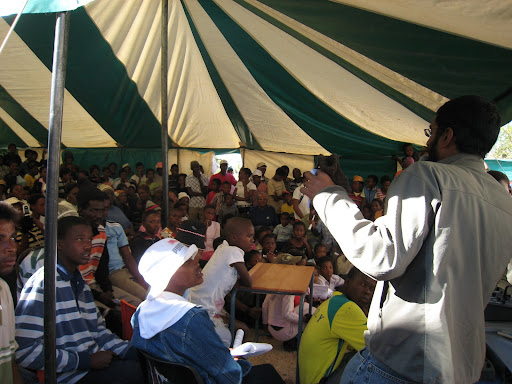
After a short opening speech, everyone raced back to the tent to try and get in without paying. I chased them out as quickly as possible and set up the entry line. One guy walked in visibly drunk, carrying a liter bottle of hard cider. This is going to be great… I thought about ejecting him but soon found myself overwhelmed. I had thought there was almost no one, but the Father was correct. People had begun to come by 11am as I finished getting the early birds seated. Other teachers took over the entrance and I looked out over the village to see people kilometers away making their way towards the school. The drizzle became a downpour and people were coming in for the whole first half. Mr. Sepeng dealt commendably with the amorphous program, creatively inserting events that had been prepared without my knowledge and removing events that failed to materialize.


I began selling raffle tickets late but still made enough money to cover the costs of the prizes as well as the prizes from the failed field day. Everywhere I looked, my teachers were busy taking initiative, making decisions, and helping out (I know my fellow PCVs are as stunned by that statement as I am). We ran a lot later than expected and we had to cancel the scheduled movie. The Beauty Pageant was wonderfully organized but took a ridiculously long time. However, in the end, we had probably over 500 people attending (close to 600 if you include participants and teachers). We raised a few hundred Rand for the library and for the Grade 12 farewell function. Though only 1/3 of my teachers had shown initial interest in the event, a full ¾ played major roles in the day. Best of all, the kids seemed to have a great time and most people involved felt successful though exhausted. When I returned home, my host sister, Kego, who goes to college in Cape Town, congratulated me on successful event. She said, it was something big for the village, getting parents involved in their kids, and even took people out of the taverns. She cited the guy that had walked in with the hard cider and I laughed thinking back on my previous disappointment at seeing him there.

Though I am still just beginning to understand it, the Tswana way of life has its own measures of success and its own way of looking at things. People, especially my teachers, surprised me, and made me feel a little ashamed for doubting them. The village came together around their youth and gave me faith that together we can make a difference in their lives.

Sunday, May 25, 2008

Motho ke Motho ka Batho

I am because you are (in seTswana). This statement, known best in its abbreviated Zulu form as, Ubuntu, is a common refrain you hear throughout South Africa. It’s a source of pride and an answer to many puzzling questions for many people here. Why wasn’t there a massacre of the white’s once black’s came to power? Ubuntu. Why is it so important to greet everyone you see? Ubuntu. Why do people welcome you into their home and offer you tea when you just stop by to chat on the road? Ubuntu. Yet, through some of the recent news coming out of this country, you may wonder, where is Ubuntu? How can mobs rape, kill, burn, and rob others simply because they have come from another country in search of hope and opportunity?

A Little Context

First off: I am safe in my village and things out here are calm.

In case you have not heard the news coming out of South Africa, here is a brief summary. Last week, violence erupted in townships around Johannesburg targeting foreign Africans in South Africa (both illegal and legal migrants). Mobs raged through shanty towns burning buildings and people, beating, looting, and killing. In response to these attacks a few groups of migrants organized gangs to protect themselves or exact revenge and soon the violence spread to areas all over Gauteng and to other urban areas in the country. The violence has been mostly one way though with the poor migrants getting the worse end. South Africa is home to millions of migrants (literally about 3 million Zimbabweans who have fled their ruined country), they come from all over Africa, Bangladesh, Pakistan, and China looking for opportunity and working hard to make a living and support family back home. Many blame these foreigners for the increased crime and for the high unemployment rates (both can be pretty much have no real quantitative support, but alas, word of mouth trumps reality). Now the army has been deployed, the police are out in force, but the violence still continues. The unions have even pledged to get involved on the ground to protect the migrants. The whole thing is a thorough embarrassment for the ANC, many of whose leaders found shelter in neighboring African countries during the apartheid regime.

Still a Rainbow Nation

Even as xenophobic attacks continue to rock the urban areas, demonstrations were held in many cities today against the violence. As I watched the news today I was struck by the scenes of the protestors: white, black, brown, and every shade in between. Though the violence is present mainly in cities, xenophobia is pretty widespread, especially in poor areas (rural villages and townships). No matter what the American pundits may say, whenever a government fails to deliver, those that economically suffer do get bitter. And when they get bitter, socially entrenched positions, good or bad, often help them lay blame, whether its race, religion, gun rights, or what-not. Out here, it is nationality. Nigerians are drug dealers. Mozambicans are thieves. Zimbabweans are stealing jobs. Bangladeshis and Pakistanis are scrooges. And perhaps most ironically, Chinese are xenophobic. Despite these prejudices though, for the most part all these people coexist with South Africans. In my village, the Chinese shop owner couple just had a baby and my host aunt and her daughter went to see the baby. Some of the South Asian shop owners have girlfriends in the village. The Tanzanian priests get visits from other South Africans on the weekends. I feel welcomed and accepted by the vast majority of people. As I walk or bike anywhere, I’ll always hear several people call out, “KB!” my seTswana nickname. This in a village about half the size of the town I grew up in in South Dakota and a lot more isolated and rural. It’s certainly not perfect, and the lack of trust for outsiders can be stifling at times. Nevertheless, the good parts are impressive. Still, what is it that feeds those prejudices and fans the flames until they explode?

E Pluribus Unum

What is it that leads people to say they won’t vote for Obama because he is black, or for Hilary because she is a woman? What is it that leads to fences being built from places as different as Texas and Israel? Xenophobia and prejudice of all shades is not confined to South Africa. But neither, on the other hand, is Ubuntu. It is a choice that lies before us all, continually presenting itself to us throughout our life. When I think back on the warmth I was shown as a child growing up in South Dakota, I smile. Despite those who judged me without knowing me, there were those who respected me and trusted me even though I was non-white and non-Christian. They saw me learning about their culture, their religion, their lives and they were curious about mine. E pluribus unum, out of many, one: it is stamped on every coin in the US. It is a testament to the fact that our nation was founded out of the peoples of many different countries, indeed different continents. It is a reminder of the 13 different colonies that united to create their own freedom and dignity by recognizing that of each other. And if you read it one way, it sounds a lot like Ubuntu. One exists because of many. In seTswana: Motho ke motho ka batho. One is a person through people.

One Love, One Choice

I have a good friend in Belize with whom I sometimes am lucky enough to catch online. After sharing our struggles and successes, he often closes the conversation with a simple expression: One love. It is a love of people that I’d like to believe is more universal and more fundamental than the xenophobia and prejudice that make the headlines.

Over ten months ago, I got off a bus with over 90 other Americans, from all walks of life who had left loved ones and certainty behind for two years. We were greeted by over a dozen South Africans, who had left their homes for two months to share their language and culture with us in preparation for our service. Ubuntu certainly is not dead, neither in the U.S. nor in South Africa.

Rather than become cynical about Ubuntu, I think it’s important, especially for us as PCVs, to realize that the concept is not uniquely South African. Ubuntu is about more than just South African pride, it’s about human dignity. It’s not something inherent in each human; it’s a choice - a choice to recognize and honor the humanity of another. So in this time of outrage and shame, rather than fault South Africa, the failure of Ubuntu, or even demonize the people perpetrating the terror, let us challenge ourselves to recognize the dignity in all humans despite all our faults. Hopefully this recognition will help those blinded by prejudice to see their own self worth and thereby realize that of others.

Tuesday, May 13, 2008

Tongue Tied

One of the things I place a lot of importance on as a Peace Corps volunteer is the ability to speak the local language. Despite what some may think, I am far from fluent in seTswana despite having been here for almost a year. Still, I’m probably one of the volunteers most comfortable speaking seTswana in my group though there are a number of my buddies who have surpassed me in written seTswana at this point. Recently, my efforts at ongoing language learning have diminished as my old tutor got busy with studies and I got busy with work. I also was starting to feel that though I’m no native speaker, I had enough seTswana under my belt and the ability to learn the rest by myself for whatever I would need to do my service. I had in fact shifted gears to try and develop language learning material to help incoming volunteers in their first encounters with the language. However, after the events of today, I’ve realized I’ll probably never have all the seTswana I need to be the best volunteer, but I damn well won’t stop trying now. I’ll still be working on language learning material for beginners, but I’m going to try a new tutor and try to get my tongue churning out new tenses, vocab, and constructs every week.

The reason for this sudden rekindling of the fire inside me was an event that was kind of like being hit in the face by a pile of bricks.

The Pitso (literally, the calling, but means a village meeting called by the chief)

Every once in a while there is a big tribal meeting in the village. The chief, village councilor, elders, and tons of villagers attend to discuss community issues. After meeting with my chief last week, I’d decided to go full steam ahead with the HIV/AIDS awareness campaign termed HELP (HIV Education & Life-skills Project). Yeah, you can’t be in Peace Corps without loads of acronyms. I met with the clinic and got their backing as well. We agreed to meet with the village and lay out our plan to get feedback and suggestions. I worked to prepare a short speech in seTswana as best I could, getting a few words translated by my teachers. I tried to make it short and to the point but perhaps I cut out a bit too much. The day of the meeting, the clinic sent a nurse to come help out. I’d never met her before but she was my saving grace.

I arrived at ten to 10am when the meeting was supposed to start. The chief arrived at about 10am and the nurse arrived around 10:10am. Everyone else arrived over the next hour. We began at a little after 11am. As is typical, there was a hymn sung and a prayer. The nurse and I were introduced and asked to say our bit. I got up, made my little speech. I motivated the fact that we have some problems here in our little village but that we can help change things together. I told them our plans for teaching life skills in the school to empower youth to make smart choices. I talked about our HIV testing drives we hope to start. I talked about our partnership with the clinic to do health education with the community and to distribute condoms to the shops and to the taverns. I talked about how we hope to train Home Based Care workers, ministers, and anyone else interested in how to implement a life skills training program for youth. Though I had my written speech in front of me, I was speaking comfortably, flying through the tough words and even putting in hand gestures and making eye contact. Then I asked if there were any questions. I looked out at blank faces and my heart sunk. Did I pronounce things that terribly?

I introduced the nurse and sat back to try and digest. She gave a talk touching on the issues I’d mentioned. She talked about HIV and how people should use gloves or at least a plastic bag when helping anyone that is bleeding. She talked about TB. She mentioned how the clinic has free testing for both and if you have them you can get meds from the government for free. She also talked about teenage pregnancy saying how we need to talk to our girls more openly. She said we tell the girls not to play with boys but then they just go and have sex with them so we need to start talking about sex and condoms. Then she asked if there were any questions. Maybe it’s a cultural thing or maybe it took time to digest, but there were hands up immediately and I soon found out they heard me loud and clear.

The first question was some technical question about TB that the nurse handled. Then one woman asked a question about what exactly we were going to put in the taverns and shops. When we said condoms, it was like opening pandora’s box. I’d said mesomelana in the speech which is the seTswana word for condom but sometimes English-Tswana is better and when we said di-condomos the room came to life. Soon there was a raging debate going on. On one side were mainly elders and other old men, with several old women nodding approvingly. On the other side were me, the nurse, a few brave younger villagers, and thankfully, the chief. When passions were ignited and the rapid fire seTswana started flying around the room I was struck with the realization of how much more I needed to learn seTswana if I wanted to make a case on any important issue and really convince people. I was very fortunate to have the nurse there answering questions for me. I was uplifted when a woman and a man both stepped up at certain points to wholeheartedly endorse our plans and make an impassioned defense of our position. I was relieved when the chief weighed in and did his best to cool heads and find common ground. But through all of it, I was frustrated that I could not do more myself. Without any of those people, I would have been completely lost.

Here are some choice bits from the debate including my inner English monologue:

Old man: “This is teaching our children to have sex!”

What I said in my head: “When did anyone ever need to be taught how to have sex? This is teaching them to make smart choices, realize the consequences of sex, and if they choose to still engage in it, to do so with as much protection as possible.”

What my defenders said (or at least what I think because they too spoke in rapid Setswana): “We are still telling the kids not to have sex. We are just saying, for those who will do it anyways, at least use a condom. We can’t tell them that unless condoms are available.”

Old man: “The condoms are being thrown in the street and small children are playing with them!”

What I said in my head: “Obviously, this means that we need MORE not less sex education so that 1) people who use condoms think of smart ways to dispose of them and 2) so that kids know what the difference between a condom and a balloon is.”

What my buddies said: “That’s why we are talking to you now. You need to go spread this information amongst the community. After using a condom, wrap it in toilet paper and throw it down the toilet. If you don’t have a toilet, dig a small hole and bury it.”

There was a lot more debate but those are the only things I really caught. The chief made a really good speech that, as far as I can tell, was about how we can’t ignore the reality of this disease and we need to talk about it openly. He talked about how it is here and partly comes from the migrant workers and then just spreads as people sleep around. We can’t stop people having sex, but we can educate them to make smart choices and give them condoms if they still choose to have sex. At least I kind of think that’s what he said based on previous conversations I’ve had with him and the bits of the speech I caught.

We didn’t really end with any kind of consensus. The old men seemed to always want to have the last word. I realized even though the chief is the chief, he’s a young chief, so the old guys don’t necessarily fall in line. Age carries huge weight here, which is the main reason I’ve kept my beard and will probably grow it back after you all visit. There is support though and it seems to exist among the younger crowd. Honestly, that’s the crowd I’m after because they are the ones that earn money, move around, and do the real work in the village. I’m not going to change some of the minds that are stuck in their ways although I don’t think all the elders are against me.

After the kgosi and the councilor wrapped things up, me and the nurse were excused to get back to work. As we walked outside one of the more cynical of the old men, who I think smelled a little drunk, came out to talk to us. He was going on about how it’s silly to tell people to wear gloves when the take care of people that are bleeding because what if he’s walking down the road and someone is hurt. The nurse pointed out that there are tons of plastic bags lying around that would work. Finally, I reached into my bag and pulled out the latex gloves I always carry around. It’s as simple as putting a plastic bag in your pocket with your phone every day. Unconvinced he went on to talk about how he never has and never will use a condom (personally, I find it hard to believe this guy is still having sex at his age…but you never know…) The nurse was getting a bit agitated at this point and was like, well, you are going to die then, good bye. Finally though, he addressed me directly asking if I was a doctor. I said no, I am a volunteer from America. Then he went off asking, do you know where AIDS comes from? It comes from America! At this point, I almost went off on the guy but the sister cut in saying, no, AIDS comes from blood, so wear gloves and use a condom (you dumb old bugger). With that she excused us and we walked away.

I guess I’d heard all the stereotypes and myths and misunderstandings before but not all at once. This is also the first time I’ve been involved in such a big (the room was literally overflowing, probably over 100 people) and public discussion about HIV/AIDS in my village. It certainly won’t be the last. I’m just glad I’d taken the chief’s advice to bring someone from the clinic with me. If it had been just me, it would have gone terribly. As it stands I think it was mixed. It was sad to see how deeply entrenched the old guard is and disheartening to face their disapproval. It was great to see the dialogue happening. It was even better to see some people really passionate and informed about working on this cause. On the balance though, I think we things did go well though because at least I’ve got the chief on my side.

So even though 80% of the conversation went over my head, some old women were giggling uncomfortably like school girls, and I’ll probably be known as “condom man” in the village from now on, at least we got people talking about HIV/AIDS and condoms in a public setting.

Life is full of successes and failures. To make them worthwhile one needs to capitalize on the successes and learn from the failures. The conversation has been opened up in my village. For my part I need to go back to seTswana boot camp so that my voice can be heard in that dialogue.

Sunday, May 11, 2008

Ke a Leboga Bomma!

So since today is Mother's Day, I'd like to dedicate this entry to Mothers (Bomma). In particular to some mothers that I really respect.

To South African Mothers: The amount of things these women have gone through is phenomenal. From growing up in Apartheid and raising children in the face of unfaithful husbands (not all, mind you, but many) and HIV/AIDS. In particular, my host mother, Mma Tati (Mother of Tati, mother's become known by the name of their firstborn...) never got past a standard 2 (grade 4) education. Her husband died early, but she pushed on building up her farm, working for white families as a domestic worker, building a nice house, and sending her only daughter through college. Thanks to her, her family is among the better off in the village. Though she's probably well over 70 and has a nasty cough (probably caused by asbestos), she's still active, going out in the yard to clear away weeds even in the ridiculously hot summer sun here. The unfortunate problem of teen pregnancy out here though leads to a lot more mothers than are probably ready for the status so the current generation of mothers is serving double duty taking care of their daughters babies. So to all the mothers of South Africa, you are the backbone of this country and we working here appreciate all you have done to bring this country to where it is. To all those contemplating becoming mothers here...be sure you know the responsibility you are about to assume. Those are some big shoes to fill.

To Mothers serving in Peace Corps: You guys rock. You've done your share of work over in the U.S. and most of you are now retired. Rather than sitting back and resting on your laurels, you suit up and get ready for an adventure. Now that you are here, you women have adopted all us college grad yearling's and helped us learn to roll with the punches, take life in strides, and see the bigger picture. Whether you have kids back in the U.S. or not, you are all my Mama's now.

To Mothers of Peace Corps Volunteers: Not only did you succeed in raising idealistic kids with the gumption to actually go out and do something in the world, but you also had the strength to let us go out on this adventure. Thanks for all the life's lessons you taught us. They are serving us well now.

To my mother: Whatever it is I have become and have accomplished, it's due to my parents and the way they have raised me. Mom, I've always had an open ear through all life's ups and downs. You're not only a mother, but you're a friend. You let me leave the nest earlier than you'd bargained for out of respect for me and my best interests. Every step of the way, you've respected me as an individual and the choices I've made, realizing we have to make our own mistakes so that we can truly know our successes. For all that you've sacrificed and given for me and for all I know you will do for me in the future despite whatever protests I may make, thank you.

Friday, May 2, 2008

The ABCs

Right now, I’m doing the preliminary work for two fairly big projects that I have a lot of high hopes for. The first is a library/literacy project that I’m hoping will help kids develop a love of reading and learning. The second is a project using ideas I got from our recent Life Skills Training to help raise awareness of HIV/AIDS. Both deal with the very difficult task of behavior change. However, I’m hoping with a multi-pronged approach and a little help from my friends I’ll be able to break some ground in developing healthier lifestyles that include a love for reading.

C is for cookie!

I grew up as a Sesame Street kid and from a young age, I’ve loved books and reading. A lot of this was thanks to my parents reading to me from as early as I can remember and also from taking part in library reading programs during the summers of my elementary school days. Out here in the village, it’s hard to find books. Reading is not something a lot of people do in their free time. However, I don’t think it’s out of lack of desire. People here, and especially kids, are often very bored. Africa may lack many things but one thing it is not short of is time. And with so much time, kids could potentially read a lot. Since I find myself with a lot of time now that I’m here in Africa, I sometimes read story books to my little 6 year old host sister (thanks Mom and Anita for sending kids books!). Even though she doesn’t understand English, she is always excited when I pull out a book now. The first time I read “Peter Rabbit” to her, we finished and she immediately said, “Bala gapa!” which means “Read again!” A lot of my buddies from Grade 12 also talk to me about wanting to read more books. I’ve leant a few some of mine. But really, we have a beautiful library room at my high school. It just lacks books…

As I’ve mentioned in a few earlier posts, my school was among the 31 selected to receive 1,100 books from Books for Africa as part of the Books for Peace Library Project orchestrated by PCV Rose Zulliger. Right now, we are undergoing fund raising efforts both locally and back at home in the states to ship all the books over to South Africa. We need to raise a total of $5000 at home for 35,000 books. Our schools together are raising about $6000 for shipping. On the home front we are about halfway there. We just need a little over $2,500 more to meet our goal. The way Peace Corps fundraising works is that we don’t receive any of the money until all of it has been raised so we are really trying to push to get that last $2,500 before the middle of May. That way we can start the books moving so hopefully they will get here, get sorted, get delivered, and be on our book-shelves by sometime in September. So, once again, I’m asking for help. Every little bit counts, every dollar you give brings over 7 books so I appreciate whatever you can give. You can donate at:

https://www.peacecorps.gov/index.cfm?shell=resources.donors.contribute.projDetail&projdesc=674-045

Once you donate, shoot me an email with your mailing address. I’d like to send a little token of appreciation for all who contribute.

Getting the books here is only the first step in this campaign. Some of my teachers and I have already started brainstorming different programs we can do with the library to encourage its use. We also want to get other teachers to start using it more and assign research projects using the library. Currently we have teacher librarians, but if local fundraising efforts go well, I’d really like to get a community member involved as a permanent librarian who can really focus on making sure everything is in order and used well. I’ve already talked to the village priests and my local NGO buddy and they are all excited and want to help out. Hopefully we can come up with some community awareness events to build up excitement and knowledge about the library before the books arrive so that once they do, we’ll have some volunteers to help us organize and arrange them all. If the books arrive in September then I’ll have a whole year to work with people involved to make sure things go smoothly, the community takes ownership, and we come up with strategies to keep building on our collection and reach out to the community. Of course the devil is in the details, but for now excitement is there.

Abstain, Be faithful, and C?

The other big project I’m trying to get rolling has to do with combating HIV/AIDS. Together with the Life Orientation teachers in my high school, I’m trying to start an awareness and testing campaign in my community. The local clinic is about 8km from where the high school and most of the community lives. With just one nurse, outreach during the week is not really possible since if she left, the clinic would have to be closed. Moreover, people in the village often fear getting tested because though tests are supposed to be confidential, there is fear of gossiping. To try and get around this, I’m trying to find outside groups that could come once a quarter and set up a voluntary testing station at the school. This would hopefully be open to the whole community and hopefully get people into the mindset of not just getting tested, but getting tested regularly. To bolster this effort, the Life Orientation teachers and I will be working throughout the school year to add basic life skills activities into the classroom to help foster a more open and honest dialog about HIV.

One place I’ve realized I need to start is with the C word. Yes, it’s tricky as an educator to talk about sex with kids. By law, we are not supposed to talk about condoms with kids under 14 (even though some kids are sexually active before then…). However, even with older kids, some teachers prefer to say C stands for “Change your attitude” rather than “Condomize.” If teachers are even afraid to talk about condoms, how are kids expected to even know how to use them properly? Because let’s be honest, we aren’t going to stop the kids from having sex. Maybe, with open honest discussion, we’ll convince a few to stop, but in a village where the main forms of entertainment are soccer, drinking, throwing rocks at goats, and sex. Sex wins out as the cheapest, easiest, and most fun. Hopefully with the library, after school clubs, and weekly movies, we can give kids other ways to have fun but until all those are rolling, we need to at least give kids knowledge on how to have safer sex. Inspired by stories from some SA15 volunteers, I’ve got ideas about how to help bridge this gap in knowledge. Hopefully I can get my teachers on board too.

Lastly, still in an extremely nascent phase, is another front I am hoping to potentially open in the battle against HIV in the village. After talking with my NGO buddy, Seatlasaone, I realized we could use the school holiday camps we’ve been doing in a more sustainable way by utilizing the kids that have finished high school but are just sitting around because they haven’t got jobs. Using the PC Life Skills manual, we are going to try to recruit and train a group of these youth to lead camps for kids during school breaks when they are generally most bored. Hopefully this will help ensure camps continue after I leave and also will empower those unemployed youth with some valuable and marketable skills. This though, is still little more than a brainstorming session and in the next few weeks hopefully will become something more solid.

The task is incredibly daunting no matter how we approach it, but we have to face it. Fortunately I’ve found sharing ideas with friends and other volunteers is one of the best ways to stay motivated and think of new things so, if you have any ideas, thoughts, or suggestions on ways to help tackle the issue of HIV/AIDS, send them my way.

Sunday, April 13, 2008

Long Walks, Physics, and Rocks

The last two weeks have been a whirlwind. After school closed, I found myself teaching supplemental physics and math for some learners up until the day I left for Mpumalanga to partake in the Long Tom Marathon. After that, I headed north to the Blyde River Canyon for some backpacking before heading back to site to put on a one week science camp. There’s a lot to talk about so this could get pretty long, but I promise many pretty pictures to those who read. Click on the albums to link to the actual albums at picasaweb.

Please sir, teach us more

I spent most of the last week of the school quarter sick with some strange virus. I was finally able to get out of bed on the last day of school, which was a half day and so I went to work trying to take care of everything I’d had planned for the week. I was rushing back and forth between offices and classrooms when I turned a corner and found myself surrounded by about a dozen grade 12 learners. They asked me if I could help teach some physics and math classes over the break. Sure, I said, we’ll start on Monday. We must meet twice a day, and you must prepare some homework for us to practice, they demanded. Why not?

So for those of you who have had any experience teaching high school kids, this may seem like a tall tail so let me put this into context. In my village, there are roughly 100 kids in grade 1. My high school is fed by the primary schools and those in villages surrounding us for a 50-70 km radius. So all in all, wild approximation puts the number of kids entering grade 1 that would feed my school at maybe 250-350 kids. By grade 10, there are only about 110 of those kids left in school. By grade 12, that number falls to about 37. Of those, only about 40% pass the final matriculation exam each year. So basically, those grade 12 kids are the 1-2% of kids who care enough about school and their future to have stuck it out this far and they want to make all that time worth it by actually passing their exam. This explains why some of them are willing to do school work over the holidays.

We took our time and got back down to the basics. We worked on algebra fundamentals, fractions, and long division in math and basics of motion in one and two dimensions in physics. Then I was off to Sabie for the race.

Long Tom

Sabie is a beautiful area in the northern end of the Drakensberg range. It is covered by the largest man made forest in the world, all pine used for lumber and paper. Long Tom had two categories for the race, the half marathon (21.1 km) and the ultra marathon (56 km). The half started at the top of the Mauchberg mountain and went downhill about 1000m to Lydenburg. The ultra started in Sabie went up 1000 m to the top and then down 1000 m to Lydenburg. It’s kind of ridiculous. What’s more ridiculous is that two Peace Corps Volunteers ran the ultra and completed it. Ellen of SA 15 completed it in about 6 hours. And Adam B. of SA 16 finished in 4 hours 2 minutes, clinching 11th place overall and a silver medal.

I hung back and walked with a number of other volunteers, cheering on runners as they passed us. My knee was acting up a bit but we still kept a decent pace. That night, all the volunteers gathered and had a braii (bbq) and the SA 16 band, performed (with me on the bucket/trash can/cooking pot drums). Two of the PCVs parents were in Sabie visiting as well as a few volunteers kids. It was a lot of fun to meet them all and get a better picture of the people we’d come to know over the past 9 months (and apparently parents like to read all our blogs too…). We did an great job at fundraising for KLM. I was the second highest fundraiser overall bringing in about $1,100 thanks to your support and I also had the second highest number of overall donors with 16 donors. As a group, we shattered all records as volunteers and raised a total of over $20,000. Together we’ve made a huge impact in the lives of children through the KLM foundation. Thank you.

Blyde River Canyon

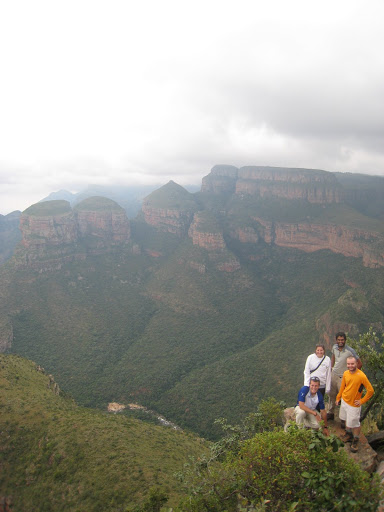
After the race, Kristy, Art, Adam, and I headed north to Graskop, on the southern end of Blyde River Canyon. Blyde is the third biggest and the greenest canyon in the world. Biggest is the Grand Canyon and second is the Fish River Canyon in Namibia (so I just need to take a week up in Namibia to have all three…). We stayed at the Valley View Backpackers which was great. We also learned that lots of people speak Sotho out there so we were able to communicate since Setswana is pretty close to Sesotho.

After a day of rest, we went on a driving tour to see many of the sites. There were lots of waterfalls named after European cities for some reason…


Blyde River Canyon

We went to the Bourke’s Luck Potholes where the Treur (sad) and Blyde (happy) rivers meet. Their confluence creates whirlpools which drill holes in the rock leading to some beautiful shapes. Bourke was lucky and found gold there. We threw a few coins in for luck since this was where our trail would end for our backpacking trip. Then we drove out to God’s Window to see the escarpment open up over the lowveld but apparently God was being shy and closed the window. (We went a total of three times over three different days, and all times were foggy). Afterwards, we headed to the trailhead and started our hike to the first hut.

the potholes

the rondavals

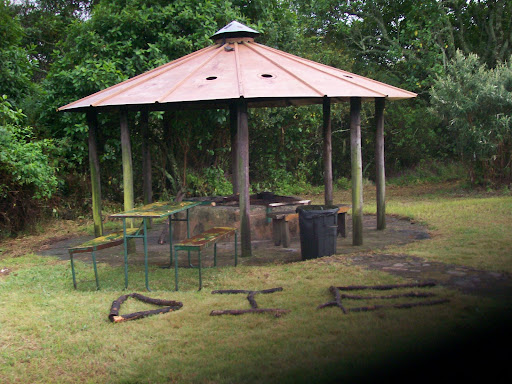
The Blyde River Canyon trail has two huts along the trail. They are equipped with toilets, bunks with mattresses, fire pits and wood. Quite plush. We had a good meal after cooling off in a nearby waterfall and went to sleep. The next day I was the first up, I stepped out of the hut and wiped the sleep from my eyes. I saw some logs on the ground. I thought to myself, Adam and Kristy must have made some picture or something before going to sleep. As my eyes focused though I realized they were letters spelling out “DIE”. At first I was a little confused and then it dawned on me. It was April 1. Adam, must have been pulling a stunt. So I decided to take it to the next level. I climbed onto the roof, dropping my cap and leatherman by the door and started making noise. Adam came out and saw my stuff on the ground. As he looked around confused, I reached down and pulled his hat off. He then accused me of writing out the message with the logs. I reasoned that it couldn’t have been me since I was the first one in that night and the logs were wet, suggesting they had been out overnight. He put on like it wasn’t him and for a while had me thinking it was Kristy. The next night though he came clean.

april fools!

finding the trail

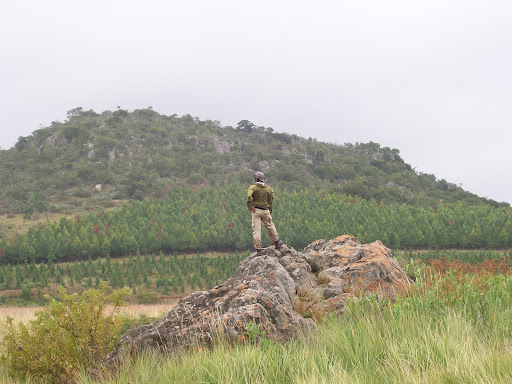
The hike was pretty good. Not too strenuous, which was perfect after the Long Tom. It was kind of bizarre though because sometimes we would be within earshot of the road and we kept running across parts of the vast tree farms. We saw some dear and antelope and lots of baboons but wildlife was pretty scarce. The second camp was nestled among a bunch of rocks and we ended up spending the afternoon bouldering around. We were pretty wet since it had rained all morning and while trying to dry out our clothes on the fire, I burned my socks L but I had a spare pair. After we finished the hike up at the potholes, Marianne, who runs Valley View Backpackers, picked us up at Bourke’s Luck Potholes and we went back to her place. She made a tall stack of Dutch pancakes which were incredibly delicious. The next day we went to Sabie and then the next day started making our way back to site.

Tricked into Learning

Tsoe Science Camp 2008

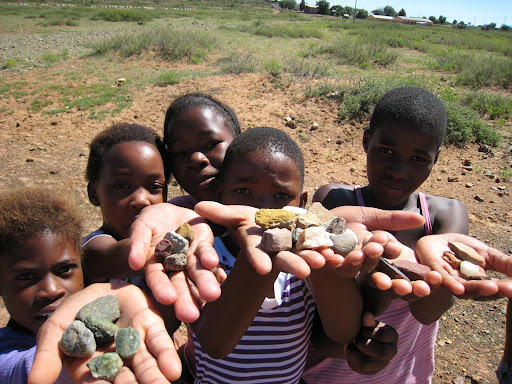
Adam came back to Tsoe with me so that we could do a one week Science and Sports Camp. Our goal was to use hands on, explorative methods to teach basic science concepts and also teach some sports to entertain the kids over the school break. Learning some lessons from my last camp, I split the day into two sessions, mornings for ages 7-14 and afternoons for 15+. We had roughly 30 younger kids each day. We made volcanoes and dinosaurs from home made play dough. We went rock hunting and talked about the rock cycle. We played with springs and talked a little about waves. We made ant farms and talked a little about insects and the requirements for life. We played kickball and four square. All in all it went pretty well although I don't think I could be a primary school teacher. Those kids can be tough to handle sometimes.


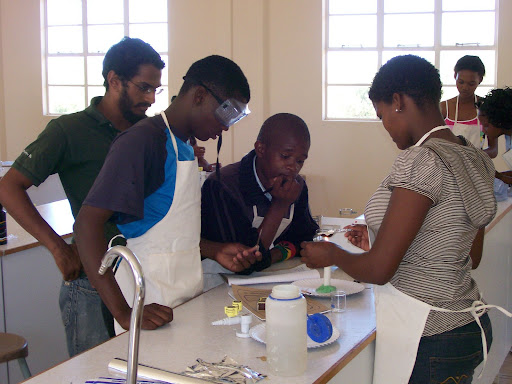
For the high school kids, we did a chemistry exploration called mystery powders. We gave the kids 5 mystery powders and gave them 6 tests to do to try and figure out what they were. We then gave them some mixtures and they had to use their tests to determine which of the 5 were in the mixture. We gave the kids notebooks for their work and taught them how to write a simple lab write up. Almost every group was able to figure out the mixtures. The second day we did ecology with them. We went outside and tried to do some observations, using our lab books to record all observations. We tried to discuss some basic adaptations to try to get the kids to think about why things are the way they are. We had mixed results there. I was impressed though at the knowledge the kids had about some of the plants. They knew which things were used in traditional medicines and what bugs and things were dangerous for livestock. At least I learned a lot. The next two days we did a physics exploration on the nature of waves. We had four stations for the kids to explore. One station was a ripple tank with two Huygen’s sources and various barriers. One station was a slinky spring that they were to calculate the velocity of waves in through observation and through theory based on tension and density. Another station was to use a candle and paper to find the focal length of a lens and to see the inverted image. The last station was to use an assortment of glass shapes to see which made a rainbow and what the others did to images and then to use mirrors to reflect a light around the room. Overall we had pretty good results. The last day we had a test and most kids did well with our high scorer getting 90% correct. For sports we played kickball and basketball and the last day we had a 4 vs. 4 tournament.

rock hunters

By the end of the week, both Adam and I were exhausted but I think we can say it was a huge success. They kids learned, had fun, and got to use resources that were sitting around gathering dust. Maybe one or two will actually see science as something fun and interactive rather than a boring class that is all paper and work. One kid, Thato, told me, "I think you've done something good here. The kids thought they were playing but they were actually learning."

testing ideas

School re-opens tomorrow and I’ve already got a lot of things to do. Our computer lab is full of new computers, a computerized writing board, and a digital projector. We just need to get clearance from the group that donated it to start using it. My school was selected to receive 1,100 books through the Peace Library Project. Now I have to raise money through my school and at home to pay for shipping. (There’ll be a post just on this soon but if you can’t wait, you can go donate now at: https://www.peacecorps.gov/index.cfm?shell=resources.donors.contribute.projDetail&projdesc=674-045 ). I’ve got 4 school improvement plans to finish and start implementing and I’ve got committee meetings and trainings to go to. I’m going to try to continue doing extra math and science classes for grade twelve. I’m trying to start up a pen pal exchange with some students here and at home. And I’m trying to work with a few teachers that have asked for help in a few areas. We’ll see how the juggling act will go.