Tuesday, May 13, 2008

Tongue Tied

One of the things I place a lot of importance on as a Peace Corps volunteer is the ability to speak the local language. Despite what some may think, I am far from fluent in seTswana despite having been here for almost a year. Still, I’m probably one of the volunteers most comfortable speaking seTswana in my group though there are a number of my buddies who have surpassed me in written seTswana at this point. Recently, my efforts at ongoing language learning have diminished as my old tutor got busy with studies and I got busy with work. I also was starting to feel that though I’m no native speaker, I had enough seTswana under my belt and the ability to learn the rest by myself for whatever I would need to do my service. I had in fact shifted gears to try and develop language learning material to help incoming volunteers in their first encounters with the language. However, after the events of today, I’ve realized I’ll probably never have all the seTswana I need to be the best volunteer, but I damn well won’t stop trying now. I’ll still be working on language learning material for beginners, but I’m going to try a new tutor and try to get my tongue churning out new tenses, vocab, and constructs every week.

The reason for this sudden rekindling of the fire inside me was an event that was kind of like being hit in the face by a pile of bricks.

The Pitso (literally, the calling, but means a village meeting called by the chief)

Every once in a while there is a big tribal meeting in the village. The chief, village councilor, elders, and tons of villagers attend to discuss community issues. After meeting with my chief last week, I’d decided to go full steam ahead with the HIV/AIDS awareness campaign termed HELP (HIV Education & Life-skills Project). Yeah, you can’t be in Peace Corps without loads of acronyms. I met with the clinic and got their backing as well. We agreed to meet with the village and lay out our plan to get feedback and suggestions. I worked to prepare a short speech in seTswana as best I could, getting a few words translated by my teachers. I tried to make it short and to the point but perhaps I cut out a bit too much. The day of the meeting, the clinic sent a nurse to come help out. I’d never met her before but she was my saving grace.

I arrived at ten to 10am when the meeting was supposed to start. The chief arrived at about 10am and the nurse arrived around 10:10am. Everyone else arrived over the next hour. We began at a little after 11am. As is typical, there was a hymn sung and a prayer. The nurse and I were introduced and asked to say our bit. I got up, made my little speech. I motivated the fact that we have some problems here in our little village but that we can help change things together. I told them our plans for teaching life skills in the school to empower youth to make smart choices. I talked about our HIV testing drives we hope to start. I talked about our partnership with the clinic to do health education with the community and to distribute condoms to the shops and to the taverns. I talked about how we hope to train Home Based Care workers, ministers, and anyone else interested in how to implement a life skills training program for youth. Though I had my written speech in front of me, I was speaking comfortably, flying through the tough words and even putting in hand gestures and making eye contact. Then I asked if there were any questions. I looked out at blank faces and my heart sunk. Did I pronounce things that terribly?

I introduced the nurse and sat back to try and digest. She gave a talk touching on the issues I’d mentioned. She talked about HIV and how people should use gloves or at least a plastic bag when helping anyone that is bleeding. She talked about TB. She mentioned how the clinic has free testing for both and if you have them you can get meds from the government for free. She also talked about teenage pregnancy saying how we need to talk to our girls more openly. She said we tell the girls not to play with boys but then they just go and have sex with them so we need to start talking about sex and condoms. Then she asked if there were any questions. Maybe it’s a cultural thing or maybe it took time to digest, but there were hands up immediately and I soon found out they heard me loud and clear.

The first question was some technical question about TB that the nurse handled. Then one woman asked a question about what exactly we were going to put in the taverns and shops. When we said condoms, it was like opening pandora’s box. I’d said mesomelana in the speech which is the seTswana word for condom but sometimes English-Tswana is better and when we said di-condomos the room came to life. Soon there was a raging debate going on. On one side were mainly elders and other old men, with several old women nodding approvingly. On the other side were me, the nurse, a few brave younger villagers, and thankfully, the chief. When passions were ignited and the rapid fire seTswana started flying around the room I was struck with the realization of how much more I needed to learn seTswana if I wanted to make a case on any important issue and really convince people. I was very fortunate to have the nurse there answering questions for me. I was uplifted when a woman and a man both stepped up at certain points to wholeheartedly endorse our plans and make an impassioned defense of our position. I was relieved when the chief weighed in and did his best to cool heads and find common ground. But through all of it, I was frustrated that I could not do more myself. Without any of those people, I would have been completely lost.

Here are some choice bits from the debate including my inner English monologue:

Old man: “This is teaching our children to have sex!”

What I said in my head: “When did anyone ever need to be taught how to have sex? This is teaching them to make smart choices, realize the consequences of sex, and if they choose to still engage in it, to do so with as much protection as possible.”

What my defenders said (or at least what I think because they too spoke in rapid Setswana): “We are still telling the kids not to have sex. We are just saying, for those who will do it anyways, at least use a condom. We can’t tell them that unless condoms are available.”

Old man: “The condoms are being thrown in the street and small children are playing with them!”

What I said in my head: “Obviously, this means that we need MORE not less sex education so that 1) people who use condoms think of smart ways to dispose of them and 2) so that kids know what the difference between a condom and a balloon is.”

What my buddies said: “That’s why we are talking to you now. You need to go spread this information amongst the community. After using a condom, wrap it in toilet paper and throw it down the toilet. If you don’t have a toilet, dig a small hole and bury it.”

There was a lot more debate but those are the only things I really caught. The chief made a really good speech that, as far as I can tell, was about how we can’t ignore the reality of this disease and we need to talk about it openly. He talked about how it is here and partly comes from the migrant workers and then just spreads as people sleep around. We can’t stop people having sex, but we can educate them to make smart choices and give them condoms if they still choose to have sex. At least I kind of think that’s what he said based on previous conversations I’ve had with him and the bits of the speech I caught.

We didn’t really end with any kind of consensus. The old men seemed to always want to have the last word. I realized even though the chief is the chief, he’s a young chief, so the old guys don’t necessarily fall in line. Age carries huge weight here, which is the main reason I’ve kept my beard and will probably grow it back after you all visit. There is support though and it seems to exist among the younger crowd. Honestly, that’s the crowd I’m after because they are the ones that earn money, move around, and do the real work in the village. I’m not going to change some of the minds that are stuck in their ways although I don’t think all the elders are against me.

After the kgosi and the councilor wrapped things up, me and the nurse were excused to get back to work. As we walked outside one of the more cynical of the old men, who I think smelled a little drunk, came out to talk to us. He was going on about how it’s silly to tell people to wear gloves when the take care of people that are bleeding because what if he’s walking down the road and someone is hurt. The nurse pointed out that there are tons of plastic bags lying around that would work. Finally, I reached into my bag and pulled out the latex gloves I always carry around. It’s as simple as putting a plastic bag in your pocket with your phone every day. Unconvinced he went on to talk about how he never has and never will use a condom (personally, I find it hard to believe this guy is still having sex at his age…but you never know…) The nurse was getting a bit agitated at this point and was like, well, you are going to die then, good bye. Finally though, he addressed me directly asking if I was a doctor. I said no, I am a volunteer from America. Then he went off asking, do you know where AIDS comes from? It comes from America! At this point, I almost went off on the guy but the sister cut in saying, no, AIDS comes from blood, so wear gloves and use a condom (you dumb old bugger). With that she excused us and we walked away.

I guess I’d heard all the stereotypes and myths and misunderstandings before but not all at once. This is also the first time I’ve been involved in such a big (the room was literally overflowing, probably over 100 people) and public discussion about HIV/AIDS in my village. It certainly won’t be the last. I’m just glad I’d taken the chief’s advice to bring someone from the clinic with me. If it had been just me, it would have gone terribly. As it stands I think it was mixed. It was sad to see how deeply entrenched the old guard is and disheartening to face their disapproval. It was great to see the dialogue happening. It was even better to see some people really passionate and informed about working on this cause. On the balance though, I think we things did go well though because at least I’ve got the chief on my side.

So even though 80% of the conversation went over my head, some old women were giggling uncomfortably like school girls, and I’ll probably be known as “condom man” in the village from now on, at least we got people talking about HIV/AIDS and condoms in a public setting.

Life is full of successes and failures. To make them worthwhile one needs to capitalize on the successes and learn from the failures. The conversation has been opened up in my village. For my part I need to go back to seTswana boot camp so that my voice can be heard in that dialogue.

Sunday, May 11, 2008

Ke a Leboga Bomma!

So since today is Mother's Day, I'd like to dedicate this entry to Mothers (Bomma). In particular to some mothers that I really respect.

To South African Mothers: The amount of things these women have gone through is phenomenal. From growing up in Apartheid and raising children in the face of unfaithful husbands (not all, mind you, but many) and HIV/AIDS. In particular, my host mother, Mma Tati (Mother of Tati, mother's become known by the name of their firstborn...) never got past a standard 2 (grade 4) education. Her husband died early, but she pushed on building up her farm, working for white families as a domestic worker, building a nice house, and sending her only daughter through college. Thanks to her, her family is among the better off in the village. Though she's probably well over 70 and has a nasty cough (probably caused by asbestos), she's still active, going out in the yard to clear away weeds even in the ridiculously hot summer sun here. The unfortunate problem of teen pregnancy out here though leads to a lot more mothers than are probably ready for the status so the current generation of mothers is serving double duty taking care of their daughters babies. So to all the mothers of South Africa, you are the backbone of this country and we working here appreciate all you have done to bring this country to where it is. To all those contemplating becoming mothers here...be sure you know the responsibility you are about to assume. Those are some big shoes to fill.

To Mothers serving in Peace Corps: You guys rock. You've done your share of work over in the U.S. and most of you are now retired. Rather than sitting back and resting on your laurels, you suit up and get ready for an adventure. Now that you are here, you women have adopted all us college grad yearling's and helped us learn to roll with the punches, take life in strides, and see the bigger picture. Whether you have kids back in the U.S. or not, you are all my Mama's now.

To Mothers of Peace Corps Volunteers: Not only did you succeed in raising idealistic kids with the gumption to actually go out and do something in the world, but you also had the strength to let us go out on this adventure. Thanks for all the life's lessons you taught us. They are serving us well now.

To my mother: Whatever it is I have become and have accomplished, it's due to my parents and the way they have raised me. Mom, I've always had an open ear through all life's ups and downs. You're not only a mother, but you're a friend. You let me leave the nest earlier than you'd bargained for out of respect for me and my best interests. Every step of the way, you've respected me as an individual and the choices I've made, realizing we have to make our own mistakes so that we can truly know our successes. For all that you've sacrificed and given for me and for all I know you will do for me in the future despite whatever protests I may make, thank you.

Friday, May 2, 2008

The ABCs

Right now, I’m doing the preliminary work for two fairly big projects that I have a lot of high hopes for. The first is a library/literacy project that I’m hoping will help kids develop a love of reading and learning. The second is a project using ideas I got from our recent Life Skills Training to help raise awareness of HIV/AIDS. Both deal with the very difficult task of behavior change. However, I’m hoping with a multi-pronged approach and a little help from my friends I’ll be able to break some ground in developing healthier lifestyles that include a love for reading.

C is for cookie!

I grew up as a Sesame Street kid and from a young age, I’ve loved books and reading. A lot of this was thanks to my parents reading to me from as early as I can remember and also from taking part in library reading programs during the summers of my elementary school days. Out here in the village, it’s hard to find books. Reading is not something a lot of people do in their free time. However, I don’t think it’s out of lack of desire. People here, and especially kids, are often very bored. Africa may lack many things but one thing it is not short of is time. And with so much time, kids could potentially read a lot. Since I find myself with a lot of time now that I’m here in Africa, I sometimes read story books to my little 6 year old host sister (thanks Mom and Anita for sending kids books!). Even though she doesn’t understand English, she is always excited when I pull out a book now. The first time I read “Peter Rabbit” to her, we finished and she immediately said, “Bala gapa!” which means “Read again!” A lot of my buddies from Grade 12 also talk to me about wanting to read more books. I’ve leant a few some of mine. But really, we have a beautiful library room at my high school. It just lacks books…

As I’ve mentioned in a few earlier posts, my school was among the 31 selected to receive 1,100 books from Books for Africa as part of the Books for Peace Library Project orchestrated by PCV Rose Zulliger. Right now, we are undergoing fund raising efforts both locally and back at home in the states to ship all the books over to South Africa. We need to raise a total of $5000 at home for 35,000 books. Our schools together are raising about $6000 for shipping. On the home front we are about halfway there. We just need a little over $2,500 more to meet our goal. The way Peace Corps fundraising works is that we don’t receive any of the money until all of it has been raised so we are really trying to push to get that last $2,500 before the middle of May. That way we can start the books moving so hopefully they will get here, get sorted, get delivered, and be on our book-shelves by sometime in September. So, once again, I’m asking for help. Every little bit counts, every dollar you give brings over 7 books so I appreciate whatever you can give. You can donate at:

https://www.peacecorps.gov/index.cfm?shell=resources.donors.contribute.projDetail&projdesc=674-045

Once you donate, shoot me an email with your mailing address. I’d like to send a little token of appreciation for all who contribute.

Getting the books here is only the first step in this campaign. Some of my teachers and I have already started brainstorming different programs we can do with the library to encourage its use. We also want to get other teachers to start using it more and assign research projects using the library. Currently we have teacher librarians, but if local fundraising efforts go well, I’d really like to get a community member involved as a permanent librarian who can really focus on making sure everything is in order and used well. I’ve already talked to the village priests and my local NGO buddy and they are all excited and want to help out. Hopefully we can come up with some community awareness events to build up excitement and knowledge about the library before the books arrive so that once they do, we’ll have some volunteers to help us organize and arrange them all. If the books arrive in September then I’ll have a whole year to work with people involved to make sure things go smoothly, the community takes ownership, and we come up with strategies to keep building on our collection and reach out to the community. Of course the devil is in the details, but for now excitement is there.

Abstain, Be faithful, and C?

The other big project I’m trying to get rolling has to do with combating HIV/AIDS. Together with the Life Orientation teachers in my high school, I’m trying to start an awareness and testing campaign in my community. The local clinic is about 8km from where the high school and most of the community lives. With just one nurse, outreach during the week is not really possible since if she left, the clinic would have to be closed. Moreover, people in the village often fear getting tested because though tests are supposed to be confidential, there is fear of gossiping. To try and get around this, I’m trying to find outside groups that could come once a quarter and set up a voluntary testing station at the school. This would hopefully be open to the whole community and hopefully get people into the mindset of not just getting tested, but getting tested regularly. To bolster this effort, the Life Orientation teachers and I will be working throughout the school year to add basic life skills activities into the classroom to help foster a more open and honest dialog about HIV.

One place I’ve realized I need to start is with the C word. Yes, it’s tricky as an educator to talk about sex with kids. By law, we are not supposed to talk about condoms with kids under 14 (even though some kids are sexually active before then…). However, even with older kids, some teachers prefer to say C stands for “Change your attitude” rather than “Condomize.” If teachers are even afraid to talk about condoms, how are kids expected to even know how to use them properly? Because let’s be honest, we aren’t going to stop the kids from having sex. Maybe, with open honest discussion, we’ll convince a few to stop, but in a village where the main forms of entertainment are soccer, drinking, throwing rocks at goats, and sex. Sex wins out as the cheapest, easiest, and most fun. Hopefully with the library, after school clubs, and weekly movies, we can give kids other ways to have fun but until all those are rolling, we need to at least give kids knowledge on how to have safer sex. Inspired by stories from some SA15 volunteers, I’ve got ideas about how to help bridge this gap in knowledge. Hopefully I can get my teachers on board too.

Lastly, still in an extremely nascent phase, is another front I am hoping to potentially open in the battle against HIV in the village. After talking with my NGO buddy, Seatlasaone, I realized we could use the school holiday camps we’ve been doing in a more sustainable way by utilizing the kids that have finished high school but are just sitting around because they haven’t got jobs. Using the PC Life Skills manual, we are going to try to recruit and train a group of these youth to lead camps for kids during school breaks when they are generally most bored. Hopefully this will help ensure camps continue after I leave and also will empower those unemployed youth with some valuable and marketable skills. This though, is still little more than a brainstorming session and in the next few weeks hopefully will become something more solid.

The task is incredibly daunting no matter how we approach it, but we have to face it. Fortunately I’ve found sharing ideas with friends and other volunteers is one of the best ways to stay motivated and think of new things so, if you have any ideas, thoughts, or suggestions on ways to help tackle the issue of HIV/AIDS, send them my way.

Sunday, April 13, 2008

Long Walks, Physics, and Rocks

The last two weeks have been a whirlwind. After school closed, I found myself teaching supplemental physics and math for some learners up until the day I left for Mpumalanga to partake in the Long Tom Marathon. After that, I headed north to the Blyde River Canyon for some backpacking before heading back to site to put on a one week science camp. There’s a lot to talk about so this could get pretty long, but I promise many pretty pictures to those who read. Click on the albums to link to the actual albums at picasaweb.

Please sir, teach us more

I spent most of the last week of the school quarter sick with some strange virus. I was finally able to get out of bed on the last day of school, which was a half day and so I went to work trying to take care of everything I’d had planned for the week. I was rushing back and forth between offices and classrooms when I turned a corner and found myself surrounded by about a dozen grade 12 learners. They asked me if I could help teach some physics and math classes over the break. Sure, I said, we’ll start on Monday. We must meet twice a day, and you must prepare some homework for us to practice, they demanded. Why not?

So for those of you who have had any experience teaching high school kids, this may seem like a tall tail so let me put this into context. In my village, there are roughly 100 kids in grade 1. My high school is fed by the primary schools and those in villages surrounding us for a 50-70 km radius. So all in all, wild approximation puts the number of kids entering grade 1 that would feed my school at maybe 250-350 kids. By grade 10, there are only about 110 of those kids left in school. By grade 12, that number falls to about 37. Of those, only about 40% pass the final matriculation exam each year. So basically, those grade 12 kids are the 1-2% of kids who care enough about school and their future to have stuck it out this far and they want to make all that time worth it by actually passing their exam. This explains why some of them are willing to do school work over the holidays.

We took our time and got back down to the basics. We worked on algebra fundamentals, fractions, and long division in math and basics of motion in one and two dimensions in physics. Then I was off to Sabie for the race.

Long Tom

Sabie is a beautiful area in the northern end of the Drakensberg range. It is covered by the largest man made forest in the world, all pine used for lumber and paper. Long Tom had two categories for the race, the half marathon (21.1 km) and the ultra marathon (56 km). The half started at the top of the Mauchberg mountain and went downhill about 1000m to Lydenburg. The ultra started in Sabie went up 1000 m to the top and then down 1000 m to Lydenburg. It’s kind of ridiculous. What’s more ridiculous is that two Peace Corps Volunteers ran the ultra and completed it. Ellen of SA 15 completed it in about 6 hours. And Adam B. of SA 16 finished in 4 hours 2 minutes, clinching 11th place overall and a silver medal.

I hung back and walked with a number of other volunteers, cheering on runners as they passed us. My knee was acting up a bit but we still kept a decent pace. That night, all the volunteers gathered and had a braii (bbq) and the SA 16 band, performed (with me on the bucket/trash can/cooking pot drums). Two of the PCVs parents were in Sabie visiting as well as a few volunteers kids. It was a lot of fun to meet them all and get a better picture of the people we’d come to know over the past 9 months (and apparently parents like to read all our blogs too…). We did an great job at fundraising for KLM. I was the second highest fundraiser overall bringing in about $1,100 thanks to your support and I also had the second highest number of overall donors with 16 donors. As a group, we shattered all records as volunteers and raised a total of over $20,000. Together we’ve made a huge impact in the lives of children through the KLM foundation. Thank you.

Blyde River Canyon

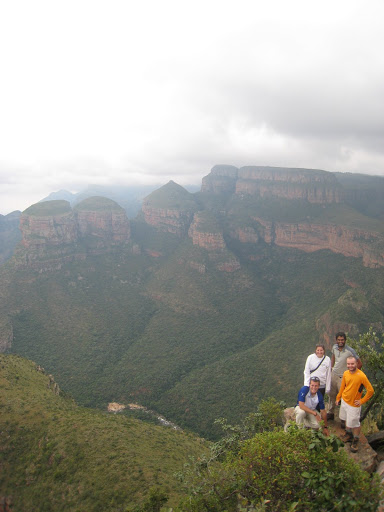
After the race, Kristy, Art, Adam, and I headed north to Graskop, on the southern end of Blyde River Canyon. Blyde is the third biggest and the greenest canyon in the world. Biggest is the Grand Canyon and second is the Fish River Canyon in Namibia (so I just need to take a week up in Namibia to have all three…). We stayed at the Valley View Backpackers which was great. We also learned that lots of people speak Sotho out there so we were able to communicate since Setswana is pretty close to Sesotho.

After a day of rest, we went on a driving tour to see many of the sites. There were lots of waterfalls named after European cities for some reason…


Blyde River Canyon

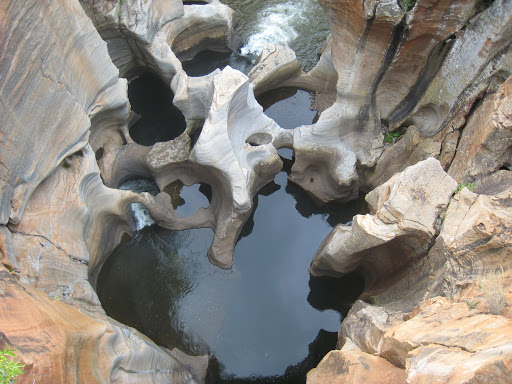
We went to the Bourke’s Luck Potholes where the Treur (sad) and Blyde (happy) rivers meet. Their confluence creates whirlpools which drill holes in the rock leading to some beautiful shapes. Bourke was lucky and found gold there. We threw a few coins in for luck since this was where our trail would end for our backpacking trip. Then we drove out to God’s Window to see the escarpment open up over the lowveld but apparently God was being shy and closed the window. (We went a total of three times over three different days, and all times were foggy). Afterwards, we headed to the trailhead and started our hike to the first hut.

the potholes

the rondavals

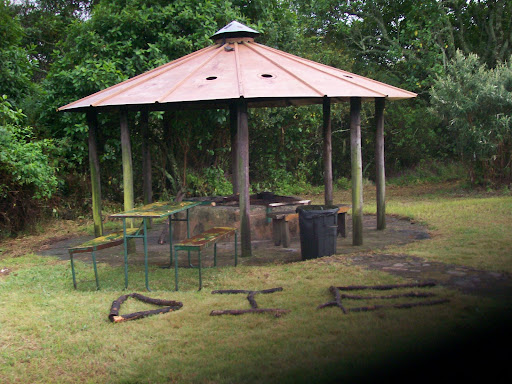
The Blyde River Canyon trail has two huts along the trail. They are equipped with toilets, bunks with mattresses, fire pits and wood. Quite plush. We had a good meal after cooling off in a nearby waterfall and went to sleep. The next day I was the first up, I stepped out of the hut and wiped the sleep from my eyes. I saw some logs on the ground. I thought to myself, Adam and Kristy must have made some picture or something before going to sleep. As my eyes focused though I realized they were letters spelling out “DIE”. At first I was a little confused and then it dawned on me. It was April 1. Adam, must have been pulling a stunt. So I decided to take it to the next level. I climbed onto the roof, dropping my cap and leatherman by the door and started making noise. Adam came out and saw my stuff on the ground. As he looked around confused, I reached down and pulled his hat off. He then accused me of writing out the message with the logs. I reasoned that it couldn’t have been me since I was the first one in that night and the logs were wet, suggesting they had been out overnight. He put on like it wasn’t him and for a while had me thinking it was Kristy. The next night though he came clean.

april fools!

finding the trail

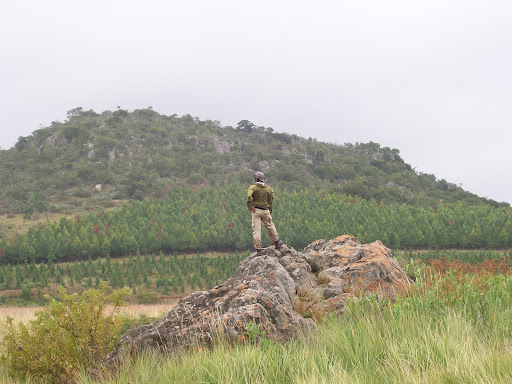
The hike was pretty good. Not too strenuous, which was perfect after the Long Tom. It was kind of bizarre though because sometimes we would be within earshot of the road and we kept running across parts of the vast tree farms. We saw some dear and antelope and lots of baboons but wildlife was pretty scarce. The second camp was nestled among a bunch of rocks and we ended up spending the afternoon bouldering around. We were pretty wet since it had rained all morning and while trying to dry out our clothes on the fire, I burned my socks L but I had a spare pair. After we finished the hike up at the potholes, Marianne, who runs Valley View Backpackers, picked us up at Bourke’s Luck Potholes and we went back to her place. She made a tall stack of Dutch pancakes which were incredibly delicious. The next day we went to Sabie and then the next day started making our way back to site.

Tricked into Learning

Tsoe Science Camp 2008

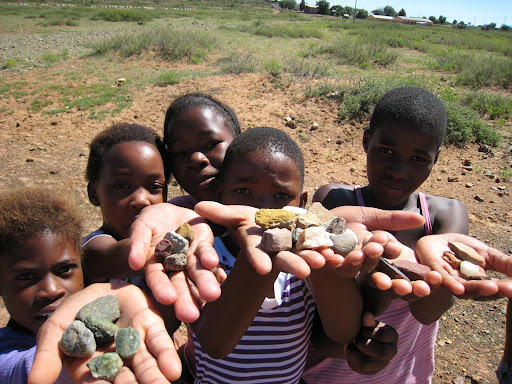
Adam came back to Tsoe with me so that we could do a one week Science and Sports Camp. Our goal was to use hands on, explorative methods to teach basic science concepts and also teach some sports to entertain the kids over the school break. Learning some lessons from my last camp, I split the day into two sessions, mornings for ages 7-14 and afternoons for 15+. We had roughly 30 younger kids each day. We made volcanoes and dinosaurs from home made play dough. We went rock hunting and talked about the rock cycle. We played with springs and talked a little about waves. We made ant farms and talked a little about insects and the requirements for life. We played kickball and four square. All in all it went pretty well although I don't think I could be a primary school teacher. Those kids can be tough to handle sometimes.


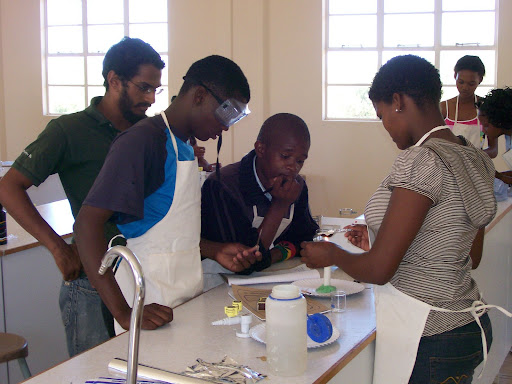
For the high school kids, we did a chemistry exploration called mystery powders. We gave the kids 5 mystery powders and gave them 6 tests to do to try and figure out what they were. We then gave them some mixtures and they had to use their tests to determine which of the 5 were in the mixture. We gave the kids notebooks for their work and taught them how to write a simple lab write up. Almost every group was able to figure out the mixtures. The second day we did ecology with them. We went outside and tried to do some observations, using our lab books to record all observations. We tried to discuss some basic adaptations to try to get the kids to think about why things are the way they are. We had mixed results there. I was impressed though at the knowledge the kids had about some of the plants. They knew which things were used in traditional medicines and what bugs and things were dangerous for livestock. At least I learned a lot. The next two days we did a physics exploration on the nature of waves. We had four stations for the kids to explore. One station was a ripple tank with two Huygen’s sources and various barriers. One station was a slinky spring that they were to calculate the velocity of waves in through observation and through theory based on tension and density. Another station was to use a candle and paper to find the focal length of a lens and to see the inverted image. The last station was to use an assortment of glass shapes to see which made a rainbow and what the others did to images and then to use mirrors to reflect a light around the room. Overall we had pretty good results. The last day we had a test and most kids did well with our high scorer getting 90% correct. For sports we played kickball and basketball and the last day we had a 4 vs. 4 tournament.

rock hunters

By the end of the week, both Adam and I were exhausted but I think we can say it was a huge success. They kids learned, had fun, and got to use resources that were sitting around gathering dust. Maybe one or two will actually see science as something fun and interactive rather than a boring class that is all paper and work. One kid, Thato, told me, "I think you've done something good here. The kids thought they were playing but they were actually learning."

testing ideas

School re-opens tomorrow and I’ve already got a lot of things to do. Our computer lab is full of new computers, a computerized writing board, and a digital projector. We just need to get clearance from the group that donated it to start using it. My school was selected to receive 1,100 books through the Peace Library Project. Now I have to raise money through my school and at home to pay for shipping. (There’ll be a post just on this soon but if you can’t wait, you can go donate now at: https://www.peacecorps.gov/index.cfm?shell=resources.donors.contribute.projDetail&projdesc=674-045 ). I’ve got 4 school improvement plans to finish and start implementing and I’ve got committee meetings and trainings to go to. I’m going to try to continue doing extra math and science classes for grade twelve. I’m trying to start up a pen pal exchange with some students here and at home. And I’m trying to work with a few teachers that have asked for help in a few areas. We’ll see how the juggling act will go.

Sunday, March 16, 2008

Education by the Mile, Education by the Book

This is an expansion on an email that I've written to some people. I've been working on several things over the last week but I wanted to use this post to draw attention to some things other volunteers have done that I'm trying to help out with.

Education by the Mile

In my experiences working with the schools, the amount of structural changes to improve a school seem overwhelming. It may take a generation of more before things truly improve to a level where all kids can really get quality education in rural regions. Faced with this, I believe one of the biggest ways to make a difference now, in addition to the long haul work, is to provide opportunities for the kids that really show potential so they can become the leaders of the next generation. Fortunately, some previous South Africa PCVs (now RPCVs) set up a program to do just that. It's called the KLM (Kgwale le Mollo) Foundation and it selects students with high potential in rural areas to join a prestigious private school, paying for tuition, living expenses, and a small stipend. To help fund this project, the PCVs set up a partnership with the Long Tom Marathon in Mpumalanga. On March 29, about 80 PCVs along with others from SA will be gathering to take part in the race (an ultra marathon, a half marathon, and a half marathon walk). Each PCV has been raising money for KLM. I'm taking part in the half marathon walk and am very excited. I began raising money a few weeks ago and things are going very well. I would like to thank the people who have already made a contribution. I've been especially pleased to see that the majority of my donors so far are my Brothers of Phi Kappa Psi, showing true dedication to our call to service.

Please take a look at the KLM Foundations: www.klm-foundation.org/

If you think this is a worthy cause, please donate whatever you can ($5 or $10 adds up fast). Fill in my name (A.J. Kumar) in the section to say who you are contributing in support of. With your help, we can be the top fund raising group this year!

Alternatively...

Education by the Book

One of my peers working in the NGO sector, Rose Zulliger, has put together an amazing project.
In partnership with Books for Africa, she is going to select 30 schools to each receive 1,100 books. It's always surprising to me to realize how few books there are in the rural communities and how little reading goes on. There's a lot of time to sit around and do nothing so with a little incentive and introduction, I feel like reading could really take off in such an area. My high school has a beautiful library with very few books. We've applied to Rose's program and if we are selected, we hope to use the books to build momentum behind a literacy program. Whether we get the books or not though, I am hoping to look to more sources for books and really push reading.

The books are provided free by Books for Africa. Once in country, Rose and other PCVs will sort through them all, deliver them to schools, and work to ensure they are utilized. The one missing ingredient is getting the books from America to South Africa. To pay for shipping, each school selected will have to raise R1500 (about $200) to contribute to the cause (also making them more accountable for the books since they are investing in them). For the rest of the money, Rose has set up a Peace Corps Private Partnership Proposal. Basically, this is a way to get donations from home to cover the rest of the costs. The site is not up yet, but will hopefully be soon. When it is, I'll be posting it. So if you feel this is a project that really strikes a chord with you, or if you just want to donate to BOTH causes, stay tuned.

My Education

Lastly, I want to reflect a bit on my own education over the last few weeks which also relates to another PCVs project. A fellow Education Volunteer, Saadiqa, works with a leadership camp group. She has put togehter a girls empowerment camp for rural students called Power Girls. I've spent the last several weeks working with my high school to select girls and help them apply for the program. Along the way, I've realized a lot about how interconnected problems really are.

After a lot of prodding and explaining, I got two of my teachers to work with me to finish the nomination forms. Based on leadership criterions, we selected 5 girls from our school. However, when it came to academic achievement, none of them met the 60% average cut off. Worse, NONE of the girls in that grade met the cut off. We decided to proceed anyways. As we worked with the girls, I soon discovered one is actually older than me. She was born in 1984 but she is in grade 9. My teachers insisted that she is a leader and that she now takes classes seriously. The next big surprise came when one of the girls said her father did not want her to do the program. This is an all expense paid, leadership development program. I could not see why he'd object. Then we talked to him and found out, the girl has a toddler at home. He had tried to warn her not to fool around but she did anyway and had a baby. As a result, he has told her, as long as she has a child at home, she will never sleep outside of the house. So going away for a week is out of the question. We decided to let her complete the application just to get practice at writing a CV and essays but we cannot allow her to apply because of her fathers stance. After reading her essays, I realized that she probably understands most of all the girls how important it is to be serious, and take a leadership role in the community, and she has learned a lot from her experience. Unfortunately, it seems she'll never get the chance to be forgiven her mistakes.


Education is the key to breaking the cycle of poverty. As we PCVs work at the grass roots to help increase the quality of education, I want to thank all those who provide the financial support to allow us to do projects. For me, each of these three projects signifies a greater truth about the Peace Corps. Though scattered across a country in sometimes remote regions, we are part of joint venture, seeking to make a difference in this country. Working together, we can make great strides.

Saturday, March 8, 2008

The Good, the Bad, and the Pragmatic

As I traveled home from a day of shopping in town, crammed in the back row of a khumbi with my groceries stacked on top of me and the elbows of my neighbors in my face, I began to ponder some of the things that I am passionate about; rock climbing, chess, experimental physics, and development work. Now, my dabbling in these four areas has been amateur at best to date, although I hope to further my abilities in all three. Yet, in the way that I’ve experienced them, I’ve found a recurring theme. The fields rely on not necessarily being “good” or “bad” but on being pragmatic. One often has to deal with non-ideal situations. Indeed, sometimes it is the complications and difficulty that draws one to them. But, solutions are possible to find, though the implementation may be beyond ones capabilities. In the end, one must use ingenuity, skill, and strength of will to find a path through the difficulties, often turning obstacles into new avenues for advance.

Sending It

I preface this by admitting I am no real rock jock. I haven’t climbed since graduating last June. However, I love climbing and feel a rush when I can “send” a route or boulder problem that has stumped me. Rock climbing is in essence an act of defiance. In our language we have sayings like “hitting a wall” and “between a rock and a hard place” that describe places you really would rather not be and that offer no real way forward. In rock climbing, you deliberately hit a wall, inching yourself up between rocks and hard places to overcome what at first seemed unassailable. The fact that a route is not easy is what makes it attractive. Being able to overcome a bad section is a real demonstration of skill. On the other hand, one cannot risk being foolhardy. There is no good and safe environment of climbing in which carelessness can be allowed. Sure, there are climbers who solo, but they do so risking their life. Rock climbing intelligently requires pragmatism. Redundant safety measures are a must as well as a cool head to judge each move and one’s own ability. Inspecting a route, one could say, well, for that part, I’d rock on from that hold, do a toe hook, and then mantle to that bomber hold. Once on the route, you must pay attention to every bit of your body and balance as you attempt to pull of what you saw in your head. Every piece of rock has potential for use. I’ve often been completely stuck on a route and then asked an experienced friend for advice. The answer generally involves viewing the environment in a different way, using what looks like an obstacle as a tool (“use that overhang to do a head jam?”). It does not help to think of a route as doable, or undoable, but rather, they are just routes and must be viewed rationally without judgment.

The Gambit

In chess, there are definitely good and bad moves, but often there are many moves that are possible, each with their own advantage and disadvantage. There are lots of strategies and memorized openings, but in the end, each game evolves uniquely. Letting emotions or psychology cloud your judgment often results in a loss. One must remain rational and pragmatic above all. A good example of this is the gambit. A gambit is a sequence of moves, usually an opening, in which a piece is deliberately lost. Sometimes a gambit is a set up to force an opponent into a sequence in which they will lose a piece of greater value than was sacrificed or into a check mate. Sometimes, it’s tossing a pawn away to change the tempo or gain a stronger position. Some might think losing material for position is questionable. It is often neither good nor bad, simply a pragmatic attempt to find a way forward through innumerable possibilities.

A Leatherman and Duct Tape

Many people have written about the elegance of physics, about beauty, simplicity, and symmetry. But any experimentalist knows that although the phenomenon that is to be studies may indeed be all these things, the process of study often is not. This is not to say experiments are always ugly. Many rely on magnificent feats of engineering and design. However, few things work as planned in life and in a physics experiment, when things don’t work, the willingness to get down and dirty to make things work is a must. I remember when I first joined the Manoharan Lab in Stanford as an undergraduate, seeing MOTA, the atomic force microscope that the group had spent years building and for which a separate room was added underground on its own foundation, I was struck by the incredible engineering and custom parts fitted together as well as the pieces of aluminum foil, wrapped around numerous parts, and the rucksacks full of lead shot sitting on the spring loaded table. As I progressed through my undergraduate career in physics I soon learned the necessity of such “think outside of the box” methods. As I worked on a team to measure the dependence of the resonant frequency of quartz oscillators in liquid helium versus temperature, I always had to grin when walking up to our bench. This set up, which was able to do measurements at temperatures of 1.47 K (-271.68⁰ C), relied in part on two by fours and duct tape. Professor Moler, who taught the lab class, commented that a true experimental physicist always has two things; a Leatherman and duct tape.

As I worked on my honors thesis I realized that there is not necessarily a “right way” to do things. You have to juggle the money and tools you have in innovative ways. I had created a device to manipulate magnetic micro- (and potentially nano-) spheres. After spending many months on simulations, designs, electronics, machining, electroplating, decarburizing, and what not, I needed to figure out a way to see and record the beads if I wanted to take any actual data. Now though the lab was equipped to see and manipulate atoms, it was not particularly suited for the micrometer range. The best we had was an optical microscope that could distinguish features down to about 6 microns. However, unlike biophysics labs I’d seen, we didn’t have a fancy camera attached to a scope. Time was short and negotiating to use a different lab’s equipment did not seem practical so I took a hint from MOTA. Using a Webcam and rubber bands, I was able to make a digital microscope good enough for the purposes of my experiment. Later, Professor Osheroff, who read my thesis to judge it for a department prize, commented on how it was nice to see some real blood and guts experimental physics. The method was not good; it was not bad; it just worked.

Change We Can Deliver*

This week I completed the final installment of my workshop series on Improving School Improvement to all of my schools. The workshop has probably been one of my most frustrating projects to date, but in the end, it seems like it may have been worth it. It did not go well. None of the 6 total sessions (3 primary school, 3 high school) started on time. All but one had to be rescheduled from its original time. No one ever did their homework. The final School Improvement Plans are not done. However, it did not go badly. The workshop was completed by all four of my schools. All schools demonstrated a greater understanding of their needs and ways to make changes. Feedback was largely positive. All schools have begun and some almost completed a well thought out School Improvement Plan. To get here though required an abundance of patience and pragmatism. I had to adjust expectations and material to meet the realities of my situation. I had to make use of knowledge of each schools strengths and weaknesses as an institution and as a staff. I had to calm myself down after experiencing great anger and frustration.

In many ways, I think all of Peace Corps is like this. We deal with non-ideal situations but have to see challenges not as problems but as opportunities. Like experimental physics, we have to juggle limited funds, resources, and time to find creative ways to help our communities find beauty in life. Like a gambit, some of us have chosen to not make a head-on attack against corporal punishment, sacrificing a value, in order to put us in a position that we can make change in a school without alienating the staff. Like rock climbing, when confronted with a wall, we chalk up our hands and push ourselves to new heights.

*This is in no way an attack on Senator Obama. In fact, I personally think he is the candidate that will deliver. These comments are my own and do not reflect those of the U.S. government, the Peace Corps, yadda yadda yadda…

A Glass of Water

There is a saying in the Peace Corps that goes like this. A pessimist says, “The glass is half empty.” An optimist says, “The glass as half full.” A Peace Corps Volunteer says, “Hey, I can take a bath in that!” Blind optimism leads to unrealistic expectations. Pessimism leads to missed opportunities. We must keep a level head, look at our environment, and find new and creative uses for everything.

Saturday, March 1, 2008

Vision and Mission

My previous post may have made it evident that I am in the midst of some soul searching, trying to pin point what it really is that I am doing here in South Africa. In my desire to try many things all at once, I’ve encountered a great deal of frustration as one thing after another gets in the way of my plans. An illustrative and ironic example is the current gridlock over computer instruction. A few weeks ago, my high school received forty brand new computers and a new server. They were received while I was away for training. The twenty old computers were removed from the room that just barely fit them and the forty new ones were crammed in so tight that you cannot lay the keyboards all out because they will be on top of one another. Now we are waiting for an inspection from the agency that has provided these computers and are told we cannot move them because that is the room the agency chose as their computer center room (7 years ago when they donated the first 20 computers). Even after the inspection, there is no physical way we can use all forty computers so the result is that 20-40 of the schools 60 computers will probably just collect more dust. I’ve started pushing, and will soon start shoving and elbowing, to use one of the three large empty halls as the new center for the 40 computers and return the old twenty to the old center. Teachers can then use the old computers for class prep and record keeping while the forty new ones can be used for classes and class research (all have Encarta installed on them). This is going to require convincing the donating agency to allow us to make a new computer center room, finding the money and labor to burglar proof and wire up one of the halls, and then move and setup the new computers again, return all the old computers to the old room. Then I can return to my original roadblocks of finding class time, finishing adapting and creating instruction material, dealing with constant electricity uncertainty, getting internet, and developing an Information and Computer Technology Policy for the school. But hey, I’ve got about 19 months left to get that done.

Faced with these frustrations (and I know my fellow volunteers face similar if not more daunting tasks at their sites), I feel a sense of kinship with those members of my schools staff that really care and want to provide quality education, but find themselves buried under piles of bureaucracy and pulled in many directions by the Department of Education, Teachers Unions, the village, and their own personal lives. Sometimes I think it pays to step back, take a deep breath, and answer the big picture questions again: Why are we here? What are we doing? Where are we going?

This past week, I worked with my schools in the second part of my workshop series on School Improvement. Our tasks were to re-evaluate the schools Vision and Mission Statements and then to use our previous analysis to come up with a prioritized school improvements list. There are many ways to define Vision and Mission but I focused mainly on the questions they answer. A Vision statement answers the questions: Where are we going? What is our ideal position in the future? A Mission statement is a bit less pie in the sky, answering the questions: Why are we here? What are we doing? Both should be succinct and clear and created with support from major stakeholders.

Here is a sampling of the fruits of my workshop and my own introspection.

Old Visions (verbatim…not my spelling/grammar errors)

Tsoe Primary School: To further the interest, well being and education of all learners.

- Upgrading of school premises

- Improve the financial status of the school

- Creating a conductive and safe learning environment for our learners

- To promote excellence in school

Ba-Ga-Lotlhare High School: To produce an Education Process which will yield a responsible, high quality, relevant and independent individuals, capable of participating fully in the society four years from 2005.

New Vision

Tsoe Primary School: To produce learners that are productive to the entire country.

Ba-Ga-Lotlhare High School: To develop learners into accountable South African citizens who will achieve excellence in global society through their initiative and creative thinking.

Old Mission

Tsoe Primary School: To commit ourselves to maintain high quality standard of education for our learners.

- To promote the culture of learning and teaching

- To promote and foster sound relationships among stakeholders

- To elect an effective and accountable governing body in our school

Ba-Ga-Lotlhare High School: To improve and develop skills, talents, guidance and capabilities of school stakeholders which will establish all democratic structures and also produce people who can deal with different challenges and situations inside and outside our country (R.S.A)

New Mission

Tsoe Primary School: To provide quality education by involving all stakeholders in order to produce learners who will be responsible and independent thinkers.

Ba-Ga-Lotlhare High School: To provide all learners with quality education, and to motivate and develop them in totality through the involvement of all stakeholders.

The difference

Besides the obvious changes in structure, both old and new may come off as nice idealistic statements. The biggest difference though is that the new statements were created by almost all the teachers and management together and so now I have something to hold up to them and say, “This is what we committed ourselves too and I am going to hold you to it.” And I hope that that will be at least marginally more productive than using something the teachers have never seen or heard before.

My personal goals

Vision: To have schools effectively and autonomously setting goals and monitoring and evaluating progress towards those goals, to lay the foundations for a culture of accountability and high expectations amongst both students and school staff, and to have youth leaders that foster and encourage constructive activities.

Mission: To work directly with school staff and students to empower them to realize their goals by providing them with ideas and advice, helping them secure resources, and training them with new skills to enhance their work, while at the same time keeping an open ear and eye to community needs so that opportunities for larger community development can be spotted and supported.

Last week, I found myself heaping my outrage on various groups outside my control: the computer donation company, the government, text book writers (who’s rewriting history now and incapable of doing science and math?). They were impossible challenges that made me feel powerless, useless. Thinking and reflecting on the big picture has helped me breathe out and realize that even though there is a lot outside of my control, there is still a lot I can do as long as I am positive and creative. Getting those things done while I’m here is my real challenge.