Sunday, November 11, 2007

Desert Flowers


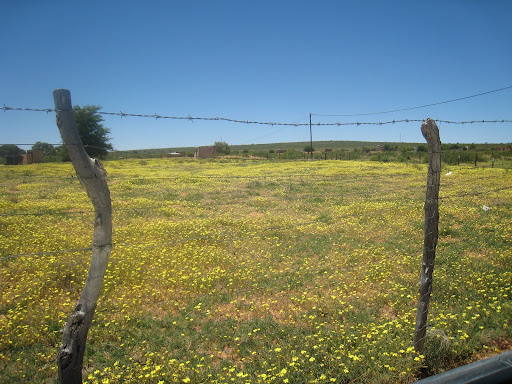
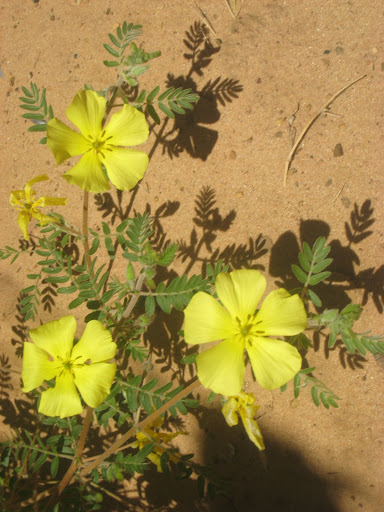
The rains come suddenly and with intensity here. The salt pan fills with water to make a shallow lake. The greening that follows comes as swiftly as the rains that caused it. The once brown landscape has a glow of life highlighted by the yellow flowers that spring to life. White butterflies swirl around me as I walk to school, but even now, the salt pan has already dried. Once the rains stop, the flowers and greens shall soon fade too. The fleeting presence of such beauty is a reminder of how fragile everything is out here. Ideas, dreams, health, and even life come and go with just as much intensity and brevity as the desert flowers.
Sickness and Health

On Wednesday, despite a mild headache, I decided to bike to Maphalwane P.S. in the middle of the day. This turned out to be a very bad idea. By the time I got home at around 2pm, I was burning up and my head was pounding. For the next two days, I medicated myself with Tylenol and oral rehydration while my host family checked in on my and brought me food. By Friday morning I was finally better though weak and fatigued. The rapidity with which the fever struck shocked me. I think the bike ride contributed to the intensity which made me fear I had heat stroke. I’ll be sure to avoid that kind of exertion in the summer heat again. It was a sobering experience to be sure. It makes the distance set in when I realized that I had to get up out of bed to check my temperature myself because my parents, Kana, and friends were thousands of miles away and my host family doesn’t understand medicine enough to know what exactly to do. However, my host family and local friends were very helpful. The high school boys I’ve befriended and my host sisters would check in on me every few hours, bringing me food or going on errands for me to get some Sprite or biscuits.

Dreams and a Disconnect

I spent part of the past week getting to know some of the people in the neighborhood I live in. I prepared an interview in Setswana and then tried to hold the whole conversation in Setswana and it worked out alright. Part of my questioning was meant to discover what kinds of project there is community interest in. Though I have not yet finished interviewing a large enough group to have a clear picture, it seems that people are very interested in starting income generating projects and a community garden. In one sense, this is wonderful to see interest here. However, it is also saddening because it underlines the lack of awareness within the community itself about what is already available. Through the efforts of the local NGO, Rural Youth Development Organization, there already is one income generating project, a honey making project. However, it is struggling because of lack of community participation. Also through RYDO, there is a garden already but again it is virtually unknown. There is a gap between what people want and what people know that causes a lot of waste. This is evident in the schools as well. Many grade 12 learners have approached me to ask how they should go about applying for bursaries (scholarships). I ask them if they have applied to college yet, and they say they haven’t because they don’t know if they’ll have money to afford college. What they don’t realize, is that they must already be accepted into college to apply for a bursary. Something I will have to work on is figuring out how to improve communication so that the dreams of the youth and the community don’t sit around only to shrivel up in the desert.

A Life Barely Lived

This past Tuesday, one of the girls in grade ten at the high school passed away after struggling with TB. Although AIDS is a huge problem in South Africa it gets a disproportionate amount of media attention in the West compared to TB which is just as real a killer here. The local clinic in my village estimates that roughly 30% of the population has TB. I’m not sure how accurate that is but it’s probably a decent ballpark figure. This Saturday, I joined a group of my teachers to go to the funeral at 5:30am in the morning. The funeral took place in Mokhubung, which is one of the villages of Tsoe about 8 km south of the school. We arrived at the house of the parents at 6am. The traditional funeral tent was up in front of the house and inside, a group of six women stood surrounding the casket, lit candles in hand. An all night vigil is done before the burial. After some time, other women go to take the place of those around the casket. By now, a large crowd has already gathered and is seated around the women. The crowd has spilled out of the tent and we stand in the back row until more chairs are brought. Prayers are said and hymns are sung. A few people make speeches but I only understand a little. After an hour, the crowd parts and the casket is moved into the back of a pick-up. Then the crowd processes down to the cemetery. Mokhubung is in the hills around the salt flats and as we process down, I am struck by the beauty of the scene sweeping my eyes out over the procession along the red brown road, over the green hills, across the white salt pan and finally resting on the wide blue sky. Finally, the procession arrives at the small plot. There are only 3 other graves on the small flat piece of earth. We gather round and the casket is placed. Prayers are said and holy water is used to bless the ground and casket. As they begin to lower it into the ground, several women, and notably one young man walk off a short distance and begin to cry. The grief is palpable as others move off to console those that have left. Once lowered, the men all line up and we take turns shoveling earth until the grave has been filled. Then more hymns are sung and prayers said before two of the oldest men in the gathering say some words, thanking the guests for coming and adding some light words to bring some cheer. We then walk back up to the home and wash our hands in the communal basin (a sign that our hands are clean and played no role in the death of the departed). Then we eat the traditional funeral fare. There is a choice of samp or rice to eat with a tomato based sauce, shredded beef (tshotle?), cabbage, and a cup of juice. After eating, people slowly begin to disperse and get back to their daily life. Though this is the first funeral I’ve attended at my site, there seems to be one almost every weekend even in my small village. When I’ve talked to teachers and other adults about their weekly schedule, many have said Friday’s are for helping with funeral preparations and Saturdays for helping with the funeral.


After I returned home, my host mother was gone to another funeral. The next day my host grandmother is away at another funeral. The constant procession of death reminds me how much I have to be thankful for and how little there is that can be taken for granted. The beauty of the village and its warm people is set against the despair of disease, alcoholism, and apathy. The sea of yellow flowers cannot hide the summer sun and the withering heat that it brings. Yet, the flowers do not seem to mind, springing from the sandy ground and living boldly if only for a month or too, spreading their petals open, almost defiantly, to the burning sun. So I must get to work, taking the fragile ideas and projects that exist in the minds of me and my counterparts, and expose them to the burning realities of South African rural life. Maybe, just maybe, one or two will actually take root.
Sunday, October 28, 2007

Changing Light bulbs

Every once in a while, good things happen unexpectedly: A potential project springs to life, a teacher takes my advice, students show they are capable of more than has been expected of them, or a baby starts to walk. Things like these give me hope that I’ll have some success here in making a positive impact. They brighten up my day and help me flush my system of frustrations with language, distance from loved ones, and cultural misunderstandings. They are the light bulbs that go off in my head and those of my counterparts that keep us going after one idea fails or comes to a standstill. I’ve found that often all that’s needed is a little know-how, a Leatherman, and a little luck. I like to think of all the opportunities that have arisen as just part of my birthday presents because that’s how my week began.

My South African Birthday

On Monday the 22nd, I turned 22. It started off as a pretty typical day, waking up by 6am, taking my bucket bath, and heading to school. At school, I continued shadowing/co-teaching with one of the natural science teachers. Along the way though, kids and teachers sang me the local birthday song which basically says, “Happy Birthday! Don’t get as big as an elephant!” I tutored some kids after school and then went to the post office to drop off some mail and pick up a package from Kana. On my way back, I met a man that started a local NGO called the Rural Youth Development Organization. They started the honey project in my town as a way to employ young people. The guy is very motivated and wants to do leadership camps/life skills retreats to help develop the youth in the area. It’s basically a perfect fit, so we’ve started meeting and brainstorming ideas. After we met, I went home and talked to Kana for almost an hour before heading over the Catholic mission house. The priests had a report due and wanted help making a cover so I did some simple stuff with Paint and they were amazed. They were very thankful and gave me some food before driving me home. At home I had dinner with the family and then celebrated back in my room with some Oreos and a glass of milk. I also got a call from my Peace Corps boss telling me the promised furniture was finally on its way. It arrived at the end of the week and now kamore ya me e tletse tota! (my room is completely full). Unfortunately this means my cardboard wardrobe is now awaiting my next creative streak but I do still have a brick bookshelf.


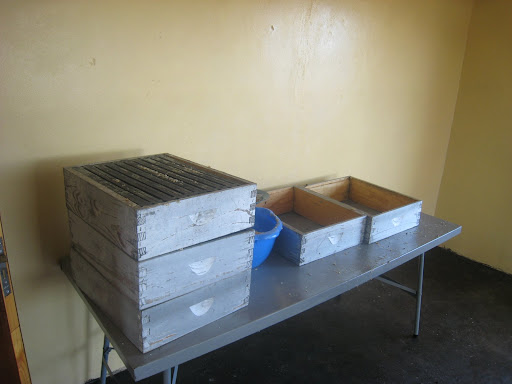
Bee farm hives
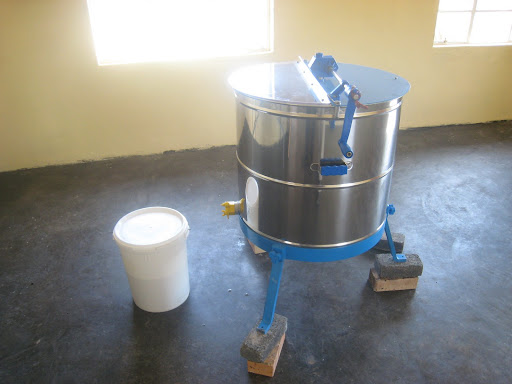
Honey exractor/ centrifuge type thing

Honey Comb

My bookshelf (more books to be added soon hopefully)

Attempts at teaching

This week, I also tried teaching some lessons. I had done some lessons last week on circuits to classes of roughly 30 kids. This week I had a combined 9th grade class of 84 kids. I taught a chemistry lesson. It made me appreciate my time in Exeter in classes of 14 students a lot more. Between the language barrier and lack of discipline, I struggled to get across basic concepts. I thought the kids understood because they answered questions I asked and in groups were able to solve some worksheet problems I gave them and some were able to explain the solution. Unfortunately, when we did an individual assessment in the form of a test, I found out they understood very little of what I said. On the flip side, I have had some good discussions with the teacher I’ve been working with and she’s starting to try some things like docking late work and discouraging copying. I also suggested to her to assign reading and have kids take their own notes rather than follow the current system where she spends an entire day writing notes on the board and having the kids copying them down without really saying anything. She was unsure if it would work, so we had an experimental class. I gave the class (grade 11, about 16 kids that day) a 15 minute spiel on how to take notes and did an example paragraph for them. Then I set them loose on the book for the rest of the hour. At the end of the class, I collected the notes and went over them. When I saw that about half the kids had taken good notes, with a couple taking outstanding notes, I felt vindicated. Now, we are planning to have the kids that understood explain to the rest of the class and use assigned reading. Potentially this could double the time that’s actually spent teaching.

My International Network

Strangely enough in my little village, I’ve begun making an international network. I’ve befriended the two priests that live at the mission from Tanzania. I spent Saturday evening cooking with them and swapping stories (had a chicken from their coup and greens from their garden). Apart from the religion aspect, we really have similar jobs in terms of development so it’s been good to get their perspective. I also met a guy from Ethiopia when my furniture arrived. He tried to sell me some pretty sheets but was way too expensive for my budget. For those of you that know Dawit, he was kind of a lankier, smaller version of Dawit (of course all Ethiopians look the same…). I also continue to meet happy Bangladeshi merchants that try to speak Bengali, then Urdu, then Hindi to me before going to English. I still have yet to break the ice with the Chinese couple that works in the shop down the road from the school though. Last but not least, I’ve found turkey in the village. So there is hope that I can get a turkey for Thanksgiving still…

Neighborliness

The three of us that live in the little house I am in are learning to all help each other out. Just as Orapeleng was there to help when I popped my tire, I was able to help out our third neighbor, Elsa today fixing a broken light socket in her apartment. I know that sounds trivial but to me it felt like a watershed. I’m starting to lose the “rock star American” effect and really be seen as a neighbor and community member. It makes sense that it would start with my closest neighbors but hopefully it will spread throughout my village in the coming years too. Although, I am afraid I will always be the “computer guy” and run around fixing computers and cleaning viruses as long as I’m here (5 viruses cleaned so far, 6 schools/organizations assisted/trained in basic computer stuff so far).

Baby steps

Perhaps the best moment of the week was when baby Kitso took his first steps. For the last month it’s been fun to watch his progress as he slowly learned to stand by himself. Now, he’s taking about 4-5 steps on his own before smiling, clapping, and falling down or deciding to crawl. He’s also trying to form words besides “mama.” Since I’ve never been around a baby at this stage with such continual contact, it’s been fun to see the whole development process. It’s also a good reminder for me of where I am. I feel like I’ve just found my feet and taken my first few tentative steps in my Peace Corps career.

Saturday, October 20, 2007

My Pimped out Peace Corps Pad

My Ride

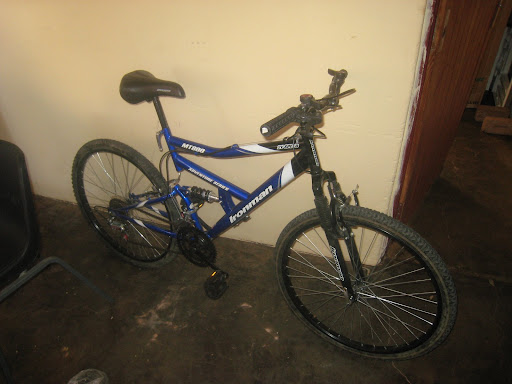
After much anticipation, my bike is finally here. It’s used but still pretty good after I adjusted the gears and brakes a bit. Biking to my farthest school is a bit of a challenge for me as I realized how out of shape I was. I have to bike about 6-7 kilos to the school, about 4 of which are uphill on a rocky/sandy road. Biking at Stanford with its general flatness and nice paved areas really spoiled me. On my third ride, coming back from my school on Monday, I had a bit of trouble. There are lots of cacti and broken glass bits all around so when riding off the main road, I pay lots of attention to whats immediately ahead of me. Just as I was about to get onto the main road though, I looked up to check for traffic and ran over a piece of glass which promptly popped my tire. After walking about halfway back, I was able to run into a friend with a pickup who took me and my bike the rest of the way home. My neighbor was trying to help me patch up the tube but tried pumping it up before the rubber sealant and patch had completely dried and the tube burst. Fortunately, he had a spare tube which I’m now using until I can go into town to pick up some of my own. I think I’ll need a stockpile as I’ll probably be changing tubes and fixing patches quite often here.

Chillin

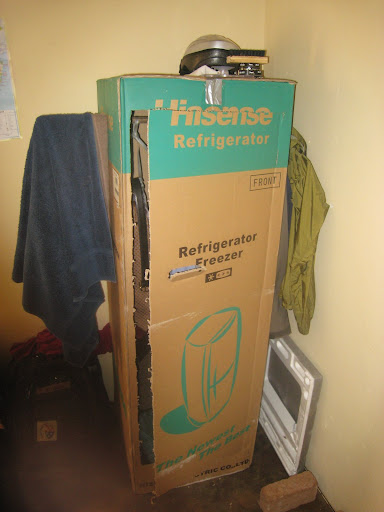
This weekend also brought my fridge/freezer! It’s given me the ability to cook for myself now that I can store my own frozen chicken and leftovers. I’ve been using some peri peri seasoning to spice things up. It’s nice to have some non-bland food. I also can have cool water and milk now whenever I want which is wonderful. I think I may actually be eating healthier now than I did in the states. Just need to stock up on veggies next time I’m in town.

Improvising

So my furniture from the gov has yet to arrive, so I used an old broomstick and my fridge box to make myself a wardrobe and I wove a plastic strip into a tie rack. I guess all those years of OM/DI are coming in handy. We have lots of bricks which I’m using as bookends (planning to make a full fledged bookshelf soon) and using as free weights. There is a handbook from the Peace Corps on how to make your own tools using just random pieces of trash and bolts. I haven’t gotten to try any of them out yet but think I may try to make a hammer sometime soon.

My kitchen

It’s not much, but it’s enough to keep me happy and allow me to cook whatever I want. No oven, but I can use the families oven if I really need one. Peanut butter is a life saver, and I’ve become a huge fan of the Black Cat brand here.

Other news

I’ve been working with a science teacher at the high school to get a feel for teaching here. Most classes are only 35 minutes long which makes it extremely difficult to do any quality teaching and assessment. Some of the teachers I’ve talked to agree with me and I’m hoping to try and see if we can do some longer classes that don’t necessarily meet every day so we can actually get more content taught. Some kids are really eager to learn though, which is refreshing. I’ve been doing some informal tutoring already and helped coach a kid for a class debate. It was on corporal punishment. He originally was going to support it but after I talked with him and asked him a few questions he changed his mind. In the debate though, unfortunately his team got a bit nervous and was not able to present their case well. I was adjudicating and had to give the win to the side supporting corporal punishment. It was tough but I was trying to stay objective. I’ve also been working with some of my teachers on typing technique and they have been very enthusiastic to learn.

Tuesday, October 9, 2007

Pastoral Peace Corps

My life as a goat herder

In the previous uploaded photos, I included several goat/sheep pics from the morokeng. Roughly half the days of the week, I go out with the family to help with the livestock. Starting as an awkward observer, I’ve slowly gotten included in various tasks. We generally go out to corral the animals for the night to protect them from jackals and to give them water. We also do make sure all the lambs and kids get fed and treat the animals for illness. One time, we took some black sticky stuff and started painting it on the goats’ backsides and hooves. I was confused until my host mom picked a tick of the dog to show me as an explanation. The next time we went, we fed the kids a liquid tapeworm treatment. Today, we drove around to find some sheep that had wandered to the edge of town near the auction lot. I helped corral them and put them in the truck. While waiting between loads, my sister, Mpho
explained the auction lot and some other basics about the many areas of the village.

Shearing myself

My hair was getting kinda shaggy but I was faced with a dilemma. Guys basically have two options of cuts in the village: buzzed or shaved completely. Also, razors are to be avoided when the HIV positive population from ages 15-40 is about 40%. So I took matters into my own hands and busted out a comb, mirror, and scissors. It’s not perfect but I think it’s pretty good for a first attempt at cutting my own hair. Pictures from that and the last few days can be found below:
Haircut and more village pics


Livestock vs. Education

I had an interesting discussion today about education with one of my principals. He was telling me that out here, the only real way to make a living is through livestock. He said for example if I had R10,000 and invested it in the bank, I’d only get R625 at the end of a year but if I used it to buy 20 sheep, and they all got pregnant then at the end of the year, I could sell 20 sheep and have made R10,000. After I prodded him a bit, he admitted that yes, there were risks of losing sheep and not all of them would have offspring, and it cost lots of time and money to look after them. Still he claimed that you’d make more. Granted that might be true, but it’s a poor example to compare it to a small bank investment compared to say, a teachers’ salary which is on average R100,000 a year. I don’t know anyone in the village with 200 sheep so I think it’s more a mindset issue than a real fiscal reason. But nonetheless, its difficult to motivate kids and even educators to commit to education when there is a strong belief that raising more sheep is the way to make money.

Small steps

Today was a really good day and helped really reaffirm why I’m here. I helped one of the science teachers set up for a chemistry demonstration and was able to share some knowledge and tips with her. She was appreciative of all suggestions and criticism and said she was happy I was here and that they would learn a lot from me in the next two years. I had a similar comment from one of the other teachers about computers as I cleaned up a virus infection from the principals computer and continued to work on my lesson plans for the computer literacy classes I’m hoping to do with the community. Then after school while I was at home, one of the students came over and asked me to help him understand an essay topic. The prompt was “Should corporal punishment be brought back into schools?” Corporal punishment has been banned since 1994, but is often practiced in rural schools in South Africa. Surprisingly, I have not seen any in my schools (at least so far…) which is rare considering many of my training class and current volunteers have had to deal with some sticky issues relating to corporal punishment in their schools. The student had written yes as his answer though. I told him that whichever answer he chose he’d have to back it up and answer the issues from the other side. I talked to him about alternative punishments, positive incentives, and some of the reasoning for banning it. I also had him give some reasons to talk about why he supported corporal punishment. He got thinking though and realized the depth of the issue. I also leant him my “Alternatives to Corporal Punishment” booklet from the Department of Education for the day. I’ll be interested to see what he chooses for his final answer tomorrow. I think he was slowly coming over to change his opinion and if he does, I think every small victory counts to changing a mindset in a society.

Other updates - I was able to get into town again on Saturday and actually purchase a bike and fridge. Unfortunately, my means of transporting them back to site didn’t work out so they are still in town waiting to be picked up…hopefully this weekend…?....please? On the bright side, I met up with and had lunch with two other PCVs in the area, Mandy and Tera. It was good to catch up and share stories and speak American English at a rapid clip again.

Friday, October 5, 2007

Cultural Learning of South Africa for Make Benefit Glorious Nation of America

So for those of you wondering why my blog posts tend to be all positive and happy, part of it is because most of my time here so far has been great and I have little to complain about but the other part is because I don’t want to vent about someone or something online only to have involved people find it and get upset. I’ll save the venting for snail mail, email, and phone for those interested.

One of the things that can be the most rewarding as well as the most challenging so far has been learning the cultural differences. Below I’ve tried to give a smattering of examples and vignettes to illustrate some of the most interesting things so far. Keep in mind that I’ve mostly been exposed to village life in rural Tswana areas in the Northwest Province and Northern Cape. Things are very different in the cities although something pervade all ethnic groups (like greetings and Ubuntu) and some things probably could generalize further. Also, I think some of this may be repetitive but I wanted to put it all down in this category.

Ubunto/Botho:

Ubuntu is actually a Zulu word but everyone uses it. I think Botho is the Tswana word. It’s hard to really encapsulate it. It is short for “I am because you are,” which really means ‘my being is established by your being’ (kind of existentialist…) or, ‘we are all in this together.’ It is the reason South Africans often give if you ask them, why didn’t you run wild once the government changed and take revenge on the whites? TRC makes a whole lot more sense with Ubuntu in mind. It is more than just a philosophy though; it is a way of life. My first week at school, I was with about three or four teachers holding down the fort during the “recovery plan” which was school held over spring break to make sure learners caught up on material missed during the teacher strikes in June. I live fairly close and planned to go back home to get some food for lunch, but two of the teachers brought out a plate of food for me when the lunch break started. We shared magwenyas (fat cakes which is basically fried balls of dough) and soup. The next day, they invited me to their home and made chicken and bogobe for me. The next day, I was out visiting other schools during lunch and when I returned, they insisted I go eat and served me mogodu (cow intestines), chicken feet, and chicken heads with bogobe (I actually liked it a lot). When I tried to give them money for the food, they refused saying, when you eat, you cannot take out your food in front of others and just eat. You must share. When a guest comes, you must make the best food by the demands of culture. It is a wonderful idea but it also is tough as an American with my strong individualist urges. When I use my modest Peace Corps stipend to buy food and snacks, I feel like I can’t munch down during break without splitting it with anyone around but I sometimes just want the things I bought for myself. Whether it’s being greedy or hungry, I don’t know…. I left my Nalgene on the table once and as kids walked by, once in a while, one would stop and ask to have some water. I’m happy to share water (it’s just the peanut butter and biscuits that I hoard…). Of course, just as Christian charity isn’t necessarily practiced wholeheartedly by all Christians, Ubuntu has its limits. It’s not really socialism (interestingly, the South African Communist Party has its roots mostly in the Jewish community).

Greetings/Go dumisa:

In America, I’ve noticed that back home in South Dakota, especially in the small towns, it’s normal to walk around and wave, say hello, and smile at everyone you pass, even strangers. However, if you don’t do this, few people think twice about it. Out here, greetings are extremely important. If you don’t greet someone, especially an elder, you are considered rude and the person may think you think they are worthless. Greeting is a way of acknowledging the humanness of another. It’s one more way that Ubuntu pervades everyday life. And you don’t just stop at the greeting, you continue to ask about ones day, one’s family, and introduce yourself if you are new. You also, often shake hands and sometimes keep shaking or holding hands through the whole thing (and sometimes for a long time after). When I was introduced to my host father for the first time in training, he took my hand and held it all the way on the walk back home. Just as in India, it’s very common for guys to hold hands. And, it’s not just saying “hello”, the real meaning goes deeper. Here’s an example in Setswana:

Dumela mma! (Good day ma’am: literally – Agree mother)

Dumela rra (same but father this time)

Le kae? (How are you (and your family and ancestors)? : literally – Where are you (plural))

Re teng, le kae? (I’m fine and you?: literally – We are here/we exist, and where are you (plural)

Re teng.

Ke a leboga (I am thankful)

Le nna, ke a leboga (And me as well, I am thankful)

In Zulu, the greeting is: “Sanibonani” which literally means “We see you (plural)” but really means, I acknowledge your presence and that of your family and the ancestors who came before you and I respect you for them.

Of course, with the younger crowd, things aren’t so formal but greetings are still important as acknowledgement. Often, they are derived from “tsotsi taal” or gangster talk that is the mesh of all South Africa’s languages that emerged from the townships. Common greetings are:

“Eta eta” – no good translation for this yet

“Wa reng” “Ga ke re sepe” – “what are you saying?” “I’m saying nothing” = What up? Not much.

“Hola skoko” – hola (from Spanish…) tough guy/strong man/the best guy on a soccer team

“Sharp sharp” – a catchall phrase that is like “cool”, “I’m fine”, “It’s all good”

Gender roles:

Gender roles are changing, but changes are slowest to reach the rural areas. Women generally do the cleaning, cooking, child rearing, everything… and men get money from working (theoretically…) Because of the migrant worker system created by segregation and then Apartheid, families send someone to work in the city and send back money to support the home. This means men are gone to the city or unemployed and probably alcoholics in the village. I’ve insisted on helping with cooking and washing dishes which has helped actually gain respect and trust within my host families. Sometimes though, even women help keep the gender roles in line. During training, while doing my own laundry, both males and females that passed by laughed or asked why I was doing the washing and not hiring some woman to do it. However, one of the Zimbabwean men next door (who is well educated as a technician but now selling mops because of the economic crisis in his home) said that real men should know how to wash their clothes. Today, after the high school graduation/ matric farewell function, I went to help the women and girls with the washing. One of the male students I had befriended saw me though and joined in so not everyone holds to the lines.

A go na molato:

It means no worries, for the rest of your days. Really, nothing is a problem, it all can work out somehow… Plans are just guidelines and if you are too set on sticking to plans you’ll cause yourself a lot of problems. This demands a lot of patience. My last attempt to get to town to buy a bike resulted in a delay of 5 hours in departure, a multitude of tasks to do with my ride once we arrived in town, and the result being the bike store was closed and I didn’t get home and get to sleep until almost midnight. But I’ll be going back again to make another attempt soon. It’s all good. It also has a positive side too. Sometimes things just work out. At the end of site visit, Kelee, Art, and I befriended a priest who not only gave us a ride to Vryburg (saving us R65), but also made arrangements for us to stay. It meant leaving a day before planned but hey, we got nice beds and a shower at the mission house. So really, it all evens out.

Perceptions of outsiders:

Like most cultures/countries, there is a bit of xenophobia here. Just as Americans make jokes about Canadians and often stereotype Mexicans, South Africans (as an economic powerhouse on the continent that attracts millions of immigrants both legal and illegal) do the same. Americans are rich. Bangladeshis are shopkeepers and are stingy. Indians know how to rewire stolen cell phones and fix all your electrical problems. People from Mozambique know how to jack cars. Nigerians are all drug dealers. Of course like all stereotypes, they have some tiny toe in reality. Funny story: While at Pick ‘N’ Pay, a supermarket, I was approached by a Nigerian guy that was awfully friendly. I was getting a bit freaked out because I wasn’t sure what he was up to until he asked if I had any friends that liked to hang out and “smoke the weed” (also called dagga here). He quickly lost interest in me though after that though when I said I didn’t. I guess the frazzled hair and beard look gave him the wrong idea.

That’s it for culture for now…there’s a whole lot more and I’m sure I’ll also experience a whole lot more in the years to come but that should give some good background for now.

Updates – I’m liking my schools and have been making friends with and getting to know my teachers better. I’ve been interviewing teachers and next week will be observing them (I double booked some so I’ll need to do some creative reshuffling, a go na molato…) I’m already coming up with ideas for projects and hopefully one will take off. Some ideas so far: computer literacy classes for teachers, students, and community; social dance class to go introduce swing, waltz, and get to learn traditional Tswana dances; scouting club; workshops on general teaching and curriculum ideas; HIV/AIDS awareness campaign working with local care givers and clinic; some kind of carnival or races on the salt flats once the water dries up.

Today was the graduation ceremony for the grade 12s. Next week they will be writing their matriculation exam (think SATs on steroids, in a second language). As the American PCV, I was asked yesterday to be the key note speaker. With little time to prepare I threw something together and got help with the Setswana part of it, nothing comparable to the swearing in speech which took two people and over a week to put together. The ceremony itself was nice, lots of speeches, some certificates handed out (that I helped make a few hours earlier) and a nice meal. It began and ended with prayer (again, religion is huge here) and began about 3 hours late (again, a go na molato). Afterwards the kids got to have the room and play music and dance. I guess it’s the equivalent to prom for a poor rural school. The city schools and boarding schools have graduations and matric dances almost identical to ours in America.

That’s it for now. Storm clouds are building and the wind is picking up so “Pula a e tla gape.”

Saturday, September 29, 2007

The rains over Africa: my first week at site

Pula e nele thata!

The rain came and came hard. On Wednesday, the wind picked up and clouds moved in "Maru a thibile" (literally 'clouds have blocked out the sky' but figuratively, danger is brewing). I sat on the families porch and watched the storm sweep across the savanna, over the salt pan and finally hit. The storm raged for nearly 12 hours pouring rain and hail down and creating a spectacular lightning and thunder display. It's the kind of weather that four years in tame California has made me hunger for. The next day, the sandy streets had become deep dry river beds and the salt pan had turned into a large but shallow lake. Electricity was out for two days and it took about a day to get cell reception back again.

More fun foods:

The teachers at my key school were generous enough to let me share their lunch for most of the week. The first day we had fat cakes (basically fried dough) and soup. Then yesterday, I had a plate of cow intestines, chicken feet, and chicken heads with some good old bogobe/pap. I actually found the chicken heads quite good. Lots of interesting little bits and textures.

Getting around town:

I did a lot of groundwork at the schools this week, meeting as many teachers as I could and setting up interviews for next week. I also met the clinic staff, the police, the post office, and several shop owners. I was unsuccessful at catching the chief/kgosi but will try again next week. I also missed the honey factory people. I also got to watch a local soccer game and found out one of the guys I've met is actually a coach. The field is dirt/sand but these guys play really well. The village is split into two sections. The one where I live has three of my schools and the post office. The other part has my last school, the tribal office, police, and clinic. It's roughly 6-7 km between the two so I got a lot of good walking in. As I've been getting to know people, I've also been able to get rides in pick ups and donkey carts. Hopefully, I'll get a bike soon and have more freedom of travel.

An Environmental Dilemma:

So I had been able to avoid this issue for a while but no longer. Trash collection doesn't happen in villages. Trash is just thrown onto the road or ground or burned. Lots of plastic fumes greet you in the mornings. Now that I am living in my own small house, I have my own trash and had to make the difficult decision about whether to just throw or to burn. I chose to burn feeling it was the lesser of the two evils. I know some PCVs were going to start compost piles and I may look into it for at least reducing what I have to burn. Any other ideas would be greatly appreciated.

The Setswana gauntlet:

This week has been most challenging probably because the only member of my household that speaks good English has been out of town leaving me to test my Setswana skills as best as possible. It's turned out alright but has definitely been frustrating at points. I want to learn what is being said but explaining it in words I can understand is not always possible. Some people are also much easier to understand than others. Part of it has to do with the speed at which they speak but there is also something else that I can't put my finger on. Regardless, I've learned a lot and figured out a lot of things that I need to learn.

More pictures have been added to my webalbum. Check out the previous link to find it.

Tuesday, September 25, 2007

Speech!

Before swearing in, some of us then PCTs wrote speeches to compete for the honor of speaking before the volunteers and guests at swearing in. The speech would be presented both in Setswana and in English. After presenting our speeches to our fellow trainees we all voted and I narrowly lost to my friend Adam B. However he was gracious enough to ask me to read the speech in Setswana and to work on revising it since some of the trainees had expressed support for his speech on condition that he modify some of it. We ended up shifting the focus of his speech from being soldiers of peace to the theme of marching for peace and we also included some of the good bits from my original speech. Come swearing in we presented it and it went over really well. A few people came up afterward and said they liked our speech the best of all the ones given that day. When I presented in Setswana, the principals of our schools all seemed to understand, laughing, nodding, and even singing along at parts. So without further ado, here is our speech in English and Setswana. I want to first make it clear though that the main credit for the imagery and theme go to Adam who was the primary author.

In Setswana:

Dumelang bagaetso, borra le bomma, baagi ba Afrika Borwa, le ditsala go tswa Amerika. Re a le leboga gore fa sebaka sa go bua mo boemoeng ba baithaopi.

Gompieno, dinaga tse pedi tse di keteka go nna teng ga Peace Corps mo Afrika Borwa, dingwaga di le lesome.

Leina la ka ke A.J., fela jaaka baithaopi jaaka nna, ke filwe leina la Afrika fa ke goroga mo Afrika Borwa. Leina la ka ke Kabelo, ke go fiwa ka bonsti. Maina a rona a mantle, a na le bokao, le ditsholofelo, gore re tla dira ka thata go di fitlhelela. Le ga le re file maina jaaka boKabelo le boMpho; kabelo ya nnete le mpho ya nnete ke thaletso ya go tla kgaogana bokamoso ba setshaba se.

Beke tse pedi tse di fetileng, ke eme mo seraleng ko sekolong sa ko Gopane, ko thapelong. Ke utlweletse mantswe a bana ka mowa ole mongwe o montle. Ga ba fetsa, barutwana ba ya ko diphaposing tsa bona. Ba opela ka boitumelo,

“Re tsamaya, re tsamaya, re tsamaya leseding la morena.”

Monyebo wa thlagelela mo sefathlegong sa ka fa ke bona ngwananyana gata a gatoga ka uniform jaaka lesole. Ka ipotsa, “Masolenyana a tsamaela eng?” Ke lemoga ka pele gore ka ditsela tse dintsi gore le rona jaaka baithaopi ba Peace Corps le badiramogo, re a tsamaya. Ke nagana gore modingwageng tse lesome tse re ipotsa gape gore, “Re tsamaela eng? Re ya kae?”

“Re tsamaya. Re tsamaya.”

Botlhe, ma Afrika Borwa le ma Amerika, re a tsamaya, fela ga re ke masole a tsamayang ka bongwe ka ditunya mo magetleng a bona. Re tsamaya ka bongwe, menagano ya rona mo magetleng e e agaeng e seng go senya. Ga re apare diveste tsa tshipi go fitlha dipelo tsa rona mo go gobaleng. Re butse dipelo tsa rona go amogela bothlhoko, leso, le tshokolo go di fetola go nna boitumelo, bophelo, le thabo go botlhe.

“Re tsamaya. Re tsamaya. Re tsamaya leseding la ENG?”

Ga gona ope wa rona yo a tsamayang ole nosi. Lesedi le re tsamayong ka lona, ke lona le re fang maatla le boitshoko. Ba bangwe ba itlhopela go tsamaya le modimo wa bona. Ba bangwe ba itlhopela go tsamaya le setshaba sa bona. Gape ba bangwe ba itlhopela go tsamaya le pitso ya bona go thusa ba bangwe. Nnete ke gore, ga re itsamaile, re tsamaela bokamoso ba bana ko diphaposing tsa rona; bokamoso ba lwetse ba HIV le AIDS; bokamoso ba rona botlhe.

Re tswa mo ditshabeng tse difarologaneng. Re itlhopetse go tsamaela mabaka a mafarologaneng. Le ga re satshwane, dinaga tse pedi tse di dumalane dingwaga tse di lesome tse di fetileng go tsamaya mmogo ka bongwe mo strateng, mo gae, mo depelong tsa ma Afrika Borwa le ma Amerika. Lona, batho ba Afrika Borwa, le setse lefenste leeto la lona le letelele go ya kgololosegong. Rona, jaaka ma Amerika, re lesego go nna fa, go kgaogana diphatogo tsa bona bangwe ba rona ba tla dira mo makeishene ko peo ya diphatogo e jetsweng teng. Ba bangwe tla bereka mo metseng e e sokotseng ka nako ya Apartheid. Go sa kgathalatsege gore re dira kae, re tla tsamaya mmogo ko bokamosong bo bobotoka. Bokamoso bo bosenang kgathologo; bokamoso bo bosenang malwetse; bokamoso bo botletseng tsholofelo. A re tsamayeng mmogo, ka thotloetso le lerato, re opela ka boitumelo, “Re tsamaya, re tsamaya, re tsamaya leseding la kagiso!”

In English:

Distinguished guests, citizens of South Africa, and friends from the United States of America, we thank you for allowing us the opportunity to speak on behalf of our fellow trainees and current volunteers of the United States Peace Corps in South Africa.

Today, both of our proud nations have chosen to collectively celebrate this joyous, once in-a-lifetime occasion, the 10 year anniversary of Peace Corps in South Africa.

My name is Adam, but like my fellow trainees, I was given an African name soon after arriving here. Mine is Thabo, which means “happiness”. All of our new names are full of both appreciation and expectation that we will have to work hard to live up to. Even though you have given us names like Kabelo, which means offering, and Mpho, which means gift, the real offering, the real gift was your invitation to us to come share in this country’s great future.

Just two weeks past I was standing in the courtyard of a primary school in Gopane, attending the morning assembly. I was listening intently to the harmonious mixture of the young school learners’ voices. At the completion of the assembly, the students strode off to their respective classrooms, proudly singing,

“We are marching, we are marching, we are marching in the light of God.”

A smile crept across my face at the sight of a small boy, no more than 6 years old and three feet tall, stomping away in his uniform like a little soldier. I asked myself, “What are these tiny soldiers marching for?” I quickly realized that in many ways we, as Peace Corps Volunteers and our South African partners, are also marching. I think on this 10 year reunion it is fitting to ask ourselves again, “What are we marching for and where are we marching?”

“We are marching, we are marching…”

All of us today, South African and American, are marching. But we are not soldiers who march in synchrony with guns on our shoulders; we march in synchrony with our minds on our shoulders, which we use to build, not to destroy. We do not wear a metal vest to conceal our heart from harm; we open up our hearts to receive pain, death, and suffering and transform them into joy, life, and happiness for all.

“We are marching, we are marching…” Marching in the light of what?

None of us is marching alone. What gives each of us the strength to persevere is the light we choose to march with. Some choose to march with their God; others choose to march with their nation; still others choose to march with their own personal calling to serve others. In truth, we are not just marching for ourselves. Rather, we are marching for the future of the little learners in our classrooms, for the future of those people affected by HIV/AIDS, for the future of us all.

We come from separate nations and we all choose to march for different reasons and causes. Despite our diversity, our two countries agreed 10 years ago to march together in unity through the streets, homes, and hearts of South Africans and Americans. You, the South African people, have already emerged victorious from the long march to freedom and we, as Americans, are fortunate to be here to share in the waves of change. Some of us will be serving in townships, where the seeds of change were sown. Others will be working in the villages that were most neglected under the old regime. No matter where we serve, together, we will march toward a brighter future: A future free of ignorance; a future free of disease; a future full of hope. Together let us march forward with courage and compassion, proudly singing, “We are marching, we are marching, we are marching in the light of peace!”

(I dunno why the text sizes got messed up in the speeches when I posted...still getting used to this blog)