Tuesday, January 8, 2008

Of mountains, mermaids, and more

In an effort to actually post this before it is too old, I’m going to forego the usual style and just expand on things I wrote in an email to some of you already. Apologies for the lack of creativity. I’ll try to get back on the ball soon.

Pictures on picasaweb.google.com/aj.kumar

The last few weeks were a whirlwind. Travel restriction ended and so we got our first chance to explore this country unhindered by job duties. I can already tell, there is not going to be enough time in the two years here to explore it all thoroughly (and still get some work done at site). I’m struck by the immense diversity and the sometimes disheartening disparities. Somehow both Phepane and Pretoria exist in the same country. Whites and to a lesser extent rich blacks, Indians, and coloured people (South African terminology), can live a privileged life in almost complete ignorance of what their country is outside of Joburg, Durban, and Cape Town. Poor rural blacks can go their whole life without knowing anything outside their village and without realizing there is anything outside of South Africa. But of course generalizations exist to be turned on their heads. Chatting with a few people in my training village of Motswedi, we debated the growing influence of China in Africa, mining rights, and how skills transfer was a more effective means of development than monetary aid. I had a wonderful experience chatting with an old English South African for two evenings on the mountain on topics ranging from how to tackle the challenges of AIDS and how to work within the village mentality to effect change in education. I met a Norwegian that had been a volunteer in SA a few years ago and had conversations that challenged many assumptions I held about education and development as well.

While Tera and I were closing out my camp in Tsoe, Stacy and Phil went down to Kimberly to rent a car and get a tent. Stacy had been kind of sick the day before but recovered just in time for Phil to get sick. The stayed at her place for the night and then made a trip to the clinic before coming to meet us out in Tsoe. We had planned on hiking out across the flat to camp out but Phil was in no shape to hike anywhere so we just had a lazy day and pitched the tent outside my house, where we were serenaded throughout the night by house music coming from some kid’s yard. The next day we headed out, dropped off Tera in Vryburg with the other girls to go straight to Pretoria and the rest of us proceeded to Motswedi, our training village.

Motswedi was absolutely gorgeous. When we had arrived for training, it was after a year long drought but now after heavy rains, the hills were blooming with everything; peaches, figs, mangoes, and amarula. Everyone was excited to see us. I chatted with my Ntate for a long time about my site, about what’s been happening in Motswedi, and about honey. The next day, I visited more people and Art came over for a little bit. While he was there, the son of Lucas Mangope came by and we had a chat about South Africa and development. We drew comparisons and contrasts to other African nations and discussed how China and India had succeeded in finding a fast track to development and foreign investment. Later, Phil came by and we played boggle with my visiting host sister who is in med school and discussed the medical system here. You go to med school for 7 years after finishing high school and they are going to try to compress it to 5 she said. A bit different to the way things go in the US. The next day, we said goodbye to our families again and packed into the car with Carmen joining us and sang Christmas carols on the way to Pretoria.

For Christmas, I was in Pretoria at a backpackers with about 15 other volunteers. We had a nice dinner provided as compliments from the owners. We talked a lot, catching up over the last three months. Then we rented our second car and began our real adventure in the mountains. We named the original red car Madi (blood) and the new white car Masi (milk). Our faithful drivers took us down long roads in these and got us all back safely, and for that, we thank them all greatly.

The Drakensbergs are an absolutely gorgeous range. The mountains are green and contrasts jagged spikes with rolling tops. It’s almost tropical hiking in the summer and I was covered in sweat in the first 10 minutes of hiking. We crossed over many streams and creeks too. We made camp at a place called Keith Bush Camp and met two groups of English South Africans. We also spotted several Berg Adders which made us antsy about stepping on more snakes. The next day, we went for the peak. It was extremely cloudy and the clouds descended on us as we ascended. Soon, we had to walk within 10 meters of each other so that we could see everyone. It also made it hard to gauge how steep and how much exposure there was to certain bits. But we carried on conservatively. The last big climb was up a boulder wash that reminded me of some ascents in California. It brought us out onto a beautiful mountain plateau at about 3000 meters high. There was a big river flowing over it. Apparently, Basotho herdsmen used to bring their cattle here to graze. We couldn’t see well so we picked out the nearest of several peaks and climbed it. We had meant to ascend Champagne Castle which is 3377 m but I think we ended up on top of a subpeak of about 3318 m. It was still quite beautiful and I think we may have accidentally walked into Lesotho since the peak straddles the border. We ate summit chocolate, took some pictures and headed back down to descend the gorge. As we started coming down the gorge, the clouds began to part. Rounding one corner, I saw a crag standing out with the valley in the background, and as the clouds cleared a bit more, I made out a stag standing on a ledge staring out at us from a distance. It was one of the most beautiful sites I’ve seen when hiking. I tried to take pictures but don’t think they capture the immensity of the scene unless they are blown up to be about 100 times bigger. As we descended, I think I injured my left knee and it gave me some trouble. I wrapped it the next day and got it checked out in Pretoria. It’s almost all better now. Back at the camp, I had some good conversations with an old man in one of the other groups. He has been a lifelong mountain climber and also a teacher in KwaZulu-Natal. He was also surprisingly understanding of black South Africans for a white guy.

The next day we descended completely and reunited with the rest of our party. With ten people total, the group could be unwieldy at times but it was nice to have a different crowd of people you could go to if you felt suffocated. We had a nice meal and then prepared for our adventure to St. Lucia the next day. We drove out over KwaZulu-Natal (KZN) which is a beautiful state. Villages dot the rolling hills which are freshened by the sea breeze rolling in from the Indian Ocean. The hills slowly give way to endless fields of sugar cane before finally succumbing to the sea. We went to Blythesdale Beach near Stanger and played in the water. I was shocked by the amount of Indians there. It seemed like half the beach was black and the other half brown. I’m sure the whites have a nice beach somewhere else… It was a little strange to not be noticeable. Even though my village is semi used to Indian guys because of the shops, I’m still a minority there and a topic of curiosity. The riptide was something fierce so we didn’t really swim. Stacy and I decided we should make a sand turtle and so we did while Phil dug a barrier to protect it from waves. Afterwards we wanted to bury someone and since no one volunteered, I ended up covered in sand and turned into a mermaid…. It seemed like a good idea at the time. After that we washed up and continued north along the coast to St. Lucia. St. Lucia was a bit of a change. A tourist haven where the only non-whites you saw were pretty much those serving the food, it had all the trappings of a coastal American tourist trap. We had dinner and coffee and then loaded up onto a monster jeep to go for our night safari to find sea turtles. Our guide was a graduate student from the Wits (Witswatersrand University – one of the best in the nation) who studies the turtles. He vaguely resembled Ralph Fiennes. It was a fun ride. On the way into the park, we saw many types of bok, zebra, and even a white rhino with her baby. It was huge and had a matching horn. We finally reached the beach and drove along for 20 km on the coast looking for turtles. We tried to keep ourselves awake in the back by playing tour guide since we couldn’t hear the real one. The sea mist rolled over us while the moon reflected moodily off the waves as.

Alas, we saw no turtles but only the tracks of one. They looked almost like tractor tracks. The most exciting part of the night was when our tourguide ran off into the night after a more commercial tourguide who was trying to lure turtles out of the water with a spotlight to please his crowd. As our more environmentally minded guide had explained, the turtles will be attracted to the lights but will often come out, get scared, and race back to the sea, dumping their eggs. He came back after exchanging some harsh words with the other guide and puffed on his cigarette, which he had been comically careful to keep while he had run off.

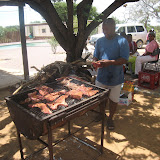
After returning to St. Lucia, we slept in our cars for a few hours before beginning the drive back. We picked up lots of groceries and cooked a huge New Years Eve feast. We made voers (sausage) and steak on the grill (or braii) as well as corn (mealie). Others made tortillas, guacamole, salsa, noodles, vegetable stir fry, sticky rice, and butternut squash. It was quite delicious. I spent the night talking to some older volunteers and locals until midnight when we toasted the New Years and retired to our tents. As I got to my tent, I noticed the fireworks being set off at the local golf course.

The next day, some of us went on a day hike in another park a little south. We had hoped to see some San Rock Paintings but the main cave they are in was closed for the holiday. Instead we played on rocks and in a stream before heading back to the cars. As we got to the cars we saw a family of baboons. The male was busy showing off by climbing and peeing on cars. He did a little dance and rolled around on them too. It was pretty hilarious, since it wasn’t our cars.


The next day we started the drive home, going to Pretoria to drop off our cars. We went out for dinner and to a pub there and I came back early to get some sleep. There we met a girl from Wellesley on a Watson Fellowship to study anthropology around the world and a Norwegian teaching student, who had been a volunteer with a European organization 2 years ago. He was heading to Namibia the next day, so me and another volunteer, Phil, got a ride with him. Unfortunately we hit a pothole and got two flats. We waited in the bush for a few hours until the rental agency brought him a fresh car and we continued on our way. Since we couldn’t make it as far, I made some calls, and arranged lodging with a fellow volunteer, Arlean who graciously gave us dinner too. The next day we drove to my shopping town Kuruman and I caught the taxi back to my site. It was quite an adventure and it was lots of fun but it’s good to be home, despite the sweltering heat.

Sunday, December 16, 2007

Bridges of Accomplishment, Flooded Roads of Insight

The last two weeks have seen the start of my first project as a volunteer; my Tsoe Youth Lifestyle Challenge summer camp. It’s also marked a time of increased collaboration between me and my fellow volunteers as well as with some of the people I’ve begun working with in my village. It’s been a time of celebration of both new connections and old relationships.

Bridges made out of straw(s) ain’t that bad


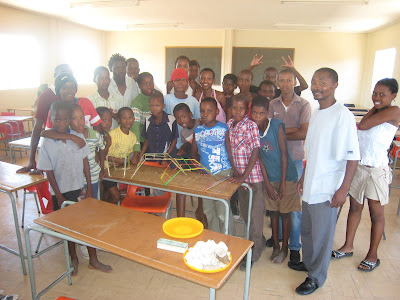
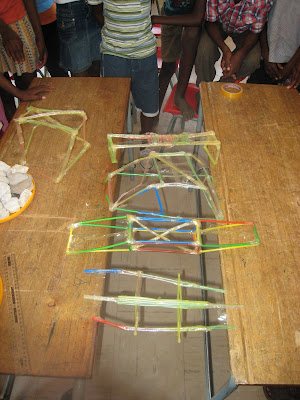
After Kelee helped me jumpstart my camp two weeks ago, I’ve kept a consistent crowd of roughly 30 kids, half teenagers, half younger. On Friday of the first week, we did our first Creative Problem Solving session. Inspired by years of Odyssey of the Mind and Destination Imagination, I figured I’d see what the kids here could do with limited resources, a well defined problem, and a little creativity. I started off with teams of kids each given 25 plastic drinking straws, a roll of scotch tape (called sole tape here) and 45 minutes to build a bridge to span 30 cm and hold a Frisbee which would be weighted with small rocks. Below are all the first designs. Apart from one team that went for a solid line, most teams focused solely on spanning the distance with little though to structural integrity. The best bridge held only 8 rocks and failed due to poor balance.


I then gave a brief lecture on physical principals of balance and support in structures followed by a discussion on personal support and balance. I had the kids fill out diagrams to figure out who supports them and who they support. I got a warm fuzzy when a couple of kids wrote down my name in their diagrams. Then, I let the kids try the bridge building again. All of them came up with much sturdier designs, using the tips I gave them in different ways. To my great surprise, none of them copied each other, which is one of the biggest problems at school. The winning design held an impressive 23 stones.


The Art of Frisbee

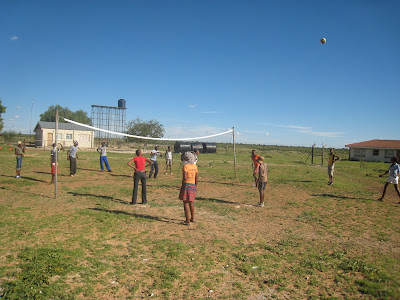
On Monday, we had sports day for the first time since kids showed up this Monday. We had 30 again and taught them how to play volleyball. Art came in from Perth to help out. Since we could only do about 12 kids at a time for volleyball, Art busted out the Frisbee and entertained the rest of the kids while Seatlasaone drilled them in volleyball.


People had said if I really wanted to get kids, I should play soccer since that’s what they always play. However, I reasoned the only reason they always play soccer is not just because they like it, but also because it’s all they know, so why not try something new? The kids loved both volleyball and Frisbee, staying almost an hour after the camp officially ended for the day to play. We also had a lesson on communications led by Seatlasaone. To start it off, I broke the kids into two groups and played telephone with each. The original message was “Ke tla nwa bojalwa fa koko e sena go tlhoga meno” which means ‘I will drink beer when chicken grow teeth’ like ‘…when pigs fly’. Here are the messages that came out the other end: “Ke a go nwa bojalwa fa ke sena go tlhapa meno” = I am to drink beer when I have begun to brush my teeth, and, “Ga o na boja lo ngwana gago one na jang” = (roughly?) You don’t have grass your baby your one has how?. Both illustrated the point greatly, that direct and clear communication are crucial.

Following my own advice

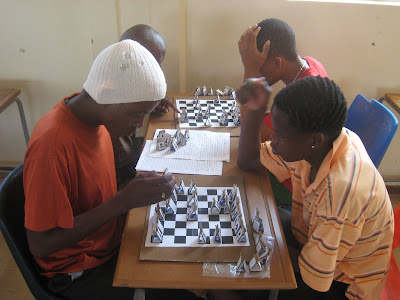
Just as Seatlasaone, Art, and I had taught the kids about communication on Monday, we forgot to practice it ourselves. I had been teaching the second chess lesson and struggling. New kids had showed up since last Wednesday so I was trying to catch them up while not boring the other kids. At the break, I asked Seatlasaone to help me by explaining points I made so that kids would hear two ways of explaining the same thing and hopefully understand it. At first he was like, it’s no point because they aren’t all going to get it to which Art and I went off on him for putting down the kids. Then he said that translating sentence for sentence would miss the point. Finally we got him to understand that what we wanted was for him to hear me explain a concept and then rephrase it in full. This he agreed too but the argument highlighted our own failures to communicate well. I think I assume that just because Seatlasaone speaks good English, he will understand what I say, but in many ways he’s like us in Setswana. We can put together words and understand what words people have said, but it’s easy to take everything literally which often misses the point. He was doing the same thing and it took us a while to figure it out. In the end, all was clear and we did our best together to try to teach some more chess. I tied the lesson in with basic study skills, taking notes, and doing homework. I then gave them all chess HW which over half of them actually did and turned in on Friday.


Clearing the path to reality

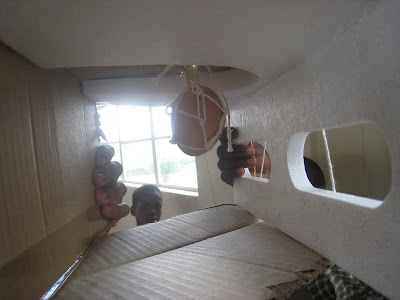
On Thursday, two other volunteers, John and Christina Campbell, joined us to help with the camp. On Friday we had our second Creative Problem Solving session. The challenge this week was an Egg Drop competition. Seatlasaone and I had accumulated a wealth of junk to give the kids to use to assemble a device to protect an egg from a two story drop onto pavement. We had 10 teams that came up with all kinds of designs. My favorite was a team where they used the string to weave a net to encase the egg and then suspended it in the center of a box.


Nine out of ten passed the drop test and the kids really got into it.


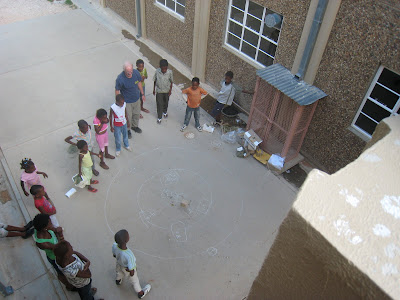
Tying into the protection and safety theme, we split the kids into older and younger groups for a health discussion. Seatlasaone, Art, and Christine worked with the younger kids to go over basic hygiene while John and I tackled AIDS with the older kids. First let me give some background. AIDS has devastated the villages. When adults go off to work in the cities and mines, they come back with AIDS, killing off their partners and leaving a sea of orphans. Although I’ve noticed before that my village has a young population in their mid to late twenties, there are very few people in their 30s and 40s compared to the number of old people and kids. But AIDS is slowly killin off the 20 somethings too. The girl that died of TB whose funeral I attended might have had AIDS and TB happened to be the Opportunistic Infection (OI) that finished her off. Two weekends ago, a 19 year old boy died of “illness”. My friend Fr. Tarimo said he buried three young people in the last two weeks, all related to AIDS. This Sunday when I went to mass at some small villages with Fr. Amandus, one congregation was made almost entirely of children. “Almost all orphans,” Fr. Amandus said. The kids get a lot of info on AIDS at school so most could shout out answers and some seemed just bored until I asked the question, “So is there AIDS here in Tsoe?” “No! well maybe, we don’t know” was the response I got. So I then wrote up 40% on the board and explained to them that their age range (15-35) was 40% HIV positive in the village according to our local clinic. This caused a visible shock. These kids hear so much about AIDS from class and from TV but why should they care about it if they don’t believe it is a part of their lives? The denial reaches its most sophisticated form among adults and worst of all politicians. Kids though are the real target. In a few years, large numbers of the skeptics will be dead anyways. Kids have not all made up their minds to shut out reality. Whether they believed me or not remains to be seen, but it was my first hack at the glacier of incompetence, ignorance, and insolence that surrounds AIDS in this country. It will definitely not be my last.

Peace Corps Partners

Though making connections with the people of the village can be difficult, I’ve increasingly found rewarding relationships and partners in the village and in the Peace Corps community. This week, Art, John, and Christine, provided good company and lots of help. Fr. Tarimo and Fr. Amandus are always cheerful and encouraging. After living here for 1 and 5 years, respectively, they also offer some insight on trying to work in the villages as a foreigner. Seatlasaone has been invaluable as a partner for the camp. If he were not around, I would have had to settle with a more activity oriented, less life lesson based program. My key principle, Mothelesi, has also been incredibly supportive of all my ideas and actually put money where his mouth is. In addition, the handful of high school guys that I’ve gotten to know have been willing to help me out with work, learning Setswana, and just been there to hang out. I’ve lucked out in many ways in terms of getting both a beautiful site and wonderful people to work with.

A letter from Omaha

In addition to the connections I’ve been making here in South Africa, I’ve also been making new ones back home in America. World Wise Schools is a program that matches up Peace Corps volunteers with classes back in the US. I want to give a shout out to the class I’ve been paired with, Mr. Kent Day’s 8th grade class at Beveridge Middle School in Omaha, NE. This past week, I received a mailing from them with lots of letters, some examples of American currency, and magazines about Nebraska which I’m excited to share with the school kids and teachers here. And since, some of you from the school may be reading this now, Thank You!

The “Road” to Phepane

“Now let us take this good road to the village.” As the Father said this, we turned off the main dirt road onto a road which had been worn down by tire tracks leaving two strips of sand cutting across the bush. We were joining the Father for mass at some of the small villages north of my village that he serves. As we bumped along the road and brushed against the bushes, we soon found ourselves in a deluge of rain. It lasted for the whole day, lightening up for a few brief respites. The first two villages were a bit smaller than Perth, the village Art is from, but still had shops, electricity, and general amenities. Then we went to the last village. The road became nothing more than sand and with the heavy rains, the path was often flooded. This is why SUVs and trucks exist. When we finally reached Phepane, we found a ghost of a village. Houses were spread out, sometimes over a kilometer apart. The tiny clinic had closed a few years back. Police refuse to come out this far. There are no khumbis so people have to walk 15-20 km to the next village if they want to go anywhere. Even the school has now closed down. Almost all the houses are mud huts. The only thing the village has is a tavern run out of someone’s house. They have a fridge that runs on propane to keep drinks cold. In some ways it was the kind of village I’d thought I’d be living in when I signed up for Peace Corps in Africa. On the other hand it was still a shock to realize how some people were just being left out of the South African future that had been promised with the end of Apartheid. The fact that two outsiders, let alone American’s, had come to visit their village prompted applause.

The past few weeks have shown me how a little effort, creativity, and initiative to reach out, is all it takes to bridge gaps of understanding, culture, and knowledge. It has also showed me that far vaster voids exist and spanning such chasms will be a great challenge.

More pictures can be seen in my web albums at picasaweb.google.com/aj.kumar

Wednesday, December 5, 2007

Getting down to business

So it’s been a while since my last post and there’s a lot to talk about. I’ve been pretty busy here which is why this has been so long in coming. Since there is so much to write, I don’t think I’ll be able to make any overarching theme like the last few posts so forgive me.

Thanksgiving!

So, for the first three months at site, we are on “Travel Restriction” which means we shouldn’t be leaving site for over a day unless it’s an emergency or your collaborating with another volunteer on a project. Traveling to town to shop for groceries of course is ok but since I’m 100 miles away from town, I only go in once a month. But, on Thanksgiving week, we were allowed to spend time at our neighboring volunteers’ sites to see their schools, brainstorm, and celebrate Thanksgiving with one of our families. So I got to travel to see Kelee and Art at the two sites closest to me and they came out to mine for Thanksgiving. It was great to see some different villages and realize how even in our rural setting there is so much diversity. And perhaps even better was seeing the things that Kelee and Art have been doing at schools. I was able to equip them with tools for their computers but Kelee helped show me how to teach English with songs in the Primary School and Art showed me how to make more effective use of school projectors using his experience as a middle school teacher in the states. Spending the week together was also great to get to know them all better. In addition to the experience of meeting so many people from another country, I think one of the other benefits of the Peace Corps is meeting other volunteers. We’re so diverse yet all very driven and can learn a lot from each other. We arrived at my site on the day before Thanksgiving. The weekend before, I had driven around with my host mom and some friends, in search of turkeys for sale (yes, though scarce, there are turkey’s in my village in South Africa, don’t ask me how…) I learned that turkeys die a lot. We went to four houses before finding one whose flock hadn’t been decimated by disease or eaten by dogs. We made a deal to collect the turkey and pay for it when I returned. When we came, we got the turkey for R150 (about $20-25) and drove it back home with its wings and feet tied. Then came the exciting part: I got to slaughter my first animal. The boys held it down and insisted I use my knife (my Leatherman) even though I’d wanted to use a hatchet. It’s surprisingly hard to cut through the neck and my local friends were laughing as I tried. Finally it was done and the turkey was dead. We then poured boiling water over the body and plucked it. Art was the master plucker and Kelee then helped clean by removing the quills that were stuck. Finally me and one of my local friends cut it open and removed all the fun stuff inside. We washed it off and stuck it in the fridge for the next day.

We spent the morning hanging out and got to cooking around noon. Art and I attempted to cook our first turkey. We had no foil so we basted it often and used a lot of margarine. We added salt and garlic too. For the stuffing, we mixed bread with onions, all the spare parts (heart, liver, kidneys, and gizzard), mango achaar, and a little cumin and coriander. It was all really good. Meanwhile, Kelee worked with my host aunt/sister (Mpho) to make bread and she made some really good custard and dumpling pudding. We made garlic mashed potatoes and a little vegetable stew as a side and of course a pot of bogobe. We invited the fathers from the mission and some of the local guys that helped get the turkey. We had a wonderful meal and I tried as best I could to explain the meaning of Thanksgiving in mixed English/seTswana. Afterward I had turkey sandwiches for days. My tummy was happier than it’s ever been here.

The link below goes to pics. WARNING: there is blood, and dead turkey.

Thanksgiving in the northern Northern Cape


A Welcome Reprieve

The last week of school, Tsoe P.S. took their grade 6 to Molopo Nature Reserve near Botswana for their farewell. And they invited me. We had a braii (BBQ) and I ate so much meat, my tummy smiled. We then piled into the trucks and drove out to see animals. We saw 3-4 types of deer (including springbok “tshepe” and something known as “tolo” – it’s in the Lion King though). We also saw zebras and wildebeest close up. And two giraffes crossed the road just in front of us.

Click on the pic below to link to this album with animals:
Molopo Nature Reserve/ Tsoe 6th grade farewell


Head first

After, Art and Kelee returned to their sites, I dove into preparing for my first real project at site. I’m doing a summer camp for the kids to teach sports, chess, and creativity competitions as a mechanism to have discussions on life skills and HIV. My high school has been super supportive in terms of money and resources and I also have benefited strongly from working with a local who runs an NGO called the Rural Youth Development Organization. I tried to get the word out during the last week at schools but attendance was poor and teachers were busy finishing paperwork. I posted signs in all the shops in town and had the priests and other churches I knew announce the program on Sundays. I made 10 chess sets from cardboard and paper by hand and then finally the first day came. I waited with my counterpart, Seatlasaone, starting at 1pm (when the camp was scheduled to start). We waited and waited, then waited some more. We spent a lot of time talking, trying to assess what we had done wrong and what we could do to fix it both for the future and for the current camp. Then finally at 3:30pm, one girl showed up. We talked for a little while and asked her to bring her friends all next time. We then left a little before 4pm and gave up for the day. Apparently 3 boys showed up a little after 4pm but the camp is scheduled to go from 1-5pm. The next day, Kelee arrived to help out. We met up with one of my friends, Thabiso, and walked the village, chatting up any kids we saw and spreading the news. Then we waited the next day. As soon as we arrived, before 1pm, there were two kids. By 1:30 we had 10. Once we got rolling, there were 22 who came. We focused the day on chess with a brief discussion on planning ahead and we started and ended the day with some sports. The kids seemed to enjoy it and I was overjoyed. Hopefully they’ll all come back on Friday and we’ll keep this momentum going. One of the best things too is that this is potentially a sustainable project. Seatlasaone will be here after I leave. Also, Thabiso, is already proving to be a great helper in explaining things and maybe someday will be able to help lead the camp. Life goes up and down as always but you’ve just gotta live the way they do out here: Ga go na molato (no worries).

Sunday, November 11, 2007

Desert Flowers


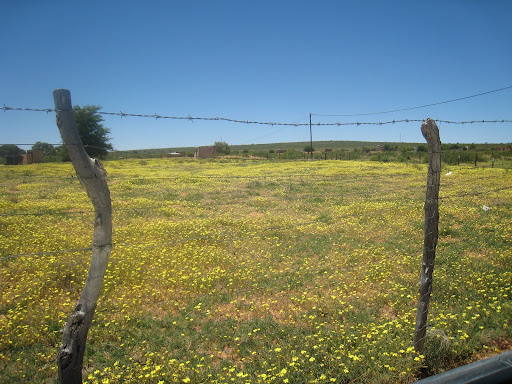
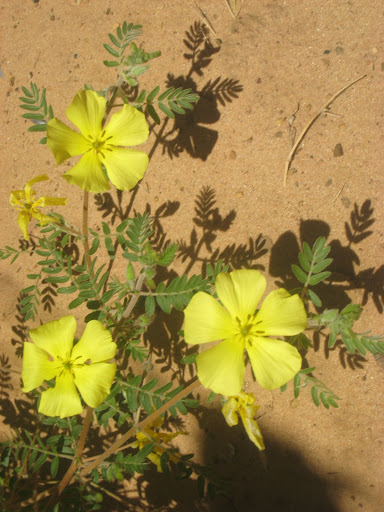
The rains come suddenly and with intensity here. The salt pan fills with water to make a shallow lake. The greening that follows comes as swiftly as the rains that caused it. The once brown landscape has a glow of life highlighted by the yellow flowers that spring to life. White butterflies swirl around me as I walk to school, but even now, the salt pan has already dried. Once the rains stop, the flowers and greens shall soon fade too. The fleeting presence of such beauty is a reminder of how fragile everything is out here. Ideas, dreams, health, and even life come and go with just as much intensity and brevity as the desert flowers.

Sickness and Health

On Wednesday, despite a mild headache, I decided to bike to Maphalwane P.S. in the middle of the day. This turned out to be a very bad idea. By the time I got home at around 2pm, I was burning up and my head was pounding. For the next two days, I medicated myself with Tylenol and oral rehydration while my host family checked in on my and brought me food. By Friday morning I was finally better though weak and fatigued. The rapidity with which the fever struck shocked me. I think the bike ride contributed to the intensity which made me fear I had heat stroke. I’ll be sure to avoid that kind of exertion in the summer heat again. It was a sobering experience to be sure. It makes the distance set in when I realized that I had to get up out of bed to check my temperature myself because my parents, Kana, and friends were thousands of miles away and my host family doesn’t understand medicine enough to know what exactly to do. However, my host family and local friends were very helpful. The high school boys I’ve befriended and my host sisters would check in on me every few hours, bringing me food or going on errands for me to get some Sprite or biscuits.

Dreams and a Disconnect

I spent part of the past week getting to know some of the people in the neighborhood I live in. I prepared an interview in Setswana and then tried to hold the whole conversation in Setswana and it worked out alright. Part of my questioning was meant to discover what kinds of project there is community interest in. Though I have not yet finished interviewing a large enough group to have a clear picture, it seems that people are very interested in starting income generating projects and a community garden. In one sense, this is wonderful to see interest here. However, it is also saddening because it underlines the lack of awareness within the community itself about what is already available. Through the efforts of the local NGO, Rural Youth Development Organization, there already is one income generating project, a honey making project. However, it is struggling because of lack of community participation. Also through RYDO, there is a garden already but again it is virtually unknown. There is a gap between what people want and what people know that causes a lot of waste. This is evident in the schools as well. Many grade 12 learners have approached me to ask how they should go about applying for bursaries (scholarships). I ask them if they have applied to college yet, and they say they haven’t because they don’t know if they’ll have money to afford college. What they don’t realize, is that they must already be accepted into college to apply for a bursary. Something I will have to work on is figuring out how to improve communication so that the dreams of the youth and the community don’t sit around only to shrivel up in the desert.

A Life Barely Lived

This past Tuesday, one of the girls in grade ten at the high school passed away after struggling with TB. Although AIDS is a huge problem in South Africa it gets a disproportionate amount of media attention in the West compared to TB which is just as real a killer here. The local clinic in my village estimates that roughly 30% of the population has TB. I’m not sure how accurate that is but it’s probably a decent ballpark figure. This Saturday, I joined a group of my teachers to go to the funeral at 5:30am in the morning. The funeral took place in Mokhubung, which is one of the villages of Tsoe about 8 km south of the school. We arrived at the house of the parents at 6am. The traditional funeral tent was up in front of the house and inside, a group of six women stood surrounding the casket, lit candles in hand. An all night vigil is done before the burial. After some time, other women go to take the place of those around the casket. By now, a large crowd has already gathered and is seated around the women. The crowd has spilled out of the tent and we stand in the back row until more chairs are brought. Prayers are said and hymns are sung. A few people make speeches but I only understand a little. After an hour, the crowd parts and the casket is moved into the back of a pick-up. Then the crowd processes down to the cemetery. Mokhubung is in the hills around the salt flats and as we process down, I am struck by the beauty of the scene sweeping my eyes out over the procession along the red brown road, over the green hills, across the white salt pan and finally resting on the wide blue sky. Finally, the procession arrives at the small plot. There are only 3 other graves on the small flat piece of earth. We gather round and the casket is placed. Prayers are said and holy water is used to bless the ground and casket. As they begin to lower it into the ground, several women, and notably one young man walk off a short distance and begin to cry. The grief is palpable as others move off to console those that have left. Once lowered, the men all line up and we take turns shoveling earth until the grave has been filled. Then more hymns are sung and prayers said before two of the oldest men in the gathering say some words, thanking the guests for coming and adding some light words to bring some cheer. We then walk back up to the home and wash our hands in the communal basin (a sign that our hands are clean and played no role in the death of the departed). Then we eat the traditional funeral fare. There is a choice of samp or rice to eat with a tomato based sauce, shredded beef (tshotle?), cabbage, and a cup of juice. After eating, people slowly begin to disperse and get back to their daily life. Though this is the first funeral I’ve attended at my site, there seems to be one almost every weekend even in my small village. When I’ve talked to teachers and other adults about their weekly schedule, many have said Friday’s are for helping with funeral preparations and Saturdays for helping with the funeral.


After I returned home, my host mother was gone to another funeral. The next day my host grandmother is away at another funeral. The constant procession of death reminds me how much I have to be thankful for and how little there is that can be taken for granted. The beauty of the village and its warm people is set against the despair of disease, alcoholism, and apathy. The sea of yellow flowers cannot hide the summer sun and the withering heat that it brings. Yet, the flowers do not seem to mind, springing from the sandy ground and living boldly if only for a month or too, spreading their petals open, almost defiantly, to the burning sun. So I must get to work, taking the fragile ideas and projects that exist in the minds of me and my counterparts, and expose them to the burning realities of South African rural life. Maybe, just maybe, one or two will actually take root.


Sunday, October 28, 2007

Changing Light bulbs

Every once in a while, good things happen unexpectedly: A potential project springs to life, a teacher takes my advice, students show they are capable of more than has been expected of them, or a baby starts to walk. Things like these give me hope that I’ll have some success here in making a positive impact. They brighten up my day and help me flush my system of frustrations with language, distance from loved ones, and cultural misunderstandings. They are the light bulbs that go off in my head and those of my counterparts that keep us going after one idea fails or comes to a standstill. I’ve found that often all that’s needed is a little know-how, a Leatherman, and a little luck. I like to think of all the opportunities that have arisen as just part of my birthday presents because that’s how my week began.

My South African Birthday

On Monday the 22nd, I turned 22. It started off as a pretty typical day, waking up by 6am, taking my bucket bath, and heading to school. At school, I continued shadowing/co-teaching with one of the natural science teachers. Along the way though, kids and teachers sang me the local birthday song which basically says, “Happy Birthday! Don’t get as big as an elephant!” I tutored some kids after school and then went to the post office to drop off some mail and pick up a package from Kana. On my way back, I met a man that started a local NGO called the Rural Youth Development Organization. They started the honey project in my town as a way to employ young people. The guy is very motivated and wants to do leadership camps/life skills retreats to help develop the youth in the area. It’s basically a perfect fit, so we’ve started meeting and brainstorming ideas. After we met, I went home and talked to Kana for almost an hour before heading over the Catholic mission house. The priests had a report due and wanted help making a cover so I did some simple stuff with Paint and they were amazed. They were very thankful and gave me some food before driving me home. At home I had dinner with the family and then celebrated back in my room with some Oreos and a glass of milk. I also got a call from my Peace Corps boss telling me the promised furniture was finally on its way. It arrived at the end of the week and now kamore ya me e tletse tota! (my room is completely full). Unfortunately this means my cardboard wardrobe is now awaiting my next creative streak but I do still have a brick bookshelf.


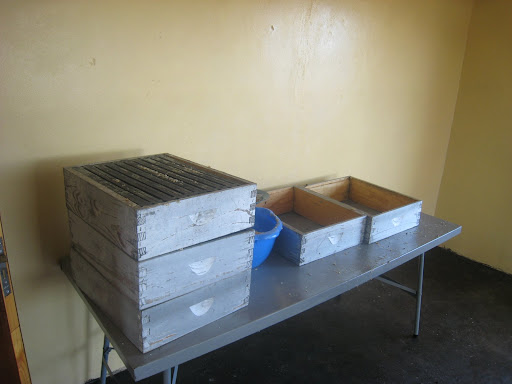
Bee farm hives
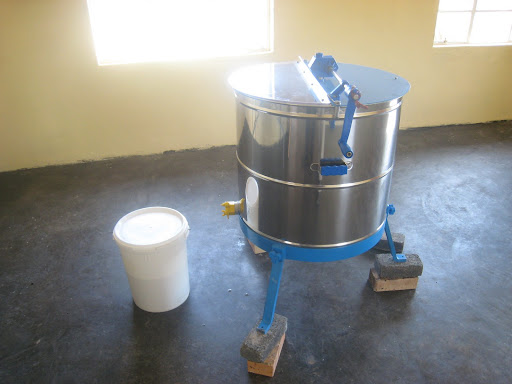
Honey exractor/ centrifuge type thing

Honey Comb

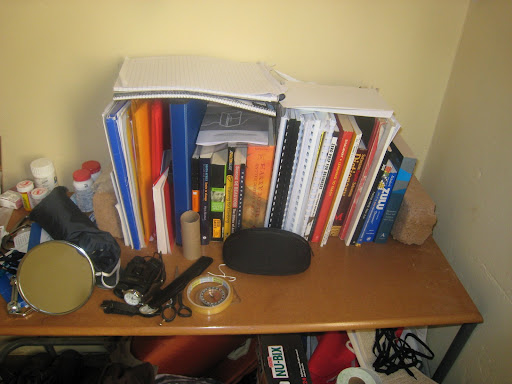
My bookshelf (more books to be added soon hopefully)

Attempts at teaching

This week, I also tried teaching some lessons. I had done some lessons last week on circuits to classes of roughly 30 kids. This week I had a combined 9th grade class of 84 kids. I taught a chemistry lesson. It made me appreciate my time in Exeter in classes of 14 students a lot more. Between the language barrier and lack of discipline, I struggled to get across basic concepts. I thought the kids understood because they answered questions I asked and in groups were able to solve some worksheet problems I gave them and some were able to explain the solution. Unfortunately, when we did an individual assessment in the form of a test, I found out they understood very little of what I said. On the flip side, I have had some good discussions with the teacher I’ve been working with and she’s starting to try some things like docking late work and discouraging copying. I also suggested to her to assign reading and have kids take their own notes rather than follow the current system where she spends an entire day writing notes on the board and having the kids copying them down without really saying anything. She was unsure if it would work, so we had an experimental class. I gave the class (grade 11, about 16 kids that day) a 15 minute spiel on how to take notes and did an example paragraph for them. Then I set them loose on the book for the rest of the hour. At the end of the class, I collected the notes and went over them. When I saw that about half the kids had taken good notes, with a couple taking outstanding notes, I felt vindicated. Now, we are planning to have the kids that understood explain to the rest of the class and use assigned reading. Potentially this could double the time that’s actually spent teaching.

My International Network

Strangely enough in my little village, I’ve begun making an international network. I’ve befriended the two priests that live at the mission from Tanzania. I spent Saturday evening cooking with them and swapping stories (had a chicken from their coup and greens from their garden). Apart from the religion aspect, we really have similar jobs in terms of development so it’s been good to get their perspective. I also met a guy from Ethiopia when my furniture arrived. He tried to sell me some pretty sheets but was way too expensive for my budget. For those of you that know Dawit, he was kind of a lankier, smaller version of Dawit (of course all Ethiopians look the same…). I also continue to meet happy Bangladeshi merchants that try to speak Bengali, then Urdu, then Hindi to me before going to English. I still have yet to break the ice with the Chinese couple that works in the shop down the road from the school though. Last but not least, I’ve found turkey in the village. So there is hope that I can get a turkey for Thanksgiving still…

Neighborliness

The three of us that live in the little house I am in are learning to all help each other out. Just as Orapeleng was there to help when I popped my tire, I was able to help out our third neighbor, Elsa today fixing a broken light socket in her apartment. I know that sounds trivial but to me it felt like a watershed. I’m starting to lose the “rock star American” effect and really be seen as a neighbor and community member. It makes sense that it would start with my closest neighbors but hopefully it will spread throughout my village in the coming years too. Although, I am afraid I will always be the “computer guy” and run around fixing computers and cleaning viruses as long as I’m here (5 viruses cleaned so far, 6 schools/organizations assisted/trained in basic computer stuff so far).

Baby steps

Perhaps the best moment of the week was when baby Kitso took his first steps. For the last month it’s been fun to watch his progress as he slowly learned to stand by himself. Now, he’s taking about 4-5 steps on his own before smiling, clapping, and falling down or deciding to crawl. He’s also trying to form words besides “mama.” Since I’ve never been around a baby at this stage with such continual contact, it’s been fun to see the whole development process. It’s also a good reminder for me of where I am. I feel like I’ve just found my feet and taken my first few tentative steps in my Peace Corps career.

Saturday, October 20, 2007

My Pimped out Peace Corps Pad

My Ride

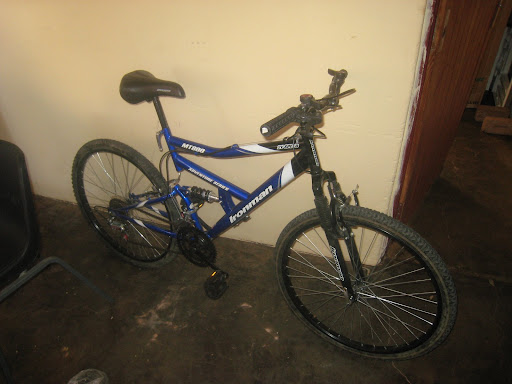
After much anticipation, my bike is finally here. It’s used but still pretty good after I adjusted the gears and brakes a bit. Biking to my farthest school is a bit of a challenge for me as I realized how out of shape I was. I have to bike about 6-7 kilos to the school, about 4 of which are uphill on a rocky/sandy road. Biking at Stanford with its general flatness and nice paved areas really spoiled me. On my third ride, coming back from my school on Monday, I had a bit of trouble. There are lots of cacti and broken glass bits all around so when riding off the main road, I pay lots of attention to whats immediately ahead of me. Just as I was about to get onto the main road though, I looked up to check for traffic and ran over a piece of glass which promptly popped my tire. After walking about halfway back, I was able to run into a friend with a pickup who took me and my bike the rest of the way home. My neighbor was trying to help me patch up the tube but tried pumping it up before the rubber sealant and patch had completely dried and the tube burst. Fortunately, he had a spare tube which I’m now using until I can go into town to pick up some of my own. I think I’ll need a stockpile as I’ll probably be changing tubes and fixing patches quite often here.

Chillin

This weekend also brought my fridge/freezer! It’s given me the ability to cook for myself now that I can store my own frozen chicken and leftovers. I’ve been using some peri peri seasoning to spice things up. It’s nice to have some non-bland food. I also can have cool water and milk now whenever I want which is wonderful. I think I may actually be eating healthier now than I did in the states. Just need to stock up on veggies next time I’m in town.

Improvising

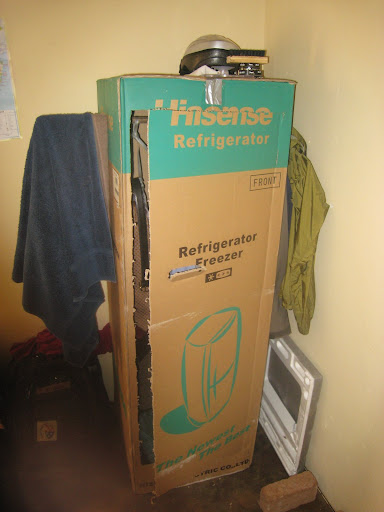
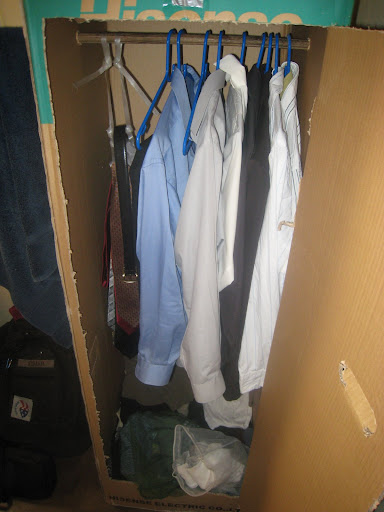
So my furniture from the gov has yet to arrive, so I used an old broomstick and my fridge box to make myself a wardrobe and I wove a plastic strip into a tie rack. I guess all those years of OM/DI are coming in handy. We have lots of bricks which I’m using as bookends (planning to make a full fledged bookshelf soon) and using as free weights. There is a handbook from the Peace Corps on how to make your own tools using just random pieces of trash and bolts. I haven’t gotten to try any of them out yet but think I may try to make a hammer sometime soon.

My kitchen

It’s not much, but it’s enough to keep me happy and allow me to cook whatever I want. No oven, but I can use the families oven if I really need one. Peanut butter is a life saver, and I’ve become a huge fan of the Black Cat brand here.

Other news

I’ve been working with a science teacher at the high school to get a feel for teaching here. Most classes are only 35 minutes long which makes it extremely difficult to do any quality teaching and assessment. Some of the teachers I’ve talked to agree with me and I’m hoping to try and see if we can do some longer classes that don’t necessarily meet every day so we can actually get more content taught. Some kids are really eager to learn though, which is refreshing. I’ve been doing some informal tutoring already and helped coach a kid for a class debate. It was on corporal punishment. He originally was going to support it but after I talked with him and asked him a few questions he changed his mind. In the debate though, unfortunately his team got a bit nervous and was not able to present their case well. I was adjudicating and had to give the win to the side supporting corporal punishment. It was tough but I was trying to stay objective. I’ve also been working with some of my teachers on typing technique and they have been very enthusiastic to learn.

Tuesday, October 9, 2007

Pastoral Peace Corps

My life as a goat herder

In the previous uploaded photos, I included several goat/sheep pics from the morokeng. Roughly half the days of the week, I go out with the family to help with the livestock. Starting as an awkward observer, I’ve slowly gotten included in various tasks. We generally go out to corral the animals for the night to protect them from jackals and to give them water. We also do make sure all the lambs and kids get fed and treat the animals for illness. One time, we took some black sticky stuff and started painting it on the goats’ backsides and hooves. I was confused until my host mom picked a tick of the dog to show me as an explanation. The next time we went, we fed the kids a liquid tapeworm treatment. Today, we drove around to find some sheep that had wandered to the edge of town near the auction lot. I helped corral them and put them in the truck. While waiting between loads, my sister, Mpho
explained the auction lot and some other basics about the many areas of the village.

Shearing myself

My hair was getting kinda shaggy but I was faced with a dilemma. Guys basically have two options of cuts in the village: buzzed or shaved completely. Also, razors are to be avoided when the HIV positive population from ages 15-40 is about 40%. So I took matters into my own hands and busted out a comb, mirror, and scissors. It’s not perfect but I think it’s pretty good for a first attempt at cutting my own hair. Pictures from that and the last few days can be found below:
Haircut and more village pics


Livestock vs. Education

I had an interesting discussion today about education with one of my principals. He was telling me that out here, the only real way to make a living is through livestock. He said for example if I had R10,000 and invested it in the bank, I’d only get R625 at the end of a year but if I used it to buy 20 sheep, and they all got pregnant then at the end of the year, I could sell 20 sheep and have made R10,000. After I prodded him a bit, he admitted that yes, there were risks of losing sheep and not all of them would have offspring, and it cost lots of time and money to look after them. Still he claimed that you’d make more. Granted that might be true, but it’s a poor example to compare it to a small bank investment compared to say, a teachers’ salary which is on average R100,000 a year. I don’t know anyone in the village with 200 sheep so I think it’s more a mindset issue than a real fiscal reason. But nonetheless, its difficult to motivate kids and even educators to commit to education when there is a strong belief that raising more sheep is the way to make money.

Small steps

Today was a really good day and helped really reaffirm why I’m here. I helped one of the science teachers set up for a chemistry demonstration and was able to share some knowledge and tips with her. She was appreciative of all suggestions and criticism and said she was happy I was here and that they would learn a lot from me in the next two years. I had a similar comment from one of the other teachers about computers as I cleaned up a virus infection from the principals computer and continued to work on my lesson plans for the computer literacy classes I’m hoping to do with the community. Then after school while I was at home, one of the students came over and asked me to help him understand an essay topic. The prompt was “Should corporal punishment be brought back into schools?” Corporal punishment has been banned since 1994, but is often practiced in rural schools in South Africa. Surprisingly, I have not seen any in my schools (at least so far…) which is rare considering many of my training class and current volunteers have had to deal with some sticky issues relating to corporal punishment in their schools. The student had written yes as his answer though. I told him that whichever answer he chose he’d have to back it up and answer the issues from the other side. I talked to him about alternative punishments, positive incentives, and some of the reasoning for banning it. I also had him give some reasons to talk about why he supported corporal punishment. He got thinking though and realized the depth of the issue. I also leant him my “Alternatives to Corporal Punishment” booklet from the Department of Education for the day. I’ll be interested to see what he chooses for his final answer tomorrow. I think he was slowly coming over to change his opinion and if he does, I think every small victory counts to changing a mindset in a society.

Other updates - I was able to get into town again on Saturday and actually purchase a bike and fridge. Unfortunately, my means of transporting them back to site didn’t work out so they are still in town waiting to be picked up…hopefully this weekend…?....please? On the bright side, I met up with and had lunch with two other PCVs in the area, Mandy and Tera. It was good to catch up and share stories and speak American English at a rapid clip again.