This is an expansion on an email that I've written to some people. I've been working on several things over the last week but I wanted to use this post to draw attention to some things other volunteers have done that I'm trying to help out with.
Education by the Mile
In my experiences working with the schools, the amount of structural changes to improve a school seem overwhelming. It may take a generation of more before things truly improve to a level where all kids can really get quality education in rural regions. Faced with this, I believe one of the biggest ways to make a difference now, in addition to the long haul work, is to provide opportunities for the kids that really show potential so they can become the leaders of the next generation. Fortunately, some previous South Africa PCVs (now RPCVs) set up a program to do just that. It's called the KLM (Kgwale le Mollo) Foundation and it selects students with high potential in rural areas to join a prestigious private school, paying for tuition, living expenses, and a small stipend. To help fund this project, the PCVs set up a partnership with the Long Tom Marathon in Mpumalanga. On March 29, about 80 PCVs along with others from SA will be gathering to take part in the race (an ultra marathon, a half marathon, and a half marathon walk). Each PCV has been raising money for KLM. I'm taking part in the half marathon walk and am very excited. I began raising money a few weeks ago and things are going very well. I would like to thank the people who have already made a contribution. I've been especially pleased to see that the majority of my donors so far are my Brothers of Phi Kappa Psi, showing true dedication to our call to service.
Please take a look at the KLM Foundations: www.klm-foundation.org/
If you think this is a worthy cause, please donate whatever you can ($5 or $10 adds up fast). Fill in my name (A.J. Kumar) in the section to say who you are contributing in support of. With your help, we can be the top fund raising group this year!
Alternatively...
Education by the Book
One of my peers working in the NGO sector, Rose Zulliger, has put together an amazing project.
In partnership with Books for Africa, she is going to select 30 schools to each receive 1,100 books. It's always surprising to me to realize how few books there are in the rural communities and how little reading goes on. There's a lot of time to sit around and do nothing so with a little incentive and introduction, I feel like reading could really take off in such an area. My high school has a beautiful library with very few books. We've applied to Rose's program and if we are selected, we hope to use the books to build momentum behind a literacy program. Whether we get the books or not though, I am hoping to look to more sources for books and really push reading.
The books are provided free by Books for Africa. Once in country, Rose and other PCVs will sort through them all, deliver them to schools, and work to ensure they are utilized. The one missing ingredient is getting the books from America to South Africa. To pay for shipping, each school selected will have to raise R1500 (about $200) to contribute to the cause (also making them more accountable for the books since they are investing in them). For the rest of the money, Rose has set up a Peace Corps Private Partnership Proposal. Basically, this is a way to get donations from home to cover the rest of the costs. The site is not up yet, but will hopefully be soon. When it is, I'll be posting it. So if you feel this is a project that really strikes a chord with you, or if you just want to donate to BOTH causes, stay tuned.
My Education
Lastly, I want to reflect a bit on my own education over the last few weeks which also relates to another PCVs project. A fellow Education Volunteer, Saadiqa, works with a leadership camp group. She has put togehter a girls empowerment camp for rural students called Power Girls. I've spent the last several weeks working with my high school to select girls and help them apply for the program. Along the way, I've realized a lot about how interconnected problems really are.
After a lot of prodding and explaining, I got two of my teachers to work with me to finish the nomination forms. Based on leadership criterions, we selected 5 girls from our school. However, when it came to academic achievement, none of them met the 60% average cut off. Worse, NONE of the girls in that grade met the cut off. We decided to proceed anyways. As we worked with the girls, I soon discovered one is actually older than me. She was born in 1984 but she is in grade 9. My teachers insisted that she is a leader and that she now takes classes seriously. The next big surprise came when one of the girls said her father did not want her to do the program. This is an all expense paid, leadership development program. I could not see why he'd object. Then we talked to him and found out, the girl has a toddler at home. He had tried to warn her not to fool around but she did anyway and had a baby. As a result, he has told her, as long as she has a child at home, she will never sleep outside of the house. So going away for a week is out of the question. We decided to let her complete the application just to get practice at writing a CV and essays but we cannot allow her to apply because of her fathers stance. After reading her essays, I realized that she probably understands most of all the girls how important it is to be serious, and take a leadership role in the community, and she has learned a lot from her experience. Unfortunately, it seems she'll never get the chance to be forgiven her mistakes.
Education is the key to breaking the cycle of poverty. As we PCVs work at the grass roots to help increase the quality of education, I want to thank all those who provide the financial support to allow us to do projects. For me, each of these three projects signifies a greater truth about the Peace Corps. Though scattered across a country in sometimes remote regions, we are part of joint venture, seeking to make a difference in this country. Working together, we can make great strides.
Sunday, March 16, 2008

Saturday, March 8, 2008
The Good, the Bad, and the Pragmatic
As I traveled home from a day of shopping in town, crammed in the back row of a khumbi with my groceries stacked on top of me and the elbows of my neighbors in my face, I began to ponder some of the things that I am passionate about; rock climbing, chess, experimental physics, and development work. Now, my dabbling in these four areas has been amateur at best to date, although I hope to further my abilities in all three. Yet, in the way that I’ve experienced them, I’ve found a recurring theme. The fields rely on not necessarily being “good” or “bad” but on being pragmatic. One often has to deal with non-ideal situations. Indeed, sometimes it is the complications and difficulty that draws one to them. But, solutions are possible to find, though the implementation may be beyond ones capabilities. In the end, one must use ingenuity, skill, and strength of will to find a path through the difficulties, often turning obstacles into new avenues for advance.
Sending It
I preface this by admitting I am no real rock jock. I haven’t climbed since graduating last June. However, I love climbing and feel a rush when I can “send” a route or boulder problem that has stumped me. Rock climbing is in essence an act of defiance. In our language we have sayings like “hitting a wall” and “between a rock and a hard place” that describe places you really would rather not be and that offer no real way forward. In rock climbing, you deliberately hit a wall, inching yourself up between rocks and hard places to overcome what at first seemed unassailable. The fact that a route is not easy is what makes it attractive. Being able to overcome a bad section is a real demonstration of skill. On the other hand, one cannot risk being foolhardy. There is no good and safe environment of climbing in which carelessness can be allowed. Sure, there are climbers who solo, but they do so risking their life. Rock climbing intelligently requires pragmatism. Redundant safety measures are a must as well as a cool head to judge each move and one’s own ability. Inspecting a route, one could say, well, for that part, I’d rock on from that hold, do a toe hook, and then mantle to that bomber hold. Once on the route, you must pay attention to every bit of your body and balance as you attempt to pull of what you saw in your head. Every piece of rock has potential for use. I’ve often been completely stuck on a route and then asked an experienced friend for advice. The answer generally involves viewing the environment in a different way, using what looks like an obstacle as a tool (“use that overhang to do a head jam?”). It does not help to think of a route as doable, or undoable, but rather, they are just routes and must be viewed rationally without judgment.
The Gambit
In chess, there are definitely good and bad moves, but often there are many moves that are possible, each with their own advantage and disadvantage. There are lots of strategies and memorized openings, but in the end, each game evolves uniquely. Letting emotions or psychology cloud your judgment often results in a loss. One must remain rational and pragmatic above all. A good example of this is the gambit. A gambit is a sequence of moves, usually an opening, in which a piece is deliberately lost. Sometimes a gambit is a set up to force an opponent into a sequence in which they will lose a piece of greater value than was sacrificed or into a check mate. Sometimes, it’s tossing a pawn away to change the tempo or gain a stronger position. Some might think losing material for position is questionable. It is often neither good nor bad, simply a pragmatic attempt to find a way forward through innumerable possibilities.
A Leatherman and Duct Tape
Many people have written about the elegance of physics, about beauty, simplicity, and symmetry. But any experimentalist knows that although the phenomenon that is to be studies may indeed be all these things, the process of study often is not. This is not to say experiments are always ugly. Many rely on magnificent feats of engineering and design. However, few things work as planned in life and in a physics experiment, when things don’t work, the willingness to get down and dirty to make things work is a must. I remember when I first joined the Manoharan Lab in Stanford as an undergraduate, seeing MOTA, the atomic force microscope that the group had spent years building and for which a separate room was added underground on its own foundation, I was struck by the incredible engineering and custom parts fitted together as well as the pieces of aluminum foil, wrapped around numerous parts, and the rucksacks full of lead shot sitting on the spring loaded table. As I progressed through my undergraduate career in physics I soon learned the necessity of such “think outside of the box” methods. As I worked on a team to measure the dependence of the resonant frequency of quartz oscillators in liquid helium versus temperature, I always had to grin when walking up to our bench. This set up, which was able to do measurements at temperatures of 1.47 K (-271.68⁰ C), relied in part on two by fours and duct tape. Professor Moler, who taught the lab class, commented that a true experimental physicist always has two things; a Leatherman and duct tape.
As I worked on my honors thesis I realized that there is not necessarily a “right way” to do things. You have to juggle the money and tools you have in innovative ways. I had created a device to manipulate magnetic micro- (and potentially nano-) spheres. After spending many months on simulations, designs, electronics, machining, electroplating, decarburizing, and what not, I needed to figure out a way to see and record the beads if I wanted to take any actual data. Now though the lab was equipped to see and manipulate atoms, it was not particularly suited for the micrometer range. The best we had was an optical microscope that could distinguish features down to about 6 microns. However, unlike biophysics labs I’d seen, we didn’t have a fancy camera attached to a scope. Time was short and negotiating to use a different lab’s equipment did not seem practical so I took a hint from MOTA. Using a Webcam and rubber bands, I was able to make a digital microscope good enough for the purposes of my experiment. Later, Professor Osheroff, who read my thesis to judge it for a department prize, commented on how it was nice to see some real blood and guts experimental physics. The method was not good; it was not bad; it just worked.
Change We Can Deliver*
This week I completed the final installment of my workshop series on Improving School Improvement to all of my schools. The workshop has probably been one of my most frustrating projects to date, but in the end, it seems like it may have been worth it. It did not go well. None of the 6 total sessions (3 primary school, 3 high school) started on time. All but one had to be rescheduled from its original time. No one ever did their homework. The final School Improvement Plans are not done. However, it did not go badly. The workshop was completed by all four of my schools. All schools demonstrated a greater understanding of their needs and ways to make changes. Feedback was largely positive. All schools have begun and some almost completed a well thought out School Improvement Plan. To get here though required an abundance of patience and pragmatism. I had to adjust expectations and material to meet the realities of my situation. I had to make use of knowledge of each schools strengths and weaknesses as an institution and as a staff. I had to calm myself down after experiencing great anger and frustration.
In many ways, I think all of Peace Corps is like this. We deal with non-ideal situations but have to see challenges not as problems but as opportunities. Like experimental physics, we have to juggle limited funds, resources, and time to find creative ways to help our communities find beauty in life. Like a gambit, some of us have chosen to not make a head-on attack against corporal punishment, sacrificing a value, in order to put us in a position that we can make change in a school without alienating the staff. Like rock climbing, when confronted with a wall, we chalk up our hands and push ourselves to new heights.
*This is in no way an attack on Senator Obama. In fact, I personally think he is the candidate that will deliver. These comments are my own and do not reflect those of the U.S. government, the Peace Corps, yadda yadda yadda…
A Glass of Water
There is a saying in the Peace Corps that goes like this. A pessimist says, “The glass is half empty.” An optimist says, “The glass as half full.” A Peace Corps Volunteer says, “Hey, I can take a bath in that!” Blind optimism leads to unrealistic expectations. Pessimism leads to missed opportunities. We must keep a level head, look at our environment, and find new and creative uses for everything.
Saturday, March 1, 2008
Vision and Mission
My previous post may have made it evident that I am in the midst of some soul searching, trying to pin point what it really is that I am doing here in South Africa. In my desire to try many things all at once, I’ve encountered a great deal of frustration as one thing after another gets in the way of my plans. An illustrative and ironic example is the current gridlock over computer instruction. A few weeks ago, my high school received forty brand new computers and a new server. They were received while I was away for training. The twenty old computers were removed from the room that just barely fit them and the forty new ones were crammed in so tight that you cannot lay the keyboards all out because they will be on top of one another. Now we are waiting for an inspection from the agency that has provided these computers and are told we cannot move them because that is the room the agency chose as their computer center room (7 years ago when they donated the first 20 computers). Even after the inspection, there is no physical way we can use all forty computers so the result is that 20-40 of the schools 60 computers will probably just collect more dust. I’ve started pushing, and will soon start shoving and elbowing, to use one of the three large empty halls as the new center for the 40 computers and return the old twenty to the old center. Teachers can then use the old computers for class prep and record keeping while the forty new ones can be used for classes and class research (all have Encarta installed on them). This is going to require convincing the donating agency to allow us to make a new computer center room, finding the money and labor to burglar proof and wire up one of the halls, and then move and setup the new computers again, return all the old computers to the old room. Then I can return to my original roadblocks of finding class time, finishing adapting and creating instruction material, dealing with constant electricity uncertainty, getting internet, and developing an Information and Computer Technology Policy for the school. But hey, I’ve got about 19 months left to get that done.
Faced with these frustrations (and I know my fellow volunteers face similar if not more daunting tasks at their sites), I feel a sense of kinship with those members of my schools staff that really care and want to provide quality education, but find themselves buried under piles of bureaucracy and pulled in many directions by the Department of Education, Teachers Unions, the village, and their own personal lives. Sometimes I think it pays to step back, take a deep breath, and answer the big picture questions again: Why are we here? What are we doing? Where are we going?
This past week, I worked with my schools in the second part of my workshop series on School Improvement. Our tasks were to re-evaluate the schools Vision and Mission Statements and then to use our previous analysis to come up with a prioritized school improvements list. There are many ways to define Vision and Mission but I focused mainly on the questions they answer. A Vision statement answers the questions: Where are we going? What is our ideal position in the future? A Mission statement is a bit less pie in the sky, answering the questions: Why are we here? What are we doing? Both should be succinct and clear and created with support from major stakeholders.
Here is a sampling of the fruits of my workshop and my own introspection.
Old Visions (verbatim…not my spelling/grammar errors)
Tsoe Primary School: To further the interest, well being and education of all learners.
- Upgrading of school premises
- Improve the financial status of the school
- Creating a conductive and safe learning environment for our learners
- To promote excellence in school
Ba-Ga-Lotlhare High School: To produce an Education Process which will yield a responsible, high quality, relevant and independent individuals, capable of participating fully in the society four years from 2005.
New Vision
Tsoe Primary School: To produce learners that are productive to the entire country.
Ba-Ga-Lotlhare High School: To develop learners into accountable South African citizens who will achieve excellence in global society through their initiative and creative thinking.
Old Mission
Tsoe Primary School: To commit ourselves to maintain high quality standard of education for our learners.
- To promote the culture of learning and teaching
- To promote and foster sound relationships among stakeholders
- To elect an effective and accountable governing body in our school
Ba-Ga-Lotlhare High School: To improve and develop skills, talents, guidance and capabilities of school stakeholders which will establish all democratic structures and also produce people who can deal with different challenges and situations inside and outside our country (R.S.A)
New Mission
Tsoe Primary School: To provide quality education by involving all stakeholders in order to produce learners who will be responsible and independent thinkers.
Ba-Ga-Lotlhare High School: To provide all learners with quality education, and to motivate and develop them in totality through the involvement of all stakeholders.
The difference
Besides the obvious changes in structure, both old and new may come off as nice idealistic statements. The biggest difference though is that the new statements were created by almost all the teachers and management together and so now I have something to hold up to them and say, “This is what we committed ourselves too and I am going to hold you to it.” And I hope that that will be at least marginally more productive than using something the teachers have never seen or heard before.
My personal goals
Vision: To have schools effectively and autonomously setting goals and monitoring and evaluating progress towards those goals, to lay the foundations for a culture of accountability and high expectations amongst both students and school staff, and to have youth leaders that foster and encourage constructive activities.
Mission: To work directly with school staff and students to empower them to realize their goals by providing them with ideas and advice, helping them secure resources, and training them with new skills to enhance their work, while at the same time keeping an open ear and eye to community needs so that opportunities for larger community development can be spotted and supported.
Last week, I found myself heaping my outrage on various groups outside my control: the computer donation company, the government, text book writers (who’s rewriting history now and incapable of doing science and math?). They were impossible challenges that made me feel powerless, useless. Thinking and reflecting on the big picture has helped me breathe out and realize that even though there is a lot outside of my control, there is still a lot I can do as long as I am positive and creative. Getting those things done while I’m here is my real challenge.
Sunday, February 24, 2008
What's my job again?
Teacher
This month has been Athletics month (read Track and Field). There was a big local meet at Art’s village, Perth and at first I was planning on going to help out because it seemed like all my schools were closing for the day even though only a fraction of students participate in the sports. However, Tsoe Primary proved an exception. The principal Mme Elesang was going to stay at school with a couple of teachers and hold down the fort. She felt that school must go on and even with few teachers, at least the kids could do reading and English practice. I was so happy to see a school making education a priority that I told her I’d come help out with classes for the day since most of the teachers were going with the kids to the sports event. I wasn’t sure where she’d stick me or what I’d be teaching so I unfortunately couldn’t really make a lesson plan. Instead I grabbed the Mad Minute books we received at IST and showed up to get instructions from the principal. When I showed up, I was set to watch, not really teach grade 6. The principal grabbed a stack of English short stories and had me sit in the class as one kid after another would come stand at the front of the room and read a page. Now, these pages weren’t in any particular order and I soon got the impression that this was an exercise they often did, and the kids with the best English would get up and read the one or two pages they knew well and sit down. I decided this was better than no school but just barely. So I tried to change things up. I had the kids pick one story to read and tried to get them to do popcorn reading. The popcorn reading worked but they still wanted to stand at the front of the class. After every page or two, I tried to ask questions about the story somehow trying to get kids to pay attention and actually get interested. Some kids really got it and were eager to answer, most however, stared blankly. Now, I was trying to teach mostly in Setswana with some English. The problem is, I find myself switching to English when something gets too complicated or beyond my Setswana vocabulary, which is far past where most of the kids’ English comprehension stops. Then the final straw was reached when one kid came up and I realized he didn’t have the same book as the other kids that had been reading. Soon I discovered that almost half the books that had been handed out were different. At this point, I aborted the reading plan my principal had set me on and decided to just fly by the seat of my pants.
First, I needed to do something about the lack of energy so thinking of Kelee’s singing for English practice, I got all the kids up and taught them to sing and do the Hokey Pokey. The kids loved it. They wanted to do it over and over but I put a stop to that. There is too much of a good thing. And there is definitely too much of the Hokey Pokey. With almost no prepared resources, I was unsure how else to teach literacy. I opted for a class game of hangman. It worked well, and I noticed the kids playing it during their break later. During break, I had time to actually prepare something. I decided to switch to numeracy and made copies of some Mad Minute game sheets. Back with the kids, I used the first game sheet as practice, to get the kids used to the concept. At first they were confused. They are so used to writing on their notebooks with rulers to underline everything that the concept of writing on a worksheet as fast as you could legibly write was a foreign concept. By the time we finished the first sheet though, they pretty much all understood. When I called time, most kids complied but some kept trying to fill out answers. After stern warnings, most complied, but one kid continued to ignore me. Even with me standing over his desk and the kids all telling him to stop, he kept going. In my experience here, two things that bother me about schools are the tolerance for cheating and late work. I ask the teachers why they don’t just make harsh penalties, like 0’s for copying and docking points for late work but they tell me, oh the kids won’t respond. Or the parents will be angry. Then they say the kids perform poorly on standardized tests because they are stupid. I’m still trying to convince them otherwise. When kids have expectations set in a safe and encouraging environment, they will at least try to meet them. If no expectations are set, why bother? I wanted to make it clear that my class was different than what kids were used too. When the kid continued to work after time was called, I took his paper and ripped it up. Maybe it was a little harsh, but I still think it was the necessary solution. When I gave the second game sheet, the kids all understood what to do, and though a few tried to get one or two more answers as I was collecting the sheets, no one refused to turn over their paper when I came around.
After that, I showed them the trick of multiplying by nine and using your hands. They went crazy for it but there was not really anywhere to go with it because I wasn’t about to explain to them the fact that it worked due to our using base 10… Instead, since the day was almost done, we went outside and set the chairs in a circle to do a few games of Around the World with math facts. The day ended and I went home exhausted. I don’t think I’ll offer to do that again unless I have time to plan my classes out. Still, it was a good experience and gave me some good ideas about things to talk with my teachers about.
After school coach
In addition to chess, I am hoping to start teaching basketball and also to help grade 12 with math and science. For the classes, I’m planning on going back to some fundamentals, like associative, commutative, and distributive properties, in math, and basics of vectors and forces in science.
Workshop Facilitator
I’ve begun my first workshop series at the school. It’s about School Improvement. Basically, we start with a session to do a basic school evaluation then have a session to do needs prioritizing and goal setting, and then use the last session to assign responsibilities and develop plans for improvement. I’m doing the workshop once for my high school and once for all my primary schools together. I’ve completed the first segment. It was so-so. Almost all my staffs came and we started just a little late. That is a big positive based on what I’ve heard from some other volunteers. I had a hard time engaging the teachers to participate. A large part was probably due to my own structuring of the workshop so I’ve changed the next two to be more group work oriented. I’m also going to try to use more Setswana in the workshop. I know my teachers all know English, but it’s so much easier to take in an argument and discussion when it’s in your mother tongue. So I need to step outside my comfort zone to reach theirs. We’ll see how it goes. The second segment is scheduled for Monday and Tuesday unless they get postponed again…
Tutor
I’ve informally started tutoring several kids in math and physics. They come up to me during breaks and after school, sometimes during class… and ask for help. I’m trying to be careful not to feed them answers and to force them to come up with solutions. It takes a lot more time and one or two kids has gotten frustrated and walked away when I say, “Tell me your thoughts first/ Mpollele ka go nagana ga gago pele.” Maybe the Setswana is wrong. But most of the kids stick through it and struggle to find the answer for themselves. And when it finally clicks and they think of an answer to one of my questions, it makes my day to see them light up and smile. Unfortunately, I still struggle to see how to get the teachers to realistically implement such a student centered approach when teaching a class of over 40 kids with only 35 minutes. At least for now, a handful of kids can be helped.
I’ve also been doing some informal tutoring for my teachers. My friend, Mr. Ntuli, in particular has been my most curious and excited student. He is a Maths/Maths Literacy teacher and we’ve been working on all sorts of topics. At first, I was a little taken aback by some of his questions, given his position as a teacher, until he explained, “KB, you mustn’t get mad at me. I’m supposed to teach these things in high school and no one ever taught me these in school.” Fittingly enough, the things he asks the most help with are things like data analysis and interpretation, tools of critical thinking that were considered too dangerous to teach anyone non-white under the previous regime. Ntuli is a bright guy though and he picks up what I teach him and applies it, and most importantly, always asks when he doesn’t understand. I’ve started working with him to do some Mad Minutes in his math classes to solidify basic facts and hope to eventually work more with him on teaching methods for math.
Local Computer Geek
This is the job I’ve been in the longest at site. Dealing with an increasingly large number of computers (my H.S. just received 40 brand spanking new computers) in a community that is computer illiterate and technologically fairly unconnected presents a lot of challenges. I’m now pretty effective at virus management and have an arsenal of tools to deal with an infected computer, including some fun Linux toys that I’m still mastering. I’ve also had to figure out ways to deal with super slow/old computers and how to get around their limitations. Kids like to come share music with me so and keep asking when I’ll start classes at the school (as soon as we negotiate the final connections of the computers). Speaking of those new computers, how’s this for bureaucratic hell: My H.S. has 20 old computers on a server in a burglar proofed room with lots of lines put in for electricity. That room is crowded with 20 computers. Now the group that brought in those computers and the new 40, has shoved ALL 40 new computers in the same room. You literally cannot lay out all the keyboards. The school has plans to convert another room to use the old 20 computers in. I said, back up, if we are going to wire up a new room, why not take a big hall that is unused, stick the 40 new computers comfortably in there and leave the old room for the 20 computers. My principal said, he’d love to but the group that donated the computers has designated this one room as their room and will not budge. So they’d rather have 40 computers sit unusable until they become outdated rather than put in a few wires and burglar bars. They are supposed to be coming in sometime in the next week to inspect the new computers. I’ve told my principal to let me know as soon as they arrive so we can talk some sense into them. Again, we’ll see…
I’m also a co-admin for the volunteer web forum, PCV Central. I’ve been trying to promote its use amongst volunteers and come up with ways to make it more useful. It’s provided a great way for me to keep in contact with a lot of volunteers in country and share information and tools.
Mentor
At our In-Service Training (IST), we elected members to our volunteer committees. There is the Volunteer Advisory Council, or VAC which deals with general issues, and is the volunteers voice to the administration. There is also the Diversity Committee, which deals mainly with training and helping volunteers understand and embrace their own diversity so as to become better representatives of America abroad and better support for each other. Then there is the Volunteer Support Network (VSN) that helps provide a trained listener for every volunteer to help us get through tough times and also help volunteers know what to expect and provide tools for dealing with stress. Now VSN and Diversity were combined when we had the election and then subsequently re-split. I got elected so now I’m on both. I’ve lobbied that both should still work largely together and thus have meetings on the same weekends. This way we can avoid redundancy in training and resources and also cut back on travel time for those of us that are on both committees.
To be honest, my primary interest was in Diversity Committee but I realized that my interest in Diversity stemmed from my desire to see us as a volunteer community use our understanding of diversity to better support each other. As such, I saw the merger as not a necessarily bad thing but just a lot of work for one group. Now though, we can spread the work load between two groups and can coordinate.
In addition to my new role to help as a mentor for volunteers, I’ve tried unsuccessfully to mentor some of my high school buddies. One of my buddies that I used to go to the morakeng to shepherd with, failed grade 10. He decided to drop out of school rather than re-enroll. One of his friends and I tried unsuccessfully to convince him to come back, saying I’d help him out with his subjects. He said he was too tired. He was supposed to come by this weekend to visit but hasn’t showed up. He is a good kid and even tried to study extra, using my Setswana/English books to study English last year. Unfortunately, he’s chosen the route of too many kids in the village.
Diversity facilitator
As part of the Diversity Committee, I’ve already gone into action, last weekend going to help out at SA 17’s training. SA 17 is the newest group of South Africa volunteers. I was part of a panel of volunteers in “The Fishbowl” where we talk about our background in the states and about how our background has influenced our service in country. I talked about being Indian and non-Christian, as well as giving a word of support to any trainees in a long distance relationship. We also had speakers talking about being married, feminist, agnostic, gay, and elderly. Overall, it went well. Hopefully we can continue to improve on it for coming groups.
Barber
On a more personal note, I’ve been perfecting my hair cutting skills. I’m hoping that by the time I get back, I won’t need to pay for a haircut ever again. I still have a ways to go to get quite that respectable by myself.
Writer
Last, but not least, I’m making an effort to get back into my writing (blog, emails, journal, and letters) to make sure to keep track and reflect on all these things. If you ever have any constructive criticism or comments on any of my blog posts, please leave a comment or shoot me an email. I’m trying to keep some of those creative fuzzy skills alive before I return to many years of straight physics.
It’s strange that with all these things, it seems like I should be busy all the time, yet I often find myself sitting staring at my schedule, struggling to fill in things to do for the day. I definitely need to get the ball rolling on projects in my schools and community more and hopefully will be able to do so in the next two weeks. In a way, writing it all out gives me a clearer picture of what I am doing and what I should be doing. Hopefully it’s given you a little insight into some things I’m trying to do.
Tuesday, January 8, 2008
Of mountains, mermaids, and more
In an effort to actually post this before it is too old, I’m going to forego the usual style and just expand on things I wrote in an email to some of you already. Apologies for the lack of creativity. I’ll try to get back on the ball soon.
Pictures on picasaweb.google.com/aj.kumar
The last few weeks were a whirlwind. Travel restriction ended and so we got our first chance to explore this country unhindered by job duties. I can already tell, there is not going to be enough time in the two years here to explore it all thoroughly (and still get some work done at site). I’m struck by the immense diversity and the sometimes disheartening disparities. Somehow both Phepane and Pretoria exist in the same country. Whites and to a lesser extent rich blacks, Indians, and coloured people (South African terminology), can live a privileged life in almost complete ignorance of what their country is outside of Joburg, Durban, and Cape Town. Poor rural blacks can go their whole life without knowing anything outside their village and without realizing there is anything outside of South Africa. But of course generalizations exist to be turned on their heads. Chatting with a few people in my training village of Motswedi, we debated the growing influence of China in Africa, mining rights, and how skills transfer was a more effective means of development than monetary aid. I had a wonderful experience chatting with an old English South African for two evenings on the mountain on topics ranging from how to tackle the challenges of AIDS and how to work within the village mentality to effect change in education. I met a Norwegian that had been a volunteer in SA a few years ago and had conversations that challenged many assumptions I held about education and development as well.
While Tera and I were closing out my camp in Tsoe, Stacy and Phil went down to Kimberly to rent a car and get a tent. Stacy had been kind of sick the day before but recovered just in time for Phil to get sick. The stayed at her place for the night and then made a trip to the clinic before coming to meet us out in Tsoe. We had planned on hiking out across the flat to camp out but Phil was in no shape to hike anywhere so we just had a lazy day and pitched the tent outside my house, where we were serenaded throughout the night by house music coming from some kid’s yard. The next day we headed out, dropped off Tera in Vryburg with the other girls to go straight to Pretoria and the rest of us proceeded to Motswedi, our training village.
Motswedi was absolutely gorgeous. When we had arrived for training, it was after a year long drought but now after heavy rains, the hills were blooming with everything; peaches, figs, mangoes, and amarula. Everyone was excited to see us. I chatted with my Ntate for a long time about my site, about what’s been happening in Motswedi, and about honey. The next day, I visited more people and Art came over for a little bit. While he was there, the son of Lucas Mangope came by and we had a chat about South Africa and development. We drew comparisons and contrasts to other African nations and discussed how China and India had succeeded in finding a fast track to development and foreign investment. Later, Phil came by and we played boggle with my visiting host sister who is in med school and discussed the medical system here. You go to med school for 7 years after finishing high school and they are going to try to compress it to 5 she said. A bit different to the way things go in the US. The next day, we said goodbye to our families again and packed into the car with Carmen joining us and sang Christmas carols on the way to Pretoria.
For Christmas, I was in Pretoria at a backpackers with about 15 other volunteers. We had a nice dinner provided as compliments from the owners. We talked a lot, catching up over the last three months. Then we rented our second car and began our real adventure in the mountains. We named the original red car Madi (blood) and the new white car Masi (milk). Our faithful drivers took us down long roads in these and got us all back safely, and for that, we thank them all greatly.
The Drakensbergs are an absolutely gorgeous range. The mountains are green and contrasts jagged spikes with rolling tops. It’s almost tropical hiking in the summer and I was covered in sweat in the first 10 minutes of hiking. We crossed over many streams and creeks too. We made camp at a place called Keith Bush Camp and met two groups of English South Africans. We also spotted several Berg Adders which made us antsy about stepping on more snakes. The next day, we went for the peak. It was extremely cloudy and the clouds descended on us as we ascended. Soon, we had to walk within 10 meters of each other so that we could see everyone. It also made it hard to gauge how steep and how much exposure there was to certain bits. But we carried on conservatively. The last big climb was up a boulder wash that reminded me of some ascents in California. It brought us out onto a beautiful mountain plateau at about 3000 meters high. There was a big river flowing over it. Apparently, Basotho herdsmen used to bring their cattle here to graze. We couldn’t see well so we picked out the nearest of several peaks and climbed it. We had meant to ascend Champagne Castle which is 3377 m but I think we ended up on top of a subpeak of about 3318 m. It was still quite beautiful and I think we may have accidentally walked into Lesotho since the peak straddles the border. We ate summit chocolate, took some pictures and headed back down to descend the gorge. As we started coming down the gorge, the clouds began to part. Rounding one corner, I saw a crag standing out with the valley in the background, and as the clouds cleared a bit more, I made out a stag standing on a ledge staring out at us from a distance. It was one of the most beautiful sites I’ve seen when hiking. I tried to take pictures but don’t think they capture the immensity of the scene unless they are blown up to be about 100 times bigger. As we descended, I think I injured my left knee and it gave me some trouble. I wrapped it the next day and got it checked out in Pretoria. It’s almost all better now. Back at the camp, I had some good conversations with an old man in one of the other groups. He has been a lifelong mountain climber and also a teacher in KwaZulu-Natal. He was also surprisingly understanding of black South Africans for a white guy.
The next day we descended completely and reunited with the rest of our party. With ten people total, the group could be unwieldy at times but it was nice to have a different crowd of people you could go to if you felt suffocated. We had a nice meal and then prepared for our adventure to St. Lucia the next day. We drove out over KwaZulu-Natal (KZN) which is a beautiful state. Villages dot the rolling hills which are freshened by the sea breeze rolling in from the Indian Ocean. The hills slowly give way to endless fields of sugar cane before finally succumbing to the sea. We went to Blythesdale Beach near Stanger and played in the water. I was shocked by the amount of Indians there. It seemed like half the beach was black and the other half brown. I’m sure the whites have a nice beach somewhere else… It was a little strange to not be noticeable. Even though my village is semi used to Indian guys because of the shops, I’m still a minority there and a topic of curiosity. The riptide was something fierce so we didn’t really swim. Stacy and I decided we should make a sand turtle and so we did while Phil dug a barrier to protect it from waves. Afterwards we wanted to bury someone and since no one volunteered, I ended up covered in sand and turned into a mermaid…. It seemed like a good idea at the time. After that we washed up and continued north along the coast to St. Lucia. St. Lucia was a bit of a change. A tourist haven where the only non-whites you saw were pretty much those serving the food, it had all the trappings of a coastal American tourist trap. We had dinner and coffee and then loaded up onto a monster jeep to go for our night safari to find sea turtles. Our guide was a graduate student from the Wits (Witswatersrand University – one of the best in the nation) who studies the turtles. He vaguely resembled Ralph Fiennes. It was a fun ride. On the way into the park, we saw many types of bok, zebra, and even a white rhino with her baby. It was huge and had a matching horn. We finally reached the beach and drove along for 20 km on the coast looking for turtles. We tried to keep ourselves awake in the back by playing tour guide since we couldn’t hear the real one. The sea mist rolled over us while the moon reflected moodily off the waves as.
Alas, we saw no turtles but only the tracks of one. They looked almost like tractor tracks. The most exciting part of the night was when our tourguide ran off into the night after a more commercial tourguide who was trying to lure turtles out of the water with a spotlight to please his crowd. As our more environmentally minded guide had explained, the turtles will be attracted to the lights but will often come out, get scared, and race back to the sea, dumping their eggs. He came back after exchanging some harsh words with the other guide and puffed on his cigarette, which he had been comically careful to keep while he had run off.
After returning to St. Lucia, we slept in our cars for a few hours before beginning the drive back. We picked up lots of groceries and cooked a huge New Years Eve feast. We made voers (sausage) and steak on the grill (or braii) as well as corn (mealie). Others made tortillas, guacamole, salsa, noodles, vegetable stir fry, sticky rice, and butternut squash. It was quite delicious. I spent the night talking to some older volunteers and locals until midnight when we toasted the New Years and retired to our tents. As I got to my tent, I noticed the fireworks being set off at the local golf course.
The next day, some of us went on a day hike in another park a little south. We had hoped to see some San Rock Paintings but the main cave they are in was closed for the holiday. Instead we played on rocks and in a stream before heading back to the cars. As we got to the cars we saw a family of baboons. The male was busy showing off by climbing and peeing on cars. He did a little dance and rolled around on them too. It was pretty hilarious, since it wasn’t our cars.
The next day we started the drive home, going to Pretoria to drop off our cars. We went out for dinner and to a pub there and I came back early to get some sleep. There we met a girl from Wellesley on a Watson Fellowship to study anthropology around the world and a Norwegian teaching student, who had been a volunteer with a European organization 2 years ago. He was heading to Namibia the next day, so me and another volunteer, Phil, got a ride with him. Unfortunately we hit a pothole and got two flats. We waited in the bush for a few hours until the rental agency brought him a fresh car and we continued on our way. Since we couldn’t make it as far, I made some calls, and arranged lodging with a fellow volunteer, Arlean who graciously gave us dinner too. The next day we drove to my shopping town Kuruman and I caught the taxi back to my site. It was quite an adventure and it was lots of fun but it’s good to be home, despite the sweltering heat.
Sunday, December 16, 2007
Bridges of Accomplishment, Flooded Roads of Insight
The last two weeks have seen the start of my first project as a volunteer; my Tsoe Youth Lifestyle Challenge summer camp. It’s also marked a time of increased collaboration between me and my fellow volunteers as well as with some of the people I’ve begun working with in my village. It’s been a time of celebration of both new connections and old relationships.
Bridges made out of straw(s) ain’t that bad

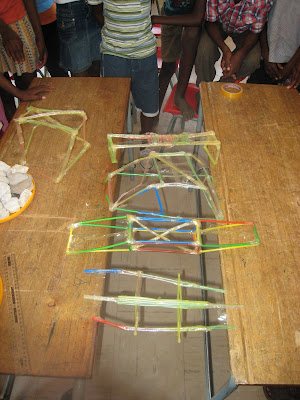
After Kelee helped me jumpstart my camp two weeks ago, I’ve kept a consistent crowd of roughly 30 kids, half teenagers, half younger. On Friday of the first week, we did our first Creative Problem Solving session. Inspired by years of Odyssey of the Mind and Destination Imagination, I figured I’d see what the kids here could do with limited resources, a well defined problem, and a little creativity. I started off with teams of kids each given 25 plastic drinking straws, a roll of scotch tape (called sole tape here) and 45 minutes to build a bridge to span 30 cm and hold a Frisbee which would be weighted with small rocks. Below are all the first designs. Apart from one team that went for a solid line, most teams focused solely on spanning the distance with little though to structural integrity. The best bridge held only 8 rocks and failed due to poor balance.
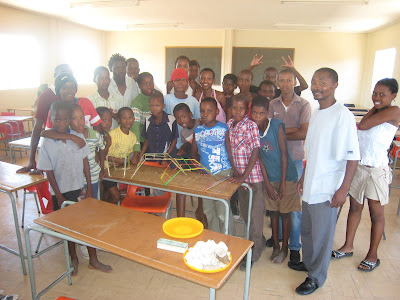
I then gave a brief lecture on physical principals of balance and support in structures followed by a discussion on personal support and balance. I had the kids fill out diagrams to figure out who supports them and who they support. I got a warm fuzzy when a couple of kids wrote down my name in their diagrams. Then, I let the kids try the bridge building again. All of them came up with much sturdier designs, using the tips I gave them in different ways. To my great surprise, none of them copied each other, which is one of the biggest problems at school. The winning design held an impressive 23 stones.

The Art of Frisbee
On Monday, we had sports day for the first time since kids showed up this Monday. We had 30 again and taught them how to play volleyball. Art came in from Perth to help out. Since we could only do about 12 kids at a time for volleyball, Art busted out the Frisbee and entertained the rest of the kids while Seatlasaone drilled them in volleyball.

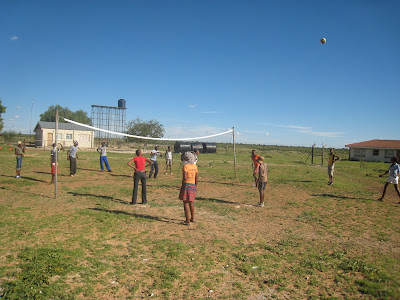
People had said if I really wanted to get kids, I should play soccer since that’s what they always play. However, I reasoned the only reason they always play soccer is not just because they like it, but also because it’s all they know, so why not try something new? The kids loved both volleyball and Frisbee, staying almost an hour after the camp officially ended for the day to play. We also had a lesson on communications led by Seatlasaone. To start it off, I broke the kids into two groups and played telephone with each. The original message was “Ke tla nwa bojalwa fa koko e sena go tlhoga meno” which means ‘I will drink beer when chicken grow teeth’ like ‘…when pigs fly’. Here are the messages that came out the other end: “Ke a go nwa bojalwa fa ke sena go tlhapa meno” = I am to drink beer when I have begun to brush my teeth, and, “Ga o na boja lo ngwana gago one na jang” = (roughly?) You don’t have grass your baby your one has how?. Both illustrated the point greatly, that direct and clear communication are crucial.
Following my own advice
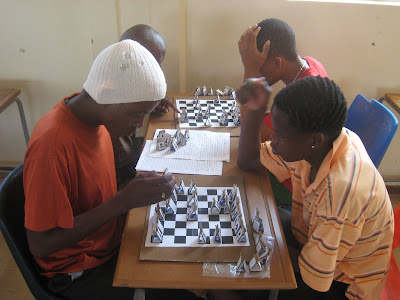
Just as Seatlasaone, Art, and I had taught the kids about communication on Monday, we forgot to practice it ourselves. I had been teaching the second chess lesson and struggling. New kids had showed up since last Wednesday so I was trying to catch them up while not boring the other kids. At the break, I asked Seatlasaone to help me by explaining points I made so that kids would hear two ways of explaining the same thing and hopefully understand it. At first he was like, it’s no point because they aren’t all going to get it to which Art and I went off on him for putting down the kids. Then he said that translating sentence for sentence would miss the point. Finally we got him to understand that what we wanted was for him to hear me explain a concept and then rephrase it in full. This he agreed too but the argument highlighted our own failures to communicate well. I think I assume that just because Seatlasaone speaks good English, he will understand what I say, but in many ways he’s like us in Setswana. We can put together words and understand what words people have said, but it’s easy to take everything literally which often misses the point. He was doing the same thing and it took us a while to figure it out. In the end, all was clear and we did our best together to try to teach some more chess. I tied the lesson in with basic study skills, taking notes, and doing homework. I then gave them all chess HW which over half of them actually did and turned in on Friday.
Clearing the path to reality
On Thursday, two other volunteers, John and Christina Campbell, joined us to help with the camp. On Friday we had our second Creative Problem Solving session. The challenge this week was an Egg Drop competition. Seatlasaone and I had accumulated a wealth of junk to give the kids to use to assemble a device to protect an egg from a two story drop onto pavement. We had 10 teams that came up with all kinds of designs. My favorite was a team where they used the string to weave a net to encase the egg and then suspended it in the center of a box.
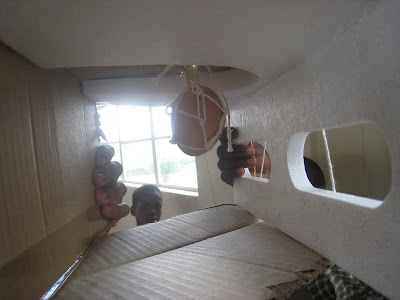
Nine out of ten passed the drop test and the kids really got into it.
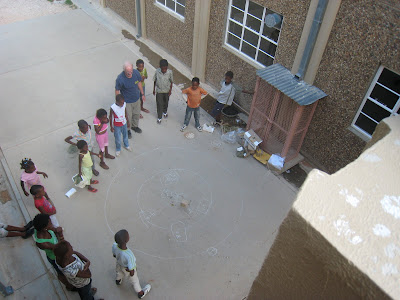

Tying into the protection and safety theme, we split the kids into older and younger groups for a health discussion. Seatlasaone, Art, and Christine worked with the younger kids to go over basic hygiene while John and I tackled AIDS with the older kids. First let me give some background. AIDS has devastated the villages. When adults go off to work in the cities and mines, they come back with AIDS, killing off their partners and leaving a sea of orphans. Although I’ve noticed before that my village has a young population in their mid to late twenties, there are very few people in their 30s and 40s compared to the number of old people and kids. But AIDS is slowly killin off the 20 somethings too. The girl that died of TB whose funeral I attended might have had AIDS and TB happened to be the Opportunistic Infection (OI) that finished her off. Two weekends ago, a 19 year old boy died of “illness”. My friend Fr. Tarimo said he buried three young people in the last two weeks, all related to AIDS. This Sunday when I went to mass at some small villages with Fr. Amandus, one congregation was made almost entirely of children. “Almost all orphans,” Fr. Amandus said. The kids get a lot of info on AIDS at school so most could shout out answers and some seemed just bored until I asked the question, “So is there AIDS here in Tsoe?” “No! well maybe, we don’t know” was the response I got. So I then wrote up 40% on the board and explained to them that their age range (15-35) was 40% HIV positive in the village according to our local clinic. This caused a visible shock. These kids hear so much about AIDS from class and from TV but why should they care about it if they don’t believe it is a part of their lives? The denial reaches its most sophisticated form among adults and worst of all politicians. Kids though are the real target. In a few years, large numbers of the skeptics will be dead anyways. Kids have not all made up their minds to shut out reality. Whether they believed me or not remains to be seen, but it was my first hack at the glacier of incompetence, ignorance, and insolence that surrounds AIDS in this country. It will definitely not be my last.
Peace Corps Partners
Though making connections with the people of the village can be difficult, I’ve increasingly found rewarding relationships and partners in the village and in the Peace Corps community. This week, Art, John, and Christine, provided good company and lots of help. Fr. Tarimo and Fr. Amandus are always cheerful and encouraging. After living here for 1 and 5 years, respectively, they also offer some insight on trying to work in the villages as a foreigner. Seatlasaone has been invaluable as a partner for the camp. If he were not around, I would have had to settle with a more activity oriented, less life lesson based program. My key principle, Mothelesi, has also been incredibly supportive of all my ideas and actually put money where his mouth is. In addition, the handful of high school guys that I’ve gotten to know have been willing to help me out with work, learning Setswana, and just been there to hang out. I’ve lucked out in many ways in terms of getting both a beautiful site and wonderful people to work with.
A letter from Omaha
In addition to the connections I’ve been making here in South Africa, I’ve also been making new ones back home in America. World Wise Schools is a program that matches up Peace Corps volunteers with classes back in the US. I want to give a shout out to the class I’ve been paired with, Mr. Kent Day’s 8th grade class at Beveridge Middle School in Omaha, NE. This past week, I received a mailing from them with lots of letters, some examples of American currency, and magazines about Nebraska which I’m excited to share with the school kids and teachers here. And since, some of you from the school may be reading this now, Thank You!
The “Road” to Phepane
“Now let us take this good road to the village.” As the Father said this, we turned off the main dirt road onto a road which had been worn down by tire tracks leaving two strips of sand cutting across the bush. We were joining the Father for mass at some of the small villages north of my village that he serves. As we bumped along the road and brushed against the bushes, we soon found ourselves in a deluge of rain. It lasted for the whole day, lightening up for a few brief respites. The first two villages were a bit smaller than Perth, the village Art is from, but still had shops, electricity, and general amenities. Then we went to the last village. The road became nothing more than sand and with the heavy rains, the path was often flooded. This is why SUVs and trucks exist. When we finally reached Phepane, we found a ghost of a village. Houses were spread out, sometimes over a kilometer apart. The tiny clinic had closed a few years back. Police refuse to come out this far. There are no khumbis so people have to walk 15-20 km to the next village if they want to go anywhere. Even the school has now closed down. Almost all the houses are mud huts. The only thing the village has is a tavern run out of someone’s house. They have a fridge that runs on propane to keep drinks cold. In some ways it was the kind of village I’d thought I’d be living in when I signed up for Peace Corps in Africa. On the other hand it was still a shock to realize how some people were just being left out of the South African future that had been promised with the end of Apartheid. The fact that two outsiders, let alone American’s, had come to visit their village prompted applause.
The past few weeks have shown me how a little effort, creativity, and initiative to reach out, is all it takes to bridge gaps of understanding, culture, and knowledge. It has also showed me that far vaster voids exist and spanning such chasms will be a great challenge.
More pictures can be seen in my web albums at picasaweb.google.com/aj.kumar
Bridges made out of straw(s) ain’t that bad

After Kelee helped me jumpstart my camp two weeks ago, I’ve kept a consistent crowd of roughly 30 kids, half teenagers, half younger. On Friday of the first week, we did our first Creative Problem Solving session. Inspired by years of Odyssey of the Mind and Destination Imagination, I figured I’d see what the kids here could do with limited resources, a well defined problem, and a little creativity. I started off with teams of kids each given 25 plastic drinking straws, a roll of scotch tape (called sole tape here) and 45 minutes to build a bridge to span 30 cm and hold a Frisbee which would be weighted with small rocks. Below are all the first designs. Apart from one team that went for a solid line, most teams focused solely on spanning the distance with little though to structural integrity. The best bridge held only 8 rocks and failed due to poor balance.
I then gave a brief lecture on physical principals of balance and support in structures followed by a discussion on personal support and balance. I had the kids fill out diagrams to figure out who supports them and who they support. I got a warm fuzzy when a couple of kids wrote down my name in their diagrams. Then, I let the kids try the bridge building again. All of them came up with much sturdier designs, using the tips I gave them in different ways. To my great surprise, none of them copied each other, which is one of the biggest problems at school. The winning design held an impressive 23 stones.

The Art of Frisbee
On Monday, we had sports day for the first time since kids showed up this Monday. We had 30 again and taught them how to play volleyball. Art came in from Perth to help out. Since we could only do about 12 kids at a time for volleyball, Art busted out the Frisbee and entertained the rest of the kids while Seatlasaone drilled them in volleyball.

People had said if I really wanted to get kids, I should play soccer since that’s what they always play. However, I reasoned the only reason they always play soccer is not just because they like it, but also because it’s all they know, so why not try something new? The kids loved both volleyball and Frisbee, staying almost an hour after the camp officially ended for the day to play. We also had a lesson on communications led by Seatlasaone. To start it off, I broke the kids into two groups and played telephone with each. The original message was “Ke tla nwa bojalwa fa koko e sena go tlhoga meno” which means ‘I will drink beer when chicken grow teeth’ like ‘…when pigs fly’. Here are the messages that came out the other end: “Ke a go nwa bojalwa fa ke sena go tlhapa meno” = I am to drink beer when I have begun to brush my teeth, and, “Ga o na boja lo ngwana gago one na jang” = (roughly?) You don’t have grass your baby your one has how?. Both illustrated the point greatly, that direct and clear communication are crucial.
Following my own advice
Just as Seatlasaone, Art, and I had taught the kids about communication on Monday, we forgot to practice it ourselves. I had been teaching the second chess lesson and struggling. New kids had showed up since last Wednesday so I was trying to catch them up while not boring the other kids. At the break, I asked Seatlasaone to help me by explaining points I made so that kids would hear two ways of explaining the same thing and hopefully understand it. At first he was like, it’s no point because they aren’t all going to get it to which Art and I went off on him for putting down the kids. Then he said that translating sentence for sentence would miss the point. Finally we got him to understand that what we wanted was for him to hear me explain a concept and then rephrase it in full. This he agreed too but the argument highlighted our own failures to communicate well. I think I assume that just because Seatlasaone speaks good English, he will understand what I say, but in many ways he’s like us in Setswana. We can put together words and understand what words people have said, but it’s easy to take everything literally which often misses the point. He was doing the same thing and it took us a while to figure it out. In the end, all was clear and we did our best together to try to teach some more chess. I tied the lesson in with basic study skills, taking notes, and doing homework. I then gave them all chess HW which over half of them actually did and turned in on Friday.
Clearing the path to reality
On Thursday, two other volunteers, John and Christina Campbell, joined us to help with the camp. On Friday we had our second Creative Problem Solving session. The challenge this week was an Egg Drop competition. Seatlasaone and I had accumulated a wealth of junk to give the kids to use to assemble a device to protect an egg from a two story drop onto pavement. We had 10 teams that came up with all kinds of designs. My favorite was a team where they used the string to weave a net to encase the egg and then suspended it in the center of a box.
Nine out of ten passed the drop test and the kids really got into it.

Tying into the protection and safety theme, we split the kids into older and younger groups for a health discussion. Seatlasaone, Art, and Christine worked with the younger kids to go over basic hygiene while John and I tackled AIDS with the older kids. First let me give some background. AIDS has devastated the villages. When adults go off to work in the cities and mines, they come back with AIDS, killing off their partners and leaving a sea of orphans. Although I’ve noticed before that my village has a young population in their mid to late twenties, there are very few people in their 30s and 40s compared to the number of old people and kids. But AIDS is slowly killin off the 20 somethings too. The girl that died of TB whose funeral I attended might have had AIDS and TB happened to be the Opportunistic Infection (OI) that finished her off. Two weekends ago, a 19 year old boy died of “illness”. My friend Fr. Tarimo said he buried three young people in the last two weeks, all related to AIDS. This Sunday when I went to mass at some small villages with Fr. Amandus, one congregation was made almost entirely of children. “Almost all orphans,” Fr. Amandus said. The kids get a lot of info on AIDS at school so most could shout out answers and some seemed just bored until I asked the question, “So is there AIDS here in Tsoe?” “No! well maybe, we don’t know” was the response I got. So I then wrote up 40% on the board and explained to them that their age range (15-35) was 40% HIV positive in the village according to our local clinic. This caused a visible shock. These kids hear so much about AIDS from class and from TV but why should they care about it if they don’t believe it is a part of their lives? The denial reaches its most sophisticated form among adults and worst of all politicians. Kids though are the real target. In a few years, large numbers of the skeptics will be dead anyways. Kids have not all made up their minds to shut out reality. Whether they believed me or not remains to be seen, but it was my first hack at the glacier of incompetence, ignorance, and insolence that surrounds AIDS in this country. It will definitely not be my last.
Peace Corps Partners
Though making connections with the people of the village can be difficult, I’ve increasingly found rewarding relationships and partners in the village and in the Peace Corps community. This week, Art, John, and Christine, provided good company and lots of help. Fr. Tarimo and Fr. Amandus are always cheerful and encouraging. After living here for 1 and 5 years, respectively, they also offer some insight on trying to work in the villages as a foreigner. Seatlasaone has been invaluable as a partner for the camp. If he were not around, I would have had to settle with a more activity oriented, less life lesson based program. My key principle, Mothelesi, has also been incredibly supportive of all my ideas and actually put money where his mouth is. In addition, the handful of high school guys that I’ve gotten to know have been willing to help me out with work, learning Setswana, and just been there to hang out. I’ve lucked out in many ways in terms of getting both a beautiful site and wonderful people to work with.
A letter from Omaha
In addition to the connections I’ve been making here in South Africa, I’ve also been making new ones back home in America. World Wise Schools is a program that matches up Peace Corps volunteers with classes back in the US. I want to give a shout out to the class I’ve been paired with, Mr. Kent Day’s 8th grade class at Beveridge Middle School in Omaha, NE. This past week, I received a mailing from them with lots of letters, some examples of American currency, and magazines about Nebraska which I’m excited to share with the school kids and teachers here. And since, some of you from the school may be reading this now, Thank You!
The “Road” to Phepane
“Now let us take this good road to the village.” As the Father said this, we turned off the main dirt road onto a road which had been worn down by tire tracks leaving two strips of sand cutting across the bush. We were joining the Father for mass at some of the small villages north of my village that he serves. As we bumped along the road and brushed against the bushes, we soon found ourselves in a deluge of rain. It lasted for the whole day, lightening up for a few brief respites. The first two villages were a bit smaller than Perth, the village Art is from, but still had shops, electricity, and general amenities. Then we went to the last village. The road became nothing more than sand and with the heavy rains, the path was often flooded. This is why SUVs and trucks exist. When we finally reached Phepane, we found a ghost of a village. Houses were spread out, sometimes over a kilometer apart. The tiny clinic had closed a few years back. Police refuse to come out this far. There are no khumbis so people have to walk 15-20 km to the next village if they want to go anywhere. Even the school has now closed down. Almost all the houses are mud huts. The only thing the village has is a tavern run out of someone’s house. They have a fridge that runs on propane to keep drinks cold. In some ways it was the kind of village I’d thought I’d be living in when I signed up for Peace Corps in Africa. On the other hand it was still a shock to realize how some people were just being left out of the South African future that had been promised with the end of Apartheid. The fact that two outsiders, let alone American’s, had come to visit their village prompted applause.
The past few weeks have shown me how a little effort, creativity, and initiative to reach out, is all it takes to bridge gaps of understanding, culture, and knowledge. It has also showed me that far vaster voids exist and spanning such chasms will be a great challenge.
More pictures can be seen in my web albums at picasaweb.google.com/aj.kumar
Wednesday, December 5, 2007
Getting down to business
So it’s been a while since my last post and there’s a lot to talk about. I’ve been pretty busy here which is why this has been so long in coming. Since there is so much to write, I don’t think I’ll be able to make any overarching theme like the last few posts so forgive me.
Thanksgiving!
So, for the first three months at site, we are on “Travel Restriction” which means we shouldn’t be leaving site for over a day unless it’s an emergency or your collaborating with another volunteer on a project. Traveling to town to shop for groceries of course is ok but since I’m 100 miles away from town, I only go in once a month. But, on Thanksgiving week, we were allowed to spend time at our neighboring volunteers’ sites to see their schools, brainstorm, and celebrate Thanksgiving with one of our families. So I got to travel to see Kelee and Art at the two sites closest to me and they came out to mine for Thanksgiving. It was great to see some different villages and realize how even in our rural setting there is so much diversity. And perhaps even better was seeing the things that Kelee and Art have been doing at schools. I was able to equip them with tools for their computers but Kelee helped show me how to teach English with songs in the Primary School and Art showed me how to make more effective use of school projectors using his experience as a middle school teacher in the states. Spending the week together was also great to get to know them all better. In addition to the experience of meeting so many people from another country, I think one of the other benefits of the Peace Corps is meeting other volunteers. We’re so diverse yet all very driven and can learn a lot from each other. We arrived at my site on the day before Thanksgiving. The weekend before, I had driven around with my host mom and some friends, in search of turkeys for sale (yes, though scarce, there are turkey’s in my village in South Africa, don’t ask me how…) I learned that turkeys die a lot. We went to four houses before finding one whose flock hadn’t been decimated by disease or eaten by dogs. We made a deal to collect the turkey and pay for it when I returned. When we came, we got the turkey for R150 (about $20-25) and drove it back home with its wings and feet tied. Then came the exciting part: I got to slaughter my first animal. The boys held it down and insisted I use my knife (my Leatherman) even though I’d wanted to use a hatchet. It’s surprisingly hard to cut through the neck and my local friends were laughing as I tried. Finally it was done and the turkey was dead. We then poured boiling water over the body and plucked it. Art was the master plucker and Kelee then helped clean by removing the quills that were stuck. Finally me and one of my local friends cut it open and removed all the fun stuff inside. We washed it off and stuck it in the fridge for the next day.
We spent the morning hanging out and got to cooking around noon. Art and I attempted to cook our first turkey. We had no foil so we basted it often and used a lot of margarine. We added salt and garlic too. For the stuffing, we mixed bread with onions, all the spare parts (heart, liver, kidneys, and gizzard), mango achaar, and a little cumin and coriander. It was all really good. Meanwhile, Kelee worked with my host aunt/sister (Mpho) to make bread and she made some really good custard and dumpling pudding. We made garlic mashed potatoes and a little vegetable stew as a side and of course a pot of bogobe. We invited the fathers from the mission and some of the local guys that helped get the turkey. We had a wonderful meal and I tried as best I could to explain the meaning of Thanksgiving in mixed English/seTswana. Afterward I had turkey sandwiches for days. My tummy was happier than it’s ever been here.
The link below goes to pics. WARNING: there is blood, and dead turkey.
A Welcome Reprieve
The last week of school, Tsoe P.S. took their grade 6 to Molopo Nature Reserve near Botswana for their farewell. And they invited me. We had a braii (BBQ) and I ate so much meat, my tummy smiled. We then piled into the trucks and drove out to see animals. We saw 3-4 types of deer (including springbok “tshepe” and something known as “tolo” – it’s in the Lion King though). We also saw zebras and wildebeest close up. And two giraffes crossed the road just in front of us.
Click on the pic below to link to this album with animals:
Head first
After, Art and Kelee returned to their sites, I dove into preparing for my first real project at site. I’m doing a summer camp for the kids to teach sports, chess, and creativity competitions as a mechanism to have discussions on life skills and HIV. My high school has been super supportive in terms of money and resources and I also have benefited strongly from working with a local who runs an NGO called the Rural Youth Development Organization. I tried to get the word out during the last week at schools but attendance was poor and teachers were busy finishing paperwork. I posted signs in all the shops in town and had the priests and other churches I knew announce the program on Sundays. I made 10 chess sets from cardboard and paper by hand and then finally the first day came. I waited with my counterpart, Seatlasaone, starting at 1pm (when the camp was scheduled to start). We waited and waited, then waited some more. We spent a lot of time talking, trying to assess what we had done wrong and what we could do to fix it both for the future and for the current camp. Then finally at 3:30pm, one girl showed up. We talked for a little while and asked her to bring her friends all next time. We then left a little before 4pm and gave up for the day. Apparently 3 boys showed up a little after 4pm but the camp is scheduled to go from 1-5pm. The next day, Kelee arrived to help out. We met up with one of my friends, Thabiso, and walked the village, chatting up any kids we saw and spreading the news. Then we waited the next day. As soon as we arrived, before 1pm, there were two kids. By 1:30 we had 10. Once we got rolling, there were 22 who came. We focused the day on chess with a brief discussion on planning ahead and we started and ended the day with some sports. The kids seemed to enjoy it and I was overjoyed. Hopefully they’ll all come back on Friday and we’ll keep this momentum going. One of the best things too is that this is potentially a sustainable project. Seatlasaone will be here after I leave. Also, Thabiso, is already proving to be a great helper in explaining things and maybe someday will be able to help lead the camp. Life goes up and down as always but you’ve just gotta live the way they do out here: Ga go na molato (no worries).
Thanksgiving!
So, for the first three months at site, we are on “Travel Restriction” which means we shouldn’t be leaving site for over a day unless it’s an emergency or your collaborating with another volunteer on a project. Traveling to town to shop for groceries of course is ok but since I’m 100 miles away from town, I only go in once a month. But, on Thanksgiving week, we were allowed to spend time at our neighboring volunteers’ sites to see their schools, brainstorm, and celebrate Thanksgiving with one of our families. So I got to travel to see Kelee and Art at the two sites closest to me and they came out to mine for Thanksgiving. It was great to see some different villages and realize how even in our rural setting there is so much diversity. And perhaps even better was seeing the things that Kelee and Art have been doing at schools. I was able to equip them with tools for their computers but Kelee helped show me how to teach English with songs in the Primary School and Art showed me how to make more effective use of school projectors using his experience as a middle school teacher in the states. Spending the week together was also great to get to know them all better. In addition to the experience of meeting so many people from another country, I think one of the other benefits of the Peace Corps is meeting other volunteers. We’re so diverse yet all very driven and can learn a lot from each other. We arrived at my site on the day before Thanksgiving. The weekend before, I had driven around with my host mom and some friends, in search of turkeys for sale (yes, though scarce, there are turkey’s in my village in South Africa, don’t ask me how…) I learned that turkeys die a lot. We went to four houses before finding one whose flock hadn’t been decimated by disease or eaten by dogs. We made a deal to collect the turkey and pay for it when I returned. When we came, we got the turkey for R150 (about $20-25) and drove it back home with its wings and feet tied. Then came the exciting part: I got to slaughter my first animal. The boys held it down and insisted I use my knife (my Leatherman) even though I’d wanted to use a hatchet. It’s surprisingly hard to cut through the neck and my local friends were laughing as I tried. Finally it was done and the turkey was dead. We then poured boiling water over the body and plucked it. Art was the master plucker and Kelee then helped clean by removing the quills that were stuck. Finally me and one of my local friends cut it open and removed all the fun stuff inside. We washed it off and stuck it in the fridge for the next day.
We spent the morning hanging out and got to cooking around noon. Art and I attempted to cook our first turkey. We had no foil so we basted it often and used a lot of margarine. We added salt and garlic too. For the stuffing, we mixed bread with onions, all the spare parts (heart, liver, kidneys, and gizzard), mango achaar, and a little cumin and coriander. It was all really good. Meanwhile, Kelee worked with my host aunt/sister (Mpho) to make bread and she made some really good custard and dumpling pudding. We made garlic mashed potatoes and a little vegetable stew as a side and of course a pot of bogobe. We invited the fathers from the mission and some of the local guys that helped get the turkey. We had a wonderful meal and I tried as best I could to explain the meaning of Thanksgiving in mixed English/seTswana. Afterward I had turkey sandwiches for days. My tummy was happier than it’s ever been here.
The link below goes to pics. WARNING: there is blood, and dead turkey.
 |
| Thanksgivi |
A Welcome Reprieve
The last week of school, Tsoe P.S. took their grade 6 to Molopo Nature Reserve near Botswana for their farewell. And they invited me. We had a braii (BBQ) and I ate so much meat, my tummy smiled. We then piled into the trucks and drove out to see animals. We saw 3-4 types of deer (including springbok “tshepe” and something known as “tolo” – it’s in the Lion King though). We also saw zebras and wildebeest close up. And two giraffes crossed the road just in front of us.
Click on the pic below to link to this album with animals:
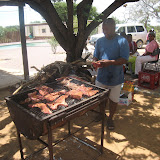 |
| Molopo Nature Reserve/ Tsoe 6th grade farewell |
Head first
After, Art and Kelee returned to their sites, I dove into preparing for my first real project at site. I’m doing a summer camp for the kids to teach sports, chess, and creativity competitions as a mechanism to have discussions on life skills and HIV. My high school has been super supportive in terms of money and resources and I also have benefited strongly from working with a local who runs an NGO called the Rural Youth Development Organization. I tried to get the word out during the last week at schools but attendance was poor and teachers were busy finishing paperwork. I posted signs in all the shops in town and had the priests and other churches I knew announce the program on Sundays. I made 10 chess sets from cardboard and paper by hand and then finally the first day came. I waited with my counterpart, Seatlasaone, starting at 1pm (when the camp was scheduled to start). We waited and waited, then waited some more. We spent a lot of time talking, trying to assess what we had done wrong and what we could do to fix it both for the future and for the current camp. Then finally at 3:30pm, one girl showed up. We talked for a little while and asked her to bring her friends all next time. We then left a little before 4pm and gave up for the day. Apparently 3 boys showed up a little after 4pm but the camp is scheduled to go from 1-5pm. The next day, Kelee arrived to help out. We met up with one of my friends, Thabiso, and walked the village, chatting up any kids we saw and spreading the news. Then we waited the next day. As soon as we arrived, before 1pm, there were two kids. By 1:30 we had 10. Once we got rolling, there were 22 who came. We focused the day on chess with a brief discussion on planning ahead and we started and ended the day with some sports. The kids seemed to enjoy it and I was overjoyed. Hopefully they’ll all come back on Friday and we’ll keep this momentum going. One of the best things too is that this is potentially a sustainable project. Seatlasaone will be here after I leave. Also, Thabiso, is already proving to be a great helper in explaining things and maybe someday will be able to help lead the camp. Life goes up and down as always but you’ve just gotta live the way they do out here: Ga go na molato (no worries).
Subscribe to:
Posts (Atom)