Pictures for these posts can be found in my albums at picasaweb.google.com/aj.kumar
http://picasaweb.google.com/aj.kumar/KilimanjaroAndTanzanianFun
http://picasaweb.google.com/aj.kumar/RockClimbing
http://picasaweb.google.com/aj.kumar/NickSVisit
http://picasaweb.google.com/aj.kumar/TsoeYouthLifeskillsCamp2009
DECEMBER
A little Elevation
In December, I travelled to Tanzania with my fellow PCVs and friends, Adam S. and Rebekah H. I had two goals, to climb Mt. Kilimanjaro and to see the home of my close friends, the Tanzanian priests of Tsoe. Both tasks ended up being more difficult than I’d imagined for various reasons and at various points, it seemed like neither might be accomplished. For a while it seemed like we might never even make it to Tanzania. In the end, I succeeded in one and came tantalizingly close to the second. Leading me to believe I will at some point return to Tanzania, to finish my business and explore more of that enchanting country. After Kilimanjaro, I was climbing again, but this time was rock climbing in South Africa with four friends, Ben and Susie BarrWilson, Ronda, and Craig. We had great food, conversations, and climbs for the week of Christmas before parting ways to return to our sites. Physically, mentally, and spiritually, the two trips ended up being just what I needed to rejuvenate myself for the new year ahead.
Schedule, what schedule?
After months of training and preparation, I was ready to go. Adam, Rebekah, and I met up in Pretoria after school closed for the holidays and we traveled down to the airport to board our flight. We wander the airport looking for the Air Tanzania counter and are told it won’t open for another hour or so. So we patiently stand around and wait for one person to finally come to the desk and tell us that all Air Tanzania flights have been cancelled and he can’t help us. Furious, we storm off to the Air Tanzania office. While haggling with the people there to get some service, I get a chance to check my email to see that they had emailed us late yesterday that we had been rebooked on Air Kenya on a flight that would leave in 20 minutes… I ran downstairs to the check in area again and went to the Air Kenya desk. They had been delayed but we might make it if we went now now, so I called Adam and Rebekah, who grabbed all our bags and booked it downstairs. We stood in line for about half an hour before finding out that the flight had been overbooked because of all the overflow from Air Tanzania so we would have to fly out tomorrow.
Thanks to Rebekah, we were able to land free meals and some hotel rooms. I called our climbing guides and rescheduled. The next day, we got to the airport very very early, only to find that our connecting flight might not leave until the following day. So I again called our guides and tried to work out the logistics so that they would pick us up from the airport and we’d go directly to the mountain. As we board our first flight we are handed our next boarding pass, leaving the same day. Confused we ask what is going on. Apparently so many people needed to get there that night, that Precision Air had added another night flight. So before we took off, I again called our guides to signal the last change of plans. We arrived in Moshi at around 10pm at night. As we drove to the hotel, the plains were illuminated by the moonlight. A white crown shined in the distance high above us; the snows of Kilimanjaro. I felt a smile creep over my face.
The Mountain
We spent 6 days on the mountain; entering through Machame Gate and leaving through Mweka Gate. We went with a great local travel guide group: AfriGalaxy Tours. Due to regulations, everyone must hire guides and porters. This is great for the local economy but makes you feel odd as a climber if you have any self-respect. Still, you take it for what it’s worth and I ended up really enjoying the company of our guides and had some really great conversations with our head guide, Alex.
Several groups were going up the route at the same time as us. There was one other American, Ryan, a marine, who quickly became friends with us. I had some great chats with him and we did a small day hike around Shire Plateau after one of our shorter days.
Each day, we’d wake up, have tea and breakfast, pack our bags, fill our water, and hit the road. After a few hours we’d stop for lunch somewhere and then continue to our camp. At the camp, there’d be hot tea, popcorn, and nuts waiting for us. We’d have a few hours to relax and then have dinner with a briefing for the next day. We’d pass the time chatting, playing Scrabble, and writing. Each day took us to new climate zones and breathtaking views. The hiking itself was not difficult at all. A little bit of rock scrambling but nothing strenuous. On the third day, we climbed higher to over 15,000 ft. Higher than I’d ever been. I finally started to feel the altitude in the form of a headache. I had been feeling good before which had me confident that the slow pace was working. On quick ascents in California, I’ve felt the headache start anywhere between 12-13,000 ft. After some sleep, my headache was gone though and I felt good about the rest of the ascent. The day before the summit attempt we climb to about 16,500 ft. My head was pounding and I took some Ibuprofen. After a few hours, the headache was gone. We rested up and went to sleep early, ready to begin the final ascent at midnight.
As we awoke, I felt fine. I could definitely feel some altitude but thought I could make it up the next 3,000 ft. We set off in the moonlight going very slow. One foot in front of the other. It was cold. Very cold. My camel back started to freeze up. I started to slow down. My head was not doing what I wanted it to do. Each step was becoming an ordeal of concentration. Rebekah and Adam went ahead with two guides and I went slower with Alex. After a little while longer, things became worse. The headache even started to come back and it hadn’t even been four hours since my last Ibuprofen. I talked to Alex and decided that it would be unwise to continue further. From previous experience, I knew that the next phases would be extreme disorientation, hallucination, and possibly worse. I was not going to put a fellow climber, Alex, in the position of having to take care of my bad choices. While I still had some clarity of mind, I needed to make the right choice we began to descend. Alex estimates we were at roughly 18,000 ft and would have taken about 3 more hours to summit at our pace. As we descended, my disorientation set in more strongly. At one point though, pride got the better of me. I stopped, turned around, and told Alex I could handle it and wanted to finish it. Fortunately, while I had still been cognizant, I had told him clearly that I needed to go down so he held me to that and convinced me that going back up was not the right decision. He was right as my earlier self had been right. The headache got worse. I stumbled a bit and at some points Alex had to hold my arm to steady me as we descended at a rapid pace. By 5am, we were back at camp. I collapsed into my tent, downed some water and got a few hours of sleep. At 7am I awoke feeling completely better. Physically, I was fit. Mentally, I was experienced. My body just didn’t have the disposition to handle high altitude at that pace. It’s a hard pill to swallow but that’s life. Perhaps thousands of climbers less experienced and less fit than me, have made it to the top of Kilimanjaro. I’ve had many lessons in humility over the last two years. I think I could have made it if I’d had a day or two to acclimate more.
I had tea with Alex and we chatted. He said I’d shown maturity and wisdom in calling my limits and thanked me for not pushing further. He’s had to carry down climbers that passed out in the past and did not enjoy that much. After tea, I walked around the high camp, snapped some photos, and reflected on the climb. By 9am, Adam and Rebekah rolled in, exhausted. They’d made it to the top and now were sore, tired, and hungry. They slept for a few hours. In the meantime, our friend Ryan stopped by to chat on his way down. At noon, we all had lunch and headed down to 10,000ft to Mweka camp. The next day we packed out and it was done.
The People
Once back at the hotel, we passed out. I got up around noon and called one of my priest friends, Fr. Amandus. Both were back in Tanzania at the time. We arranged to meet at the hotel and it was wonderful to greet them in their own country. We were scheduled to fly back with Fr. Amandus in two days but we soon found all was not well. Air Tanzania was grounded indefinitely. We made some calls to discover we no longer had flights home and we had not been rescheduled. Apparently other carriers were refusing to take continue to clean up Air Tanzania’s mess. My guess is that Air Tanz wasn’t honoring any of their payments so no one wanted to lose more money. Unfortunately, that meant that we all lost money. Fortunately, the Fr.s were there and could direct us around Moshi and interpret for us when needed. With their help we were able to make a plan. All flights out of Moshi were booked until Christmas. Since I needed to be in SA for my rock climbing trip on the 21st, I was eager for other solutions. We finally came up with a plan. We got bus tickets to Nairobi to leave on the 20th and we booked a flight out of Nairobi early on the 21st. I’d arrive and catch a shuttle bus out to the town where I’d be rock climbing. In the meantime, we had some time to kill but no money to spare. Again, the Fathers came to the rescue. They got us free accommodations and meals at a convent in Moshi, with a gorgeous view of the mountain. We also got invited to meet their whole extended family.
I had gotten a bit of a cold after coming off the mountain and was feeling slightly feverish. I spent the day debating what to do. Adam and Rebekah had opted out of traveling anymore and just wanted to rest at the convent. I had given my word to the priests that I’d see their homes though and I knew it would be a long time before I’d get such an opportunity again. So I decided to go with it. The next day, Fr. Amandus and his brother picked me up and we drove 80km to the villages around Rombo. I met many families, ate lots of food (various types of bananas, and various parts of chickens, goats, and cows). I picked up a few Swahili phrases as well as a few Chagga phrases (Kilimanjaro is Chagga for “Our mountain”). My final destination was the home of Fr. Tarimo. Fr. Tarimo had returned to South Africa but had insisted I honor him by staying at his home. So Fr. Amandus dropped me off, I ate yet again, and spent the night with a bunch of people I’d never met, who spoke almost no English, but who were so warm and friendly that none of that mattered. I took a bath by kerosene lamp with water they’d warmed over the fire for me. I entertained the family with my digital camera. Late at night, one of Fr. Tarimo’s sister’s arrived. She is a nurse in Moshi and speaks good English, so she was able to interpret for me the rest of the night. Finally, I got to bed and slept like a baby. The next day, Fr. Tarimo’s other sister showed me around their compound. The village is on the foot of Kilimanjaro and that whole area is one of the most beautiful places I’ve ever been. After tea and bread, we parted ways and I was picked up again by Fr. Amandus’ brother. We returned to Moshi and to the convent. After a night there, we headed out early in the morning on the bus headed to Nairobi. The bus ride itself was enough to convince me that I needed to return to Africa and explore East Africa more, as we passed serene savannah, Maasai herdsmen, and incredible mountains. We got to the airport by 2pm and our flight left the next morning at 7am. We couldn’t check in until 5am the next morning. So, we busted out our sleeping bags and slept in front of the check in counter. Traveling in Africa makes traveling anywhere seem easy. But soon enough, it was all over and we were back in SA. I got a move on to catch my shuttle and within a few hours, was in the quiet town of Waterval Boven.
During my time in Tanzania, I had reflected quite a bit about my life in South Africa. When we first arrived, I’d thought to myself: “This could have been my life.” Indeed, I’d really love to go out and spend significant time doing some work in a village like Rombo. However, while I was out there, even in the midst of all the beauty, I had a feeling deep inside of me that I was in the place I needed to be in South Africa. My service in SA has challenged me in so many ways unique to that country. I would have grown anywhere I’d been placed but I feel South Africa provides its own special challenges and opportunities that perhaps could not have been better prescribed for me. It made my arrival back in South Africa feel more like coming home.
The Rocks
Back in South Africa, I spent a the week over Christmas having a great time climbing in Waterval Boven. After two days of guided climbs, we shored up our skills, and I refreshed my lead climbing knowledge. On Chistmas we rented out our own gear and spent that day and the next two climbing on our own. We played in rivers, had an adventurous day hike, and a magical Christmas (thanks to Susie and Ronda). I remembered why I loved rock climbing so much. Not only is the sport such an incredible mix of mental and physical complexity, the people that do it are so interesting. I could write tons more but will leave it at this for now. By the end of our week, we were sore, but happy. I was able to climb a 5.9 but struggled on a 5.10a/b which means I’ve understandably lost ground since I was climbing in college. I hope once I’m stateside, I’ll get back at it more regularly and push past my previous limits. It was refreshing though and was a great way to follow the Kilimanjaro adventure.
JANUARY
(Stanford + Phi Psi + Peace Corps)^2 = ?
After the new year began, I received a visit from a good friend. Nick Chan was my HPAC at Stanford (kind of like an RA) and also a brother in my Fraternity, Phi Kappa Psi. After graduating, he did AmeriCorps, City Year, and then Peace Corps. I remember writing one of his rec letters for Peace Corps and had him return the favor when I was applying. He has been serving in Ecuador and has extended for a third year as a Peace Corps Volunteer Coordinator. When he came over, he told me, he wanted to see Peace Corps SA, so that’s what we did. After a few days in Pretoria and a day at the office, we headed to the taxi rank and began the long haul out to my site.
At my site, we ended up helping with the funeral arrangements for my host grandmother (more about that later). Nick got quite the cultural experience with all the people, prayers, and slaughtering going on. On our first day at my place, Nick and I ended up cooking lunch for all the visitors at the house.
We also made a trip out to some neighboring volunteers sites and saw one of my shopping towns. After that, we got to take a day with Fr. Tarimo to go on safari at the Molopo Nature Reserve, north of my site. We saw giraffes, wildebeest, gemsbok, and hartebeest. We also saw several tortoises and tried to keep one as a pet, but he got away… After the safari, we went out to a lodge near the Botswana border to get some drinks. Strangely, the only person running the lodge that day was a middle aged woman that only spoke French. “Wait, I know French!” was my first thought, but no, I don’t actually. Although I could understand her fairly well, when I opened my mouth, out came “FreTswana”. It was kind of embarrassing but in the end we communicated somehow and got some drinks.
Tsoe Youth Lifeskills Challenge 2009
While Nick was here, I took advantage of his Youth Development Skills, to put on another youth camp. We had sessions in the morning for young kids and in the afternoon for youth for three days. We used the library as the springboard as well as the sports grounds. We did reading, sports, chess, library skills and life skills. Overall, it went very well with over 70 kids total coming out. A nearby volunteer, Erin, also came out to help out. Strangely our afternoon sessions contained only teenage girls which would have made the whole HIV/AIDS sex talk a bit awkward had it been just me and Nick. Erin came to the rescue though and did a fantastic job spreading the message to the girls about how to take care of themselves.
Soon though, it was time to go back to the airport and bid Nick adieu. We took off early on Saturday and spent the night in Pretoria. The next day, I headed back to site as he headed out to the airport. It was great to share the my Peace Corps experience with someone that “gets it” if that makes any sense. I feel the two years we’ve spent have brought us closer together in some ways than we were even in college. I look forward to connecting with other RPCVs once I get back to the states because of that kind of understanding and comraderie.
Desert Flowers Again
When September arrived this past year, I looked out to the sky anxiously each day, anticipating the rains. When I first got to site, the rains quickly followed and they preceded a burst of color and life in the arid veld. September passed as dry as August and slightly warmer. October brought little relief as well. Finally, in November the rains arrived but not the deluges of 2007 that filled the salt pan. As a result, the land remained fairly parched, hungrily drinking in the little water the sky saw fit to spit upon it. By the end of December, the earth had finally had its fill and released the little yellow flowers I’d been waiting for. Some butterflies have appeared but not the vast clouds that appeared with the last blossoming.
Whereas the last rains had been bounteous and followed by an immodest burst of greenery and life, the rains of this summer have been niggardly and the plants and animals have had to scratch out what little life they could and stretch it out as long as possible. Strikingly, the one similarity between these two seasons of blossoming I’ve witnessed here is that they have been accompanied by death. Yet the difference in the lives preceding those deaths runs parallel to the markedly different manner of the two seasons unfolding.
Last year, I wrote about the death of a student. At 20 years old, she died of TB, which means she most probably had AIDS and TB was the opportunistic infection that ended her life. She had been born under Apartheid but grown up under the blossoming of democracy and relative plenty. The opportunities available to her were vastly greater than those afforded her grandmothers but her life was spent quickly, probably with exuberance, but quickly. As I wrote at the time, it was a life barely lived like the little butterflies that appear with the flowers only to disappear.
On January 7th, 2009, Selwana Edith Mabihi, known variously as Mma Thathi (Mother of Thathi), the Old Woman, Nkoko (Grandma), my South African Grandmother, passed away early in the morning. A few hours later, I received a phone call. I had been sitting in a taxi with my friend Nick, about to travel to my training village to show him different parts of SA and introduce him to other volunteers as we would wind back to my village. After the phone call, we got out of the taxi to Rustenburg and switched to the one to Vryburg. The taxi rank marshall’s at first were blustering and confused (it is kind of a cardinal sin to leave a taxi once you have chosen it). I just said “Mma wa me o tlhokafetse. Ke tshwanetsa go boela gae.” And they dropped all protest. If there is one thing the communities here understand, it’s death. About ten hours later, I arrived home, even beating my host mother who had been in Rustenburg at the time for the holidays. I’ve written a bit about the actual funeral preparations and ceremonies leading up to the funeral above. The real story here is Mma Thathi herself.
At over 70 years old when she passed away, Mma Thathi had lived through the darkest days of Apartheid. She had recounted to me about the hardships of working as a domestic servant, about the police driving through the village just to find people to beat, about how the past was a time of evil. She had lost many children to various causes and only had one surviving child, a daughter. Her husband too had passed away, leaving a matriarchal family amidst a still largely patriarchal society. And Mma Thathi was definitely the matriarch in a bounteous rather than gregarious way. She took me in as her own son and there was unique bond I felt with her that I will truly miss.
For my first few months in the village, I struggled with my host aunt Mpho, who speaks very fast and is a bit strong headed about doing things her way. One day, fed up, I confessed to Mma Thathi that I was just not getting through to Mpho. She nodded and with a slight chuckle said something to the effect of, “Eh, that Mpho, sometimes she just makes noise.” Mma Thathi did not speak much English but she knew some and was always kind and helpful in teaching me Setswana, gently correcting my mistakes and teaching me new things all the time. She taught me about the rains, about the culture, and about the family. When an old man came to the house and asked me to sell him some things she saved me from explaining that I wasn’t a shop keeper. “Ga se morekisa! Ke Kabelo wa rona, ngwanaaka.” “That’s no shopkeeper! That’s our Kabelo, my child.” Cultural boundaries did not bind us nor did any other boundaries. If I had a question that might be awkward to ask about the village or culture, I knew she’d give me a straight forward answer. Heck, once it got hot, we used to joke with each other about how we would just want to get naked.
Above all, she was an incredibly warm and positive person. She suffered from a chronic cough that would take her in fits, sometimes lasting several minutes. She claimed she had had it since she was a girl but I think it had something to do with the asbestos mines that used to be around here. She had severe arthritis that at times confined her to a foam mattress because it was too painful for her to move. With some help from my parents, we’d been able to find some meds that helped the arthritis so when I saw her in December and early January, she kept talking about how much better she felt and was moving around a lot more. Remarkably though, her face most often wore a smile. Not an artificial smile coaxed out to appear sociable, but a genuine smile, greeting me each day I came home, greeting the world around her.
FEBRUARY and now
Kicking into High Gear
-Crikey, there’s not much time left, I need to do everything now now…-
And now, I’m in over my head. I am at the point where I’m turning down opportunities and projects that first year volunteers would kill for simply because I do not have the time or capacity to do any more. I am teaching 12th grade mathematics, setting the library on its own feet, working on remedial mathematics and literacy intervention at a primary school, training staff members to use computers at all four of my schools, tying up all the work I’ve done on language, diversity, and for Peace Corps training, and trying to find time to stay healthy and happy. I've gotten to visit a few of my friends sites, play with monkeys, break up bloody fist fights, dialog with the provincial government, start setting up a children's corner in the library, spend two weeks training incoming volunteers on language, diversity, and volunteer life, put together a beginners Setswana manual, and begin reflecting on my overall service. It's been a wild few months.
I’m sorry these posts have been so long in coming. There is so much more that’s happened since then but I don’t have the time to chronicle them now. I will try to write more posts when I get a breather but can’t promise timely updates from now on. I may be resorting more to quick updates to my email list. If you are not on it, and would like to be, let me know. Otherwise, I hope all is well from wherever you are reading this. I am living and loving this experience. I’ve been humbled and crushed in more ways than I imagined but I’ve discovered so much more about what is important to me and who I really am. Now I want to give my all to my community and this country, to make at least a little ripple in this vast sea.
Friday, March 20, 2009

Tuesday, January 27, 2009
Testify
I am still working on a series of blog posts to catch up on many happenings over the past two months including Mt. Kilimanjaro, rock climbing, my friend’s visit here to South Africa, and many other events of significance. However, after a conversation today I decided I needed to give broader voice to some issues. So here’s some food for thought while I continue to work on the leviathan of a post that is to come.
Supply and Demand
As the schools reopened, I found myself faced with a difficult choice. The high school had lost 3 teachers to transfers. We would be bringing in one teacher from Zimbabwe that had come over last year part time and make him a full teacher. That left us two short and most notably short of a maths teacher. I knew there was no one of the rest of the staff qualified to teach upper level maths and so I threw my hat in the ring. I’m now the grade 12 maths teacher, teaching a morning class every day and doing two afterschool review/boot camp maths sessions to try and get the kids up to scratch. It was a tough choice to make as I increasingly have less time before the end of my service and my other projects like the library are still going to require substantial work before I can trust them to hold up with my absence. On the other hand, not trying to teach would almost certainly leave 17 kids to failing their final exam and vastly decreasing their chances of further education or employment. So for now, I’m doing the best I can to be a teacher but I’m was hoping to find a more sustainable solution to the lack as I can’t teach here indefinitely. So I was thinking, Zimbabwe has LOTS of maths teachers available. Why couldn’t we bring one over? Today I had a chat with our new teacher from Zimbabwe and this is what I learned. (For his own privacy and also out of safety concerns for his family, he shall be referred to as Mr. Nomugabe.)
Let’s back up
Before I get into detail, here is a quick summary for those of you not up to date on the current events in Zimbabwe. So here’s a quick, politically incorrect, summary. Long ago, Zimbabwe was part of Rhodesia and run/oppressed by white people. These white people set up lots of farms in this bountiful land, making it the breadbasket of Africa. In the 1980’s a revolutionary force led by Robert Mugabe overthrew the government and brought Zimbabwe to independence. He was the pride of all of Africa and Zimbabwe was a haven for anti-Apartheid activists. He set up a titular democracy that conveniently always brought him back to power. He also set up a vast secret police force that has been highly effective in rooting out any coup attempts over the past three decades. Blaming all Zimbabwe’s troubles on the Imperialists, Mugabe seized all the land of the white farmers and effectively forced them out. A combination of a lack of skills transfer and a workforce ravaged by AIDS, led to tremendous drops in agricultural productivity. As things went down, the government freaked out and imposed all sorts of terrible economic policies leading to some of the most outrageous hyperinflation the world has ever seen. Economic collapse has ruined the internal market, making petrol, bread, and basic goods nearly impossible to get (only really possible on the black market, bought in foreign currency). Bakeries are forced to stay open by the government and waste electricity as light glares off their empty shelves. The breadbasket of Africa can no longer feed itself. The treasury said that there were not enough items on the shelves to get an appropriate index to measure inflation. That was several months ago. Inflation is estimated at over 10,000,000%. On the news, images of people picking through the garbage for food zoom in on 10 Million ZIm Dollar notes being passed over by people in search for a bite. Children fill cups of water from puddles. Not surprisingly, cholera has broken out in epidemic proportions. Millions of Zimbabweans have fled across the border to South Africa. Of them, hundreds have been killed and thousands intimidated in xenophobic violence. I could go on…and I will for a little while.
20,000,000,000,000 Problems
Given the trouble up north, South Africa seems like the land of milk and honey to many Zimbabweans even despite the threats of violence. Mr. Nomugabe, has come out deep to the Kalahari Desert to teach where few South African teachers would ever choose to be. I asked him if he knew of any maths teachers in need of work. Lots, he replied. Many with 15+ years of working experience. Why don’t they come over? Well, they don’t have passports and to get one right now in Zimbabwe costs about 670 USD. Once you have the passport, you need a visa to enter South Africa, which has just been raised from about 200 USD to 600 USD. Then, you need a work permit, which is another 600 USD. Add in the bribes and other expenses you might have to pay, that’s about 2,000 USD just to get into South Africa to work. A US Dollar is roughly 10 trillion Zim Dollars (several zeroes may be added to that each day from now). So that’s 20 quadrillion Zim Dollars. Teachers are being paid the equivalent of 30 US CENTS a month. Yes. In a year, they pull in about 3.60 USD. That’s a trained professional. It costs more to get to the bank than all the money they have in the bank is worth, so most teachers are now working as hawkers on the street. So while students around southern Africa sit without qualified maths teachers, if any maths teachers at all, some of the best trained and most competent teachers in the region are selling bananas.
Do Something World
Somethings gotta give. I know some at home that will sit comfortably in their armchairs will paw-paw that if Zimbabweans don’t like Mugabe, they should get rid of him. They’ve tried by ballot and been killed for it. They’ve tried by force and been killed for it. Mugabe holds the guns and his sycophantic circle is lustily guarding what they have from anyone that would try to topple them from within. It doesn’t take much to hold a cholera-ridden, half starved, dirt poor people down. In this era of global connectivity, we as a world need to take action. As Botswana’s brave president and Odinga of Kenya have suggested, perhaps we need to use force to tear Mugabe’s strangle hold over the nation. Unfortunately the power broker in the region is South Africa and it has yet to take a strong stance. The U.S. and Europe tried to bring out a targeted set of sanctions to restrict the Mugabe regime and isolate them, weakening their power. It was blocked in the UN Security Council by South Africa, but more importantly by China and Russia who exercised their veto power. I know the developed world has a lot on its plate right now with their economic crises and all but whatever plight we are in is not as dire as what Zimbabwe is facing right now. As long as the oppressive Mugabe regime is in power, other governments need to reduce rather than increase the barriers of entry for Zimbabwean professionals so their skills can be used effectively and they can use the money they earn to feed their families hungry mouths at home. That’s not charity, that’s just good economical sense. South Africa faces a huge shortage of medical and educational professionals. In my training village I met a Zimbabwean man. A former medical technician, he is now scratching out a living by making mops. What a waste.
Mugabe is old but simply waiting for him to die is an irresponsible position to take. Besides supporting governments to stand up against the Mugabe regime, what can we do? Find respectable aid agencies working to try and bring relief to the many suffering Zimbabweans and do what you can to help. Unfortunately, the number is not so big as Mugabe has tried to stifle their activities. I admit that besides this, there is not a lot we can do but I think’s it’s necessary every once in a while to remind people of the silent tragedies that get dropped from the news once it gets too boring. I’m mostly just frustrated that South Africa is shooting itself in the foot by not making it easier for Zimbabweans to help themselves out by filling long vacant slots in the professional workforce.
Supply and Demand
As the schools reopened, I found myself faced with a difficult choice. The high school had lost 3 teachers to transfers. We would be bringing in one teacher from Zimbabwe that had come over last year part time and make him a full teacher. That left us two short and most notably short of a maths teacher. I knew there was no one of the rest of the staff qualified to teach upper level maths and so I threw my hat in the ring. I’m now the grade 12 maths teacher, teaching a morning class every day and doing two afterschool review/boot camp maths sessions to try and get the kids up to scratch. It was a tough choice to make as I increasingly have less time before the end of my service and my other projects like the library are still going to require substantial work before I can trust them to hold up with my absence. On the other hand, not trying to teach would almost certainly leave 17 kids to failing their final exam and vastly decreasing their chances of further education or employment. So for now, I’m doing the best I can to be a teacher but I’m was hoping to find a more sustainable solution to the lack as I can’t teach here indefinitely. So I was thinking, Zimbabwe has LOTS of maths teachers available. Why couldn’t we bring one over? Today I had a chat with our new teacher from Zimbabwe and this is what I learned. (For his own privacy and also out of safety concerns for his family, he shall be referred to as Mr. Nomugabe.)
Let’s back up
Before I get into detail, here is a quick summary for those of you not up to date on the current events in Zimbabwe. So here’s a quick, politically incorrect, summary. Long ago, Zimbabwe was part of Rhodesia and run/oppressed by white people. These white people set up lots of farms in this bountiful land, making it the breadbasket of Africa. In the 1980’s a revolutionary force led by Robert Mugabe overthrew the government and brought Zimbabwe to independence. He was the pride of all of Africa and Zimbabwe was a haven for anti-Apartheid activists. He set up a titular democracy that conveniently always brought him back to power. He also set up a vast secret police force that has been highly effective in rooting out any coup attempts over the past three decades. Blaming all Zimbabwe’s troubles on the Imperialists, Mugabe seized all the land of the white farmers and effectively forced them out. A combination of a lack of skills transfer and a workforce ravaged by AIDS, led to tremendous drops in agricultural productivity. As things went down, the government freaked out and imposed all sorts of terrible economic policies leading to some of the most outrageous hyperinflation the world has ever seen. Economic collapse has ruined the internal market, making petrol, bread, and basic goods nearly impossible to get (only really possible on the black market, bought in foreign currency). Bakeries are forced to stay open by the government and waste electricity as light glares off their empty shelves. The breadbasket of Africa can no longer feed itself. The treasury said that there were not enough items on the shelves to get an appropriate index to measure inflation. That was several months ago. Inflation is estimated at over 10,000,000%. On the news, images of people picking through the garbage for food zoom in on 10 Million ZIm Dollar notes being passed over by people in search for a bite. Children fill cups of water from puddles. Not surprisingly, cholera has broken out in epidemic proportions. Millions of Zimbabweans have fled across the border to South Africa. Of them, hundreds have been killed and thousands intimidated in xenophobic violence. I could go on…and I will for a little while.
20,000,000,000,000 Problems
Given the trouble up north, South Africa seems like the land of milk and honey to many Zimbabweans even despite the threats of violence. Mr. Nomugabe, has come out deep to the Kalahari Desert to teach where few South African teachers would ever choose to be. I asked him if he knew of any maths teachers in need of work. Lots, he replied. Many with 15+ years of working experience. Why don’t they come over? Well, they don’t have passports and to get one right now in Zimbabwe costs about 670 USD. Once you have the passport, you need a visa to enter South Africa, which has just been raised from about 200 USD to 600 USD. Then, you need a work permit, which is another 600 USD. Add in the bribes and other expenses you might have to pay, that’s about 2,000 USD just to get into South Africa to work. A US Dollar is roughly 10 trillion Zim Dollars (several zeroes may be added to that each day from now). So that’s 20 quadrillion Zim Dollars. Teachers are being paid the equivalent of 30 US CENTS a month. Yes. In a year, they pull in about 3.60 USD. That’s a trained professional. It costs more to get to the bank than all the money they have in the bank is worth, so most teachers are now working as hawkers on the street. So while students around southern Africa sit without qualified maths teachers, if any maths teachers at all, some of the best trained and most competent teachers in the region are selling bananas.
Do Something World
Somethings gotta give. I know some at home that will sit comfortably in their armchairs will paw-paw that if Zimbabweans don’t like Mugabe, they should get rid of him. They’ve tried by ballot and been killed for it. They’ve tried by force and been killed for it. Mugabe holds the guns and his sycophantic circle is lustily guarding what they have from anyone that would try to topple them from within. It doesn’t take much to hold a cholera-ridden, half starved, dirt poor people down. In this era of global connectivity, we as a world need to take action. As Botswana’s brave president and Odinga of Kenya have suggested, perhaps we need to use force to tear Mugabe’s strangle hold over the nation. Unfortunately the power broker in the region is South Africa and it has yet to take a strong stance. The U.S. and Europe tried to bring out a targeted set of sanctions to restrict the Mugabe regime and isolate them, weakening their power. It was blocked in the UN Security Council by South Africa, but more importantly by China and Russia who exercised their veto power. I know the developed world has a lot on its plate right now with their economic crises and all but whatever plight we are in is not as dire as what Zimbabwe is facing right now. As long as the oppressive Mugabe regime is in power, other governments need to reduce rather than increase the barriers of entry for Zimbabwean professionals so their skills can be used effectively and they can use the money they earn to feed their families hungry mouths at home. That’s not charity, that’s just good economical sense. South Africa faces a huge shortage of medical and educational professionals. In my training village I met a Zimbabwean man. A former medical technician, he is now scratching out a living by making mops. What a waste.
Mugabe is old but simply waiting for him to die is an irresponsible position to take. Besides supporting governments to stand up against the Mugabe regime, what can we do? Find respectable aid agencies working to try and bring relief to the many suffering Zimbabweans and do what you can to help. Unfortunately, the number is not so big as Mugabe has tried to stifle their activities. I admit that besides this, there is not a lot we can do but I think’s it’s necessary every once in a while to remind people of the silent tragedies that get dropped from the news once it gets too boring. I’m mostly just frustrated that South Africa is shooting itself in the foot by not making it easier for Zimbabweans to help themselves out by filling long vacant slots in the professional workforce.
Wednesday, December 31, 2008
A Tale of Three Thanksgivings
It’s New Year’s Eve and I’m writing about Thanksgiving… I guess I’m a little behind the time. I resolve to catch up though as best I can. November was a good month overall and it was capped off by three memorable Thanksgiving celebrations. Funny how spending time outside of the US has multiplied the American holidays I celebrate.
Part I – The Foreigners and the Natives
The weekend before Thanksgiving, I joined several friends to hang out with Kelee, her boyfriend Philip, and their South African friends out on a farm. The band of Americans was bringing Thanksgiving to the South Africans. Kelee had gone all out, even getting some costumes… Traveling out to the farm was an adventure in itself but the real fun was once we got there late Friday. We had a big braii with delicious lamb from Kelee and Philip’s farm. On Saturday morning, we began cooking. I was in charge of the turkeys (we had two young turkeys) and I made some stuffing from scratch.
After a few hours and lots of melted butter, I think the turkeys came out pretty well. We also had candied yams, mashed potatoes, green bean casserole, salad, iced tea, and apple, pumpkin, and pecan pies made from scratch.
Needless to say we were all very full after the big meal. After a little digestion though, it was time to continue the Thanksgiving tradition with some good old American football. We taught our South African friends the basic rules and then played a while using their rugby ball. Rugby balls aren’t meant to be thrown overhand. After a while, we switched things up and the South African’s taught us how to play touch rugby. It’s a ton of fun and moves a lot faster than football. The hardest things is remembering to stay behind the ball since it is a foul to pass the ball forward. After the game we relaxed a bit and watched real rugby on TV as the South African National Team (Springboks) crushed the English. Watching rugby with true fans allowed me to finally understand the intricacies of the game. Now I know the difference between a scrum and a ruck. The weekend was a blast and I really enjoyed getting to know Kelee’s friends. I returned back to site for the week and soon was preparing for my next feast.
Part II – Giving Thanks
As the quarter was drawing to a close, I wanted to organize a celebration for the library committee to thank them for all the hard work they’ve done. With all their help we are just a few steps away from opening to general circulation. The only big steps remaining are to create our full library policy, to finish with the student library cards, and to streamline the registration system. The library itself is set up and organized and the librarians seem to know the basics of how to get what they want.
Based on the exam schedule and teacher’s availability to help, the library party was set for November 27th. I thought it was fitting to be giving thanks to my volunteers on Thanksgiving. The teachers on the committee got food and cooked up a yummy meal of dumpy (a big dumpling bread) and beef stew. I made certificates and we got prizes for our student and community volunteers. We had a few speeches and then watched some movies as we ate.
Part III – American style
Finally, the weekend after the real Thanksgiving brought my last big feast. I traveled to some nearby volunteers who had organized a big meal at a lodge in their village. We played football, ate more turkey and pumpkin pie, and then sang karaoke into the night.
The next day I traveled back to site and scrambled to finish everything I had planned before school let out for the year. I had to leave early to go to a training session for Peace Corps in preparation for the next intake of new volunteers. Then I was off to other adventures, whose details shall follow…
Here are some more pictures of things I'm thankful for:
Part I – The Foreigners and the Natives
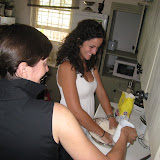 |
| Thanksgivings and More |
The weekend before Thanksgiving, I joined several friends to hang out with Kelee, her boyfriend Philip, and their South African friends out on a farm. The band of Americans was bringing Thanksgiving to the South Africans. Kelee had gone all out, even getting some costumes… Traveling out to the farm was an adventure in itself but the real fun was once we got there late Friday. We had a big braii with delicious lamb from Kelee and Philip’s farm. On Saturday morning, we began cooking. I was in charge of the turkeys (we had two young turkeys) and I made some stuffing from scratch.
 |
| From Thanksgivings and More |
After a few hours and lots of melted butter, I think the turkeys came out pretty well. We also had candied yams, mashed potatoes, green bean casserole, salad, iced tea, and apple, pumpkin, and pecan pies made from scratch.
Needless to say we were all very full after the big meal. After a little digestion though, it was time to continue the Thanksgiving tradition with some good old American football. We taught our South African friends the basic rules and then played a while using their rugby ball. Rugby balls aren’t meant to be thrown overhand. After a while, we switched things up and the South African’s taught us how to play touch rugby. It’s a ton of fun and moves a lot faster than football. The hardest things is remembering to stay behind the ball since it is a foul to pass the ball forward. After the game we relaxed a bit and watched real rugby on TV as the South African National Team (Springboks) crushed the English. Watching rugby with true fans allowed me to finally understand the intricacies of the game. Now I know the difference between a scrum and a ruck. The weekend was a blast and I really enjoyed getting to know Kelee’s friends. I returned back to site for the week and soon was preparing for my next feast.
Part II – Giving Thanks
 |
| From Thanksgivings and More |
As the quarter was drawing to a close, I wanted to organize a celebration for the library committee to thank them for all the hard work they’ve done. With all their help we are just a few steps away from opening to general circulation. The only big steps remaining are to create our full library policy, to finish with the student library cards, and to streamline the registration system. The library itself is set up and organized and the librarians seem to know the basics of how to get what they want.
 |
| From Thanksgivings and More |
Based on the exam schedule and teacher’s availability to help, the library party was set for November 27th. I thought it was fitting to be giving thanks to my volunteers on Thanksgiving. The teachers on the committee got food and cooked up a yummy meal of dumpy (a big dumpling bread) and beef stew. I made certificates and we got prizes for our student and community volunteers. We had a few speeches and then watched some movies as we ate.
Part III – American style
Finally, the weekend after the real Thanksgiving brought my last big feast. I traveled to some nearby volunteers who had organized a big meal at a lodge in their village. We played football, ate more turkey and pumpkin pie, and then sang karaoke into the night.
 |
| From Thanksgivings and More |
The next day I traveled back to site and scrambled to finish everything I had planned before school let out for the year. I had to leave early to go to a training session for Peace Corps in preparation for the next intake of new volunteers. Then I was off to other adventures, whose details shall follow…
Here are some more pictures of things I'm thankful for:
 |
| From Thanksgivings and More |
 |
| From Thanksgivings and More |
 |
| From Thanksgivings and More |
Sunday, November 16, 2008
Bring the Rain
In American or perhaps all of western culture, rainy days seem to bear an image of bleakness and despondency. Rain-checks stand in for unfulfilled obligation. Sports fans curse the rain and the dreaded delay of game that follows. Sunshine gets all the glory with smiley faced suns. Find me a smiley faced raincloud. Sure, a rainmaker is someone that brings great fortune. But seriously, even the Grumpy Care Bear had a raincloud belly.
Perhaps it is because we are used to running water and impeccably watered lawns even in the deserts of Nevada. Perhaps it’s because such a small percentage of Americans still depend on the land for their living. Whatever it is, living out here in the semi-desert in amongst a population that depends first on agriculture and second on government pensions for survival, I’ve come to despise sunny days and love the rain clouds. The stultifying heat probably also biases my opinion… Sunny days may be nice for the right now but too many and you’re dead. Rain brings renewal. Rain brings hope and nourishment for the future. To be fair, too much rain and you’re also dead. But even a flood can be renewing in a sense (see Noah or Gilgamesh).
When I was struggling, my friend Kelee wrote to me with some words of encouragement. She had faced even more difficult situations than I had and during those times her boyfriend had told her to think of the veld grass. Out on the open veld, you see these stubborn tufts of grass trying to survive heat and goats every day. During the long dry winter, the blades become crisp and turn a light yellow. They seem so weak and dead on the outside, easily crushed by whatever passes their way. But deep down, their roots stay strong. The life of the grass has retreated inwards to the core during those hard times, holding on with stubbornness to the dry earth, fed only by the expectation and hope that sometime in the future, the rains will come again. And when those rains do come, the grass drinks its fill of the sweetest ambrosia the heavens have to offer.
Sprinkles of Expectation (I’ll never be a meteorologist)
Last year, the day after I arrived at site, a huge storm came and opened up over us. The next day the entire salt pan was filled with water. That was towards the end of September. This year, we passed through October with few clouds ever passing the sky. Two weeks ago, I saw the clouds gathering. In the distance, lightning bolts lighted the sky. Soon, the winds picked up. As I inhaled the crisp air, I felt lighter in anticipation. I stood out on my stoop far past sunset waiting for the rain and only begrudgingly went in to sleep. Finally, I heard a few drops of rain begin to fall on my roof but within 5 minutes, it was over. What a tease. No one likes a tease. Or as my friend Erin’s host father puts it. “This is not a rain. It is a baby. It just spits and makes noise.” The next day, I got up and went to work as usual. The rain would come eventually, and until then, one just needs to keep oneself ready to receive it.
Three thousand two hundred books and counting; the library is almost ready. Posters and signs are being made. At least one person on the library committee besides me knows how to do every task apart from myself. Things are looking good. But there have been troubles. The student in charge of library cards gave up the job, adding 500 more tasks to my list. Some of the volunteers have stopped coming as exams started (it’s not because they are studying that much though…). But the big hit was the news that my main principal is transferring at the end of this year and thus goes the guaranteed support and backing of the school and its budget. Furthermore, I’ve begun to hear rumors that my library chair, one of the teachers I’ve worked most closely with, may be leaving next year too. Strangely, I don’t feel too phased. I just need to recalibrate. I’ve still got several months left and will find a new foundation while I in the meantime hold things up. In the end, even if the library fails and the changes I wished to bring to the village don’t come when I want them too, I’ve seen enough here to realize some change will come, on its own time, as a result of what I’ve done. The best I can do in the meantime is to prepare the grounds to best receive it when it does arrive.
Enter the Deluge (Make hay while the sun shines…dance like a fool when the rain falls)
On the Tuesday before last, I tried in vain to sleep at night. Every few hours, I’d wake up, turn over, and check the latest returns on nytimes.com on my phone. By 8am my time, it had happened. Barack Obama had won the election. Not only had America elected someone that wasn’t white but they had elected someone who was unabashedly intellectual. Even though our country had entered dark times, the future is still full of possibility. After years in a drought, I believe America has finally chosen a leader (and I count the drought longer than 8 years because though I think Clinton did a good job, I wouldn’t follow him to the gates of hell and back…) I know for many American’s the election was a moving moment. My teachers congratulated me since they had been aware of whom I was supporting. One sent me a text “Obama is the man”. During the day, as I walked between schools and home, I caught myself unconsciously smiling for the first time in many months. At certain points in the day, as I watched the news or heard people talking about America, I was seriously choking up. It’s not that I think Obama is the savior. He’s got a tall order to fill and there is no way he can do it all. I believe he can do a lot though. What I think had me so emotionally welled up though was something that can’t be taken away no matter what happens during the next administration; the fact that American’s rejected the smear campaigns and attacks. The fact that even Montana was close had me dumbfounded. For me, the heaven’s had opened up and were raining down renewal upon me and my country. For a little while, it was easy to look past all my own problems and believe in my own future. It was pouring down and for a little while, I rejoiced, knowing that all of us as American’s would need to soon put our heads down and get to work to make sure every drop fulfilled its potential for life bringing renewal, just as the farmers know rains bring work, but welcome work.
Over that weekend, I went on a bike ride to a few villages over, riding over the salt pan. I knew soon the real rains would come and traversing the flat would mean fording the lake. Sure enough, that night the clouds were gathering again. The lighting was all around. Surely this would not be another dry light show. Soon, the rain was beating down; so loud on my metal roof that I couldn’t hear my thoughts, but I knew they were happy thoughts.
Scattered showers
The past week has been interesting. As I grapple with what I should try to force through while my principal is still around, I am also returning to some of the management work I did early on as schools should now be evaluating to what degree we’ve fulfilled the action plans we created at the beginning of the year. In the library, with my volunteers starting to drop off and internal politics from outside the committee conspiring to turn my partners against each other, I’ve been digging in and preparing for a fight. The heat was on and no relief was in site. Then while I was walking back from the post office two days ago, a little girl walked up to me on the street. “KB, Nkopelela!” “KB, Sing to me!” I had spent most mornings last quarters singing English songs with the primary school kids but had started phasing it out as I tried to hand it off to teachers and got myself caught up in the library again. I stopped in the middle of the street and we sang a few songs before she was satisfied and I continued on my way with a smile on my face. Yesterday, I went to the library to do some work. A group of kids was out front as usual, playing on the weatherproof housed computers out there. As I unlocked the door, I looked over my shoulder at a couple of kids standing behind me expectantly. We hadn’t really officially opened yet but I asked them, “A lo batla go bala?” “Do you want to read?” And they nodded their heads excitedly. I showed them to the Children’s Fiction section and picked out a few short books for them. Soon 6 little boys were sitting and reading intently. Three of them stayed over half an hour, reading different short stories. Whatever fight I need to put up for this library, it’s worth it.
In the burning summer heat, the downpours bring life, but even a little unexpected shower can be life saving.
Perhaps it is because we are used to running water and impeccably watered lawns even in the deserts of Nevada. Perhaps it’s because such a small percentage of Americans still depend on the land for their living. Whatever it is, living out here in the semi-desert in amongst a population that depends first on agriculture and second on government pensions for survival, I’ve come to despise sunny days and love the rain clouds. The stultifying heat probably also biases my opinion… Sunny days may be nice for the right now but too many and you’re dead. Rain brings renewal. Rain brings hope and nourishment for the future. To be fair, too much rain and you’re also dead. But even a flood can be renewing in a sense (see Noah or Gilgamesh).
When I was struggling, my friend Kelee wrote to me with some words of encouragement. She had faced even more difficult situations than I had and during those times her boyfriend had told her to think of the veld grass. Out on the open veld, you see these stubborn tufts of grass trying to survive heat and goats every day. During the long dry winter, the blades become crisp and turn a light yellow. They seem so weak and dead on the outside, easily crushed by whatever passes their way. But deep down, their roots stay strong. The life of the grass has retreated inwards to the core during those hard times, holding on with stubbornness to the dry earth, fed only by the expectation and hope that sometime in the future, the rains will come again. And when those rains do come, the grass drinks its fill of the sweetest ambrosia the heavens have to offer.
Sprinkles of Expectation (I’ll never be a meteorologist)
Last year, the day after I arrived at site, a huge storm came and opened up over us. The next day the entire salt pan was filled with water. That was towards the end of September. This year, we passed through October with few clouds ever passing the sky. Two weeks ago, I saw the clouds gathering. In the distance, lightning bolts lighted the sky. Soon, the winds picked up. As I inhaled the crisp air, I felt lighter in anticipation. I stood out on my stoop far past sunset waiting for the rain and only begrudgingly went in to sleep. Finally, I heard a few drops of rain begin to fall on my roof but within 5 minutes, it was over. What a tease. No one likes a tease. Or as my friend Erin’s host father puts it. “This is not a rain. It is a baby. It just spits and makes noise.” The next day, I got up and went to work as usual. The rain would come eventually, and until then, one just needs to keep oneself ready to receive it.
Three thousand two hundred books and counting; the library is almost ready. Posters and signs are being made. At least one person on the library committee besides me knows how to do every task apart from myself. Things are looking good. But there have been troubles. The student in charge of library cards gave up the job, adding 500 more tasks to my list. Some of the volunteers have stopped coming as exams started (it’s not because they are studying that much though…). But the big hit was the news that my main principal is transferring at the end of this year and thus goes the guaranteed support and backing of the school and its budget. Furthermore, I’ve begun to hear rumors that my library chair, one of the teachers I’ve worked most closely with, may be leaving next year too. Strangely, I don’t feel too phased. I just need to recalibrate. I’ve still got several months left and will find a new foundation while I in the meantime hold things up. In the end, even if the library fails and the changes I wished to bring to the village don’t come when I want them too, I’ve seen enough here to realize some change will come, on its own time, as a result of what I’ve done. The best I can do in the meantime is to prepare the grounds to best receive it when it does arrive.
Enter the Deluge (Make hay while the sun shines…dance like a fool when the rain falls)
On the Tuesday before last, I tried in vain to sleep at night. Every few hours, I’d wake up, turn over, and check the latest returns on nytimes.com on my phone. By 8am my time, it had happened. Barack Obama had won the election. Not only had America elected someone that wasn’t white but they had elected someone who was unabashedly intellectual. Even though our country had entered dark times, the future is still full of possibility. After years in a drought, I believe America has finally chosen a leader (and I count the drought longer than 8 years because though I think Clinton did a good job, I wouldn’t follow him to the gates of hell and back…) I know for many American’s the election was a moving moment. My teachers congratulated me since they had been aware of whom I was supporting. One sent me a text “Obama is the man”. During the day, as I walked between schools and home, I caught myself unconsciously smiling for the first time in many months. At certain points in the day, as I watched the news or heard people talking about America, I was seriously choking up. It’s not that I think Obama is the savior. He’s got a tall order to fill and there is no way he can do it all. I believe he can do a lot though. What I think had me so emotionally welled up though was something that can’t be taken away no matter what happens during the next administration; the fact that American’s rejected the smear campaigns and attacks. The fact that even Montana was close had me dumbfounded. For me, the heaven’s had opened up and were raining down renewal upon me and my country. For a little while, it was easy to look past all my own problems and believe in my own future. It was pouring down and for a little while, I rejoiced, knowing that all of us as American’s would need to soon put our heads down and get to work to make sure every drop fulfilled its potential for life bringing renewal, just as the farmers know rains bring work, but welcome work.
Over that weekend, I went on a bike ride to a few villages over, riding over the salt pan. I knew soon the real rains would come and traversing the flat would mean fording the lake. Sure enough, that night the clouds were gathering again. The lighting was all around. Surely this would not be another dry light show. Soon, the rain was beating down; so loud on my metal roof that I couldn’t hear my thoughts, but I knew they were happy thoughts.
Scattered showers
The past week has been interesting. As I grapple with what I should try to force through while my principal is still around, I am also returning to some of the management work I did early on as schools should now be evaluating to what degree we’ve fulfilled the action plans we created at the beginning of the year. In the library, with my volunteers starting to drop off and internal politics from outside the committee conspiring to turn my partners against each other, I’ve been digging in and preparing for a fight. The heat was on and no relief was in site. Then while I was walking back from the post office two days ago, a little girl walked up to me on the street. “KB, Nkopelela!” “KB, Sing to me!” I had spent most mornings last quarters singing English songs with the primary school kids but had started phasing it out as I tried to hand it off to teachers and got myself caught up in the library again. I stopped in the middle of the street and we sang a few songs before she was satisfied and I continued on my way with a smile on my face. Yesterday, I went to the library to do some work. A group of kids was out front as usual, playing on the weatherproof housed computers out there. As I unlocked the door, I looked over my shoulder at a couple of kids standing behind me expectantly. We hadn’t really officially opened yet but I asked them, “A lo batla go bala?” “Do you want to read?” And they nodded their heads excitedly. I showed them to the Children’s Fiction section and picked out a few short books for them. Soon 6 little boys were sitting and reading intently. Three of them stayed over half an hour, reading different short stories. Whatever fight I need to put up for this library, it’s worth it.
In the burning summer heat, the downpours bring life, but even a little unexpected shower can be life saving.
Saturday, September 13, 2008
Setshwaro ke Dinja tse Pedi, Ga se Thata
(That which is caught by two dogs cannot give them much difficulty. – Setswana Proverb)
The last month or so, I’ve been involved in a lot of slow paced, hard slogging work. Unlike the flash-in-the-pan events like Youth Day and my camps, this work is high risk as it has involved a huge commitment of time, thought, and energy giving it the potential for incredible success or terrifying failure… Hopefully in a few months I’ll be writing a big triumphant story. For now though, there are no big magnificent events to post, but there are some encouraging signs that I wanted to share. There are some attitudes and actions that beat us down every day in our work here, but when I see behavior change, when I see people breaking the stultifying norm and taking control of their lives, I know why I am here. I am here to applaud them, tell them they are not crazy, and help give them the strength and knowledge to go on forging their own paths. As they say; the whole is greater than the sum of the parts, united we stand, or, in Setswana, Setshwaro ke dinja tse pede, ga se thata.
A committee…that meets?
In my previous posts, I mentioned the Books for Peace Project, started by my colleague Rose. Firstly, a huge thank you again to all of you that donated to the project and helped 30 libraries each get a huge jump start. Secondly, a huge thanks to Rose, Books for Africa, and the others that made the project a reality. As the time for the books to arrive came closer, I had a huddle with some of my key teachers and we decided to form a library committee. We set our first meeting date and invited any staff that was interested. In the end, only 6 of my 21 teachers attended that first meeting. The library chair himself did not come. Still, with a little prodding and encouragement, those of us that showed up used the lack of interest and leadership to rally ourselves. We made an action plan to recruit community members and students into the committee, we solidified our finances, and we set a second meeting for right before the books would arrive.
In the two weeks that followed, we recruited 2 students and 3 community members to the committee. I played some backdoor politics and convinced the chair that he was over-worked and over-committed. Then I gave him a face-saving way to step down from his position so that I could get a more driven teacher in his place. For our second meeting, we had over 90% attendance at the time of the meeting and opened about 10 minutes later. What? T.I.A.? Yes, on time and in Africa. For my American readership, this may not seem that big of a deal, but my PCV buddies, you feel me here. The principal attended the meeting too. We came up with several plans of action, including the creation of student and library cards, a volunteer timetable and training schedule, and solidified our leadership. The students and community members actually spoke up to voice their opinions rather than sitting in deference to the teachers (yes, really). Our next meeting was set for when the books arrived.
I left the next day and spent a week in meetings and sorting books in Pretoria before returning to my school to see what had been done. When I arrived, I found that the students had continued on with the work of cataloging old books that I had started. I had trained them for maybe 2 days and they had spent the week labeling 300 books and cataloging 30 more books on the Linux based computer system I had set up. Our principal showed his commitment to us by getting us a laminating machine and color printer to make some snazzy library and student cards. On top of that, one of our community volunteers, an old man that only completed standard 8 (grade 10), was coming every day and would excitedly talk about books he found and check them out to read.
When it came time for our next meeting, again we had high attendance and began within minutes of our scheduled start time. The two guys I’d recruited from the students had recruited two girls to help, balancing out our student librarians. We committed to a schedule to start working and set the end of September as our deadline to get the library up and running. Other teachers at the school were continually confused by finding out we were meeting. There are dozens of committees on paper in the school, but they don’t actually meet or do anything… Some complained because we were actually making decisions. Fortunately the principal is so thrilled by the idea of a committee actually accomplishing something that he has given us all the support we need.
Knocking on
In South Africa, when you are going to “close shop” or leave work at the end of the day, you “knock off.” (e.g. “Where are you going?” “I’m knocking off now.” “Now? It’s only 1pm…” “It’s month end. Ke chaile! Sharp!” “Sharp…”). One of the big challenges of the education system here is that a plethora of students (and educators and administrators) that are intent on skipping classes (or dodging classes, or bunking classes).
Once again, my library team proved to buck the trend. (Part of it is perhaps because I recruited the teachers that consistently worked late every day and showed up early each morning…) My student and community volunteers have been coming almost every day and working from school out until 5 or 6pm. Last Friday, one of them was chatting with me as we started work. “You know KB, I am seeing we have a lot of work left to do. And really, we must get this work done soon so that we can use the books. I think we must push harder.” “Ok…what do you have in mind?” “Let’s work on Saturdays.” “Ok, what time?” “8am.” Sure enough, the next day, that learner showed up at 8am and together we worked until 4pm. The next weekend all four students committed to coming even though I wouldn’t be there due to a prior commitment. This Friday as I was preparing to “knock off” at 5pm, another student refused. “Let us at least go to half past five. Bring over another box of books, no two boxes.” We locked up at close to 6pm. With kids and community members this committed, I am optimistic that we actually will open this library in a few weeks.
Fasten your Seatbelts
On Monday, I received terrible news. Two of my teachers had been driving back to the village and had lost control of their car. It rolled 4 times and landed in the veld. The car was totaled. They were both in the hospital being checked on. These were two of my hand-picked library teachers, including the new chair of the committee. My heart sank. Fortunately, they sustained no major injuries and were back at school after a few days of rest. How? They were wearing their seatbelts. South Africa, like most developing countries I’ve been in, has a reluctance to buckle up. Indeed, even drunk driving isn’t really looked down upon in the cases I’ve seen. But thankfully, my teachers had done what was unfashionable and uncomfortable and actually used their seatbelts. As a result, they may have saved their lives.
Remove the stumbling blocks
My friend, Adam Bohach (see blogs on my side-bar), recently wrote a post about spoken and unspoken appreciation (and several other very inspiring posts). Basically, the work of development workers is often unsung. We go into our service prepared to pat ourselves on the back because we don’t ask or expect anyone else to. Sometimes though, people surprise you.
After knocking off from the library at near 6pm on Friday, one of my teachers and I were walking back to the teachers quarters. We were chatting about how impressed we were with the students. Caught up in my excitement, I wasn’t paying attention to where I was stepping and stumbled on a rock. My teacher grabbed me then rushed off in front of me tossing rocks out of the way. “Hey, what are these rocks doing here! They are trying to knock down our KB! KB, you can’t let yourself get knocked down, you are too important to us.” It was a playful and somewhat trivial act in a place that is literally covered in rocks (where there aren’t sand pits or thorn bushes) but I think the real meaning he was conveying was more figurative.
The work we do sometimes can be hard to see as meaningful. We see many projects fail, so many people who go on ignoring anything we try to do to help, children being beaten, insurmountable bureaucracy, corruption, risky behavior, and needless deaths. But we also see some people who say no to all of that: people that catch a glimpse of a little light and run after it with all their strength. These people give meaning to my work. No one can be helped without helping themselves first. Rather than trying to force people to stand up, I think our real job is to find those people pushing hard against all the odds holding them down and offer them all we can. And then, if ever we find ourselves knocked down, we don’t have to look far to find a helping hand.
The last month or so, I’ve been involved in a lot of slow paced, hard slogging work. Unlike the flash-in-the-pan events like Youth Day and my camps, this work is high risk as it has involved a huge commitment of time, thought, and energy giving it the potential for incredible success or terrifying failure… Hopefully in a few months I’ll be writing a big triumphant story. For now though, there are no big magnificent events to post, but there are some encouraging signs that I wanted to share. There are some attitudes and actions that beat us down every day in our work here, but when I see behavior change, when I see people breaking the stultifying norm and taking control of their lives, I know why I am here. I am here to applaud them, tell them they are not crazy, and help give them the strength and knowledge to go on forging their own paths. As they say; the whole is greater than the sum of the parts, united we stand, or, in Setswana, Setshwaro ke dinja tse pede, ga se thata.
A committee…that meets?
In my previous posts, I mentioned the Books for Peace Project, started by my colleague Rose. Firstly, a huge thank you again to all of you that donated to the project and helped 30 libraries each get a huge jump start. Secondly, a huge thanks to Rose, Books for Africa, and the others that made the project a reality. As the time for the books to arrive came closer, I had a huddle with some of my key teachers and we decided to form a library committee. We set our first meeting date and invited any staff that was interested. In the end, only 6 of my 21 teachers attended that first meeting. The library chair himself did not come. Still, with a little prodding and encouragement, those of us that showed up used the lack of interest and leadership to rally ourselves. We made an action plan to recruit community members and students into the committee, we solidified our finances, and we set a second meeting for right before the books would arrive.
In the two weeks that followed, we recruited 2 students and 3 community members to the committee. I played some backdoor politics and convinced the chair that he was over-worked and over-committed. Then I gave him a face-saving way to step down from his position so that I could get a more driven teacher in his place. For our second meeting, we had over 90% attendance at the time of the meeting and opened about 10 minutes later. What? T.I.A.? Yes, on time and in Africa. For my American readership, this may not seem that big of a deal, but my PCV buddies, you feel me here. The principal attended the meeting too. We came up with several plans of action, including the creation of student and library cards, a volunteer timetable and training schedule, and solidified our leadership. The students and community members actually spoke up to voice their opinions rather than sitting in deference to the teachers (yes, really). Our next meeting was set for when the books arrived.
I left the next day and spent a week in meetings and sorting books in Pretoria before returning to my school to see what had been done. When I arrived, I found that the students had continued on with the work of cataloging old books that I had started. I had trained them for maybe 2 days and they had spent the week labeling 300 books and cataloging 30 more books on the Linux based computer system I had set up. Our principal showed his commitment to us by getting us a laminating machine and color printer to make some snazzy library and student cards. On top of that, one of our community volunteers, an old man that only completed standard 8 (grade 10), was coming every day and would excitedly talk about books he found and check them out to read.
When it came time for our next meeting, again we had high attendance and began within minutes of our scheduled start time. The two guys I’d recruited from the students had recruited two girls to help, balancing out our student librarians. We committed to a schedule to start working and set the end of September as our deadline to get the library up and running. Other teachers at the school were continually confused by finding out we were meeting. There are dozens of committees on paper in the school, but they don’t actually meet or do anything… Some complained because we were actually making decisions. Fortunately the principal is so thrilled by the idea of a committee actually accomplishing something that he has given us all the support we need.
Knocking on
In South Africa, when you are going to “close shop” or leave work at the end of the day, you “knock off.” (e.g. “Where are you going?” “I’m knocking off now.” “Now? It’s only 1pm…” “It’s month end. Ke chaile! Sharp!” “Sharp…”). One of the big challenges of the education system here is that a plethora of students (and educators and administrators) that are intent on skipping classes (or dodging classes, or bunking classes).
Once again, my library team proved to buck the trend. (Part of it is perhaps because I recruited the teachers that consistently worked late every day and showed up early each morning…) My student and community volunteers have been coming almost every day and working from school out until 5 or 6pm. Last Friday, one of them was chatting with me as we started work. “You know KB, I am seeing we have a lot of work left to do. And really, we must get this work done soon so that we can use the books. I think we must push harder.” “Ok…what do you have in mind?” “Let’s work on Saturdays.” “Ok, what time?” “8am.” Sure enough, the next day, that learner showed up at 8am and together we worked until 4pm. The next weekend all four students committed to coming even though I wouldn’t be there due to a prior commitment. This Friday as I was preparing to “knock off” at 5pm, another student refused. “Let us at least go to half past five. Bring over another box of books, no two boxes.” We locked up at close to 6pm. With kids and community members this committed, I am optimistic that we actually will open this library in a few weeks.
Fasten your Seatbelts
On Monday, I received terrible news. Two of my teachers had been driving back to the village and had lost control of their car. It rolled 4 times and landed in the veld. The car was totaled. They were both in the hospital being checked on. These were two of my hand-picked library teachers, including the new chair of the committee. My heart sank. Fortunately, they sustained no major injuries and were back at school after a few days of rest. How? They were wearing their seatbelts. South Africa, like most developing countries I’ve been in, has a reluctance to buckle up. Indeed, even drunk driving isn’t really looked down upon in the cases I’ve seen. But thankfully, my teachers had done what was unfashionable and uncomfortable and actually used their seatbelts. As a result, they may have saved their lives.
Remove the stumbling blocks
My friend, Adam Bohach (see blogs on my side-bar), recently wrote a post about spoken and unspoken appreciation (and several other very inspiring posts). Basically, the work of development workers is often unsung. We go into our service prepared to pat ourselves on the back because we don’t ask or expect anyone else to. Sometimes though, people surprise you.
After knocking off from the library at near 6pm on Friday, one of my teachers and I were walking back to the teachers quarters. We were chatting about how impressed we were with the students. Caught up in my excitement, I wasn’t paying attention to where I was stepping and stumbled on a rock. My teacher grabbed me then rushed off in front of me tossing rocks out of the way. “Hey, what are these rocks doing here! They are trying to knock down our KB! KB, you can’t let yourself get knocked down, you are too important to us.” It was a playful and somewhat trivial act in a place that is literally covered in rocks (where there aren’t sand pits or thorn bushes) but I think the real meaning he was conveying was more figurative.
The work we do sometimes can be hard to see as meaningful. We see many projects fail, so many people who go on ignoring anything we try to do to help, children being beaten, insurmountable bureaucracy, corruption, risky behavior, and needless deaths. But we also see some people who say no to all of that: people that catch a glimpse of a little light and run after it with all their strength. These people give meaning to my work. No one can be helped without helping themselves first. Rather than trying to force people to stand up, I think our real job is to find those people pushing hard against all the odds holding them down and offer them all we can. And then, if ever we find ourselves knocked down, we don’t have to look far to find a helping hand.
Wednesday, August 27, 2008
The Lekgoa and the Lekwerekwere
“Lekgoa! Lekgoa!” the children scream as they run behind me. Well, I guess it’s not surprising; it’s what you expect as the only white person in the village. Every Peace Corps Volunteer is told to expect it. Wait a second…
I’m not white.
There is no mob of little people trailing me in adoration. There is no verbal labeling of “Whitey”. But there is another type of labeling.
My white colleagues may at first find me in an enviable position. As an American of South Asian decent, I fit rather well into my Tswana village. There are roughly half a dozen Bangladeshi and Pakistani shop owners (in addition to the Somali and the Chinese couple). When I showed up in the village, I wasn’t a rock star. People assumed I had come to sell biscuits and cooldrink (pop…or soda…or coke…whatever). Granted, it’s been almost a year now so people have mostly figured out that’s not my shtick. In a couple of months, if all goes well, when villagers see children reading books under trees and condoms flowing freely from the taverns, they’ll shake their heads and say, “Oh, that KB…” But it’s taken a lot to get to this point. Upon entering my village, I quickly realized, I needed to make an effort to go out and introduce myself to people. If I showed up at a community event or was just walking around the village, I did not attract the attention, questions, and introductions that my fairer skinned friends received a few villages away. I didn’t mind. The challenge added to the impetus to bulk up on language and social networking skills.
The biggest challenge of not being a “Lekgoa” PCV is knowing when to pre-empt a random stranger by somehow declaring, “Wait! I’m not Makwerekwere! I’m an American volunteer.” Ma-what? While Lekgoa is used to reference to any White, non-South African or English South African, Makwerekwere is used to reference migrant workers and illegal immigrants. Makwerekwere is mostly used in reference to other African’s but can extend to the East and South Asians who work all over the country and are often perceived as “stealing” jobs. Examining each word etymologically is an interesting exercise. I’ve heard two different tales of the origins of Lekgoa.
Lekgoa – “lay-k’ho-a” – n. – a European or white American, “whitey”
The first, perhaps more fanciful origin, is that the word is a combination of the Tswana/Sotho words “lewatle” and “go kqwa”. These word’s mean “ocean” and “to spit”, respectively. Hence “Lekgoa” would be “The spit of the ocean” because the first white people to arrive in South Africa were more or less spat up from the ocean. Lovely [1]. The second, and perhaps more credible explanation is that the word finds its roots in the verb “go kgoa” which means “to be rude or have no manners”. Adding “le-“ is a common way to nounify a verb in Setswana [2]. (Now, I have friends that complain that the “le-/ma-“ noun class is an object class used to describe things like brooms, spoons, and bad people like thieves. Honestly, though, “lekgarebe” and “lekgau” are in the same class and mean “girlfriend” and “boyfriend” respectively, so no more complaining on that count.)
Lekwerekwere – “lay-kway-ray-kway-ray” – n. – non-southern African African’s, illegal immigrants, the equivalent of “spick” in American English.
This also has many fanciful candidates for an origin story, but the most credible one I’ve found comes from Lesotho. The Sotho equivalent is “lekoerekoere” and it’s origin is pretty much the same as the origin of the word “barbarian”. When Sotho speaking southern African’s encountered other Africans, it sounded like they were speaking gibberish saying “kwere-kwere-kwere” so there you have it, they are the “makwerekwere”.
So on the face of it, “Lekgoa” seems like a greater slur than “Lekwerekwere” but the subtext of South Africa flips that on its head.
When the xenophobic attacks broke out, people at home became frantic because PCVs are also foreigners and might be targeted. But there are two classes of foreigners in South Africa; the Lekgoa and the Lekwerekwere. Xenophobia is mostly targeted at the latter. “Makwerekwere” was originally restricted to other Africans, but unfortunately, I feel like the term has become a bit more derogatory in South Africa and signifies a sentiment against any “foreigner” that is seen to be taking jobs. I was told that I shouldn’t worry about the attacks because it was aimed at other Africans. Then I watched the news and saw a Bangladeshi guy almost in tears talking about how a mob came and destroyed everything he had worked years to create. In the background, some cops were standing around outside of his shop, laughing. My Bangladeshi shop owner friends started locking up earlier each night.
So really, even if I was white, I wouldn’t mind being called “Lekgoa” every day. At least it means, people know I’m a foreigner and not an Afrikaaner. Not that there is anything wrong with being Afrikaaner. It would just lead to a lot of other unspoken assumptions that could be problematic. Instead, whenever I travel to a city or a new taxi rank, I ask myself, who is calling me “Makwerekwere” in their head and what can I do to change their mind. I have never heard someone call me “Makwerekwere” to my face and if I did, I would probably be better off showing them my heels; whether that meant kicking them in the face or running away, would probably depend on how many of them there were. (On the plus side, I do get called “my friend” which is the generic village term for any South Asian shopowner. The less nice term for South Asians is “coolie” or “macoolie” in Tswana)
Riding a khumbi is always a unique experience. Cramming a minimum of 14 people, a driver, a few babies, luggage, groceries, and perhaps two, three, or ten more people into a minibus van has a tendency to bring out the best and worst in people. A week ago, two of my teachers were shopping in town and loading up a taxi to take their things back to the village. Now, these teachers, like most of my teachers, are not Batswana (Tswana people). They come from Gauteng, Limpopo, Eastern Cape, KZN, Mpumalanga, etc. They serve a village educating kids while their own kids are thousands of kilometers away. Some of them have been doing it for up to 13 years. I have a huge respect for them because I know I couldn’t do this for much more than two years. So, two of these teachers were at the taxi loading up and leaving some bags on their seats to save their spots.
A woman came buy, looked angrily at the seats and demanded, “Why are those bags on the seat?”
Mme S replied, “We are loading our things. That is where my friend Mme M is going to sit.”
The woman grunted in disapproval, removed the bags, and sat down. Mme M confronted her about it to which the woman replied,
“You teachers think you are so special but you’re just Makwerekwere who came here on the back of some trucks. You should just go back to where you came from.”
“Excuse me, we are teaching your children.”
“You’re just here because you can’t get a job in your home. We aren’t stupid. Why do we need you to teach our children?”
“So where are your teachers then?”
In the end both my teachers made it back to the village but they were both fuming. It made me wonder what people might be thinking about me on the khumbi, or anywhere really.
But being “Lekwerekwere” isn’t always a bad thing. When a group is stereotyped and clumped together, people that previously had no connection tend to unite and watch each other’s backs. On a taxi, a South Asian will always give me a knowing nod. Non-South African African’s will approach me in the taxi rank to ask for help or directions, sometimes choosing to talk to me over South Africans. Once, a village shop owner that I’d never met before sat next to me on a taxi. After saying hello we sat in silence for one and a half hours until we came to a gas station. While the tank filled, he got out and came back with two Powerades and handed me one. Again, I got the knowing nod. I like that nod.
Most recently, I was standing by the side of the road waiting for a taxi to take me back to my village. There were a few Tswana people waiting as well as a guy that I’m going to guess was Somali. I greeted everyone as usual and we stood around for a long time. Finally a taxi came but had only two spots open. A woman with a small child got in as well as the Somali guy. Once I saw the taxi was full, I turned around to go sit down. When I didn’t hear the engine start, I turned around to see the Somali guy gesturing for me to come back. He said I had arrived before him so shouldn’t wait and he squeezed over to give me room to cram in. There were other people who had arrived earlier too but he knew I was a strange person in a strange land, just like him, and lent a hand with a knowing nod.
I used to be a bit annoyed that I didn’t have the “Pied Piper Effect”. I used to be relieved to not constantly be harangued by people yelling “Lekgoa”. Being a white volunteer brings challenges and benefits. Being a minority volunteer brings challenges and benefits. They just are different challenges and benefits. In the end you just have to be aware of it, be mindful of it, and give a little nod.
(1) This first explanation comes from my Pre-Service Training language instructor, in incredible Gordan.
(2) http://en.wikipedia.org/wiki/Lekgoa
(3) http://www.languagehat.com/archives/003131.php
(4) http://sotho.blogsome.com/2004/01/12/6/
I’m not white.
There is no mob of little people trailing me in adoration. There is no verbal labeling of “Whitey”. But there is another type of labeling.
My white colleagues may at first find me in an enviable position. As an American of South Asian decent, I fit rather well into my Tswana village. There are roughly half a dozen Bangladeshi and Pakistani shop owners (in addition to the Somali and the Chinese couple). When I showed up in the village, I wasn’t a rock star. People assumed I had come to sell biscuits and cooldrink (pop…or soda…or coke…whatever). Granted, it’s been almost a year now so people have mostly figured out that’s not my shtick. In a couple of months, if all goes well, when villagers see children reading books under trees and condoms flowing freely from the taverns, they’ll shake their heads and say, “Oh, that KB…” But it’s taken a lot to get to this point. Upon entering my village, I quickly realized, I needed to make an effort to go out and introduce myself to people. If I showed up at a community event or was just walking around the village, I did not attract the attention, questions, and introductions that my fairer skinned friends received a few villages away. I didn’t mind. The challenge added to the impetus to bulk up on language and social networking skills.
The biggest challenge of not being a “Lekgoa” PCV is knowing when to pre-empt a random stranger by somehow declaring, “Wait! I’m not Makwerekwere! I’m an American volunteer.” Ma-what? While Lekgoa is used to reference to any White, non-South African or English South African, Makwerekwere is used to reference migrant workers and illegal immigrants. Makwerekwere is mostly used in reference to other African’s but can extend to the East and South Asians who work all over the country and are often perceived as “stealing” jobs. Examining each word etymologically is an interesting exercise. I’ve heard two different tales of the origins of Lekgoa.
Lekgoa – “lay-k’ho-a” – n. – a European or white American, “whitey”
The first, perhaps more fanciful origin, is that the word is a combination of the Tswana/Sotho words “lewatle” and “go kqwa”. These word’s mean “ocean” and “to spit”, respectively. Hence “Lekgoa” would be “The spit of the ocean” because the first white people to arrive in South Africa were more or less spat up from the ocean. Lovely [1]. The second, and perhaps more credible explanation is that the word finds its roots in the verb “go kgoa” which means “to be rude or have no manners”. Adding “le-“ is a common way to nounify a verb in Setswana [2]. (Now, I have friends that complain that the “le-/ma-“ noun class is an object class used to describe things like brooms, spoons, and bad people like thieves. Honestly, though, “lekgarebe” and “lekgau” are in the same class and mean “girlfriend” and “boyfriend” respectively, so no more complaining on that count.)
Lekwerekwere – “lay-kway-ray-kway-ray” – n. – non-southern African African’s, illegal immigrants, the equivalent of “spick” in American English.
This also has many fanciful candidates for an origin story, but the most credible one I’ve found comes from Lesotho. The Sotho equivalent is “lekoerekoere” and it’s origin is pretty much the same as the origin of the word “barbarian”. When Sotho speaking southern African’s encountered other Africans, it sounded like they were speaking gibberish saying “kwere-kwere-kwere” so there you have it, they are the “makwerekwere”.
So on the face of it, “Lekgoa” seems like a greater slur than “Lekwerekwere” but the subtext of South Africa flips that on its head.
When the xenophobic attacks broke out, people at home became frantic because PCVs are also foreigners and might be targeted. But there are two classes of foreigners in South Africa; the Lekgoa and the Lekwerekwere. Xenophobia is mostly targeted at the latter. “Makwerekwere” was originally restricted to other Africans, but unfortunately, I feel like the term has become a bit more derogatory in South Africa and signifies a sentiment against any “foreigner” that is seen to be taking jobs. I was told that I shouldn’t worry about the attacks because it was aimed at other Africans. Then I watched the news and saw a Bangladeshi guy almost in tears talking about how a mob came and destroyed everything he had worked years to create. In the background, some cops were standing around outside of his shop, laughing. My Bangladeshi shop owner friends started locking up earlier each night.
So really, even if I was white, I wouldn’t mind being called “Lekgoa” every day. At least it means, people know I’m a foreigner and not an Afrikaaner. Not that there is anything wrong with being Afrikaaner. It would just lead to a lot of other unspoken assumptions that could be problematic. Instead, whenever I travel to a city or a new taxi rank, I ask myself, who is calling me “Makwerekwere” in their head and what can I do to change their mind. I have never heard someone call me “Makwerekwere” to my face and if I did, I would probably be better off showing them my heels; whether that meant kicking them in the face or running away, would probably depend on how many of them there were. (On the plus side, I do get called “my friend” which is the generic village term for any South Asian shopowner. The less nice term for South Asians is “coolie” or “macoolie” in Tswana)
Riding a khumbi is always a unique experience. Cramming a minimum of 14 people, a driver, a few babies, luggage, groceries, and perhaps two, three, or ten more people into a minibus van has a tendency to bring out the best and worst in people. A week ago, two of my teachers were shopping in town and loading up a taxi to take their things back to the village. Now, these teachers, like most of my teachers, are not Batswana (Tswana people). They come from Gauteng, Limpopo, Eastern Cape, KZN, Mpumalanga, etc. They serve a village educating kids while their own kids are thousands of kilometers away. Some of them have been doing it for up to 13 years. I have a huge respect for them because I know I couldn’t do this for much more than two years. So, two of these teachers were at the taxi loading up and leaving some bags on their seats to save their spots.
A woman came buy, looked angrily at the seats and demanded, “Why are those bags on the seat?”
Mme S replied, “We are loading our things. That is where my friend Mme M is going to sit.”
The woman grunted in disapproval, removed the bags, and sat down. Mme M confronted her about it to which the woman replied,
“You teachers think you are so special but you’re just Makwerekwere who came here on the back of some trucks. You should just go back to where you came from.”
“Excuse me, we are teaching your children.”
“You’re just here because you can’t get a job in your home. We aren’t stupid. Why do we need you to teach our children?”
“So where are your teachers then?”
In the end both my teachers made it back to the village but they were both fuming. It made me wonder what people might be thinking about me on the khumbi, or anywhere really.
But being “Lekwerekwere” isn’t always a bad thing. When a group is stereotyped and clumped together, people that previously had no connection tend to unite and watch each other’s backs. On a taxi, a South Asian will always give me a knowing nod. Non-South African African’s will approach me in the taxi rank to ask for help or directions, sometimes choosing to talk to me over South Africans. Once, a village shop owner that I’d never met before sat next to me on a taxi. After saying hello we sat in silence for one and a half hours until we came to a gas station. While the tank filled, he got out and came back with two Powerades and handed me one. Again, I got the knowing nod. I like that nod.
Most recently, I was standing by the side of the road waiting for a taxi to take me back to my village. There were a few Tswana people waiting as well as a guy that I’m going to guess was Somali. I greeted everyone as usual and we stood around for a long time. Finally a taxi came but had only two spots open. A woman with a small child got in as well as the Somali guy. Once I saw the taxi was full, I turned around to go sit down. When I didn’t hear the engine start, I turned around to see the Somali guy gesturing for me to come back. He said I had arrived before him so shouldn’t wait and he squeezed over to give me room to cram in. There were other people who had arrived earlier too but he knew I was a strange person in a strange land, just like him, and lent a hand with a knowing nod.
I used to be a bit annoyed that I didn’t have the “Pied Piper Effect”. I used to be relieved to not constantly be harangued by people yelling “Lekgoa”. Being a white volunteer brings challenges and benefits. Being a minority volunteer brings challenges and benefits. They just are different challenges and benefits. In the end you just have to be aware of it, be mindful of it, and give a little nod.
(1) This first explanation comes from my Pre-Service Training language instructor, in incredible Gordan.
(2) http://en.wikipedia.org/wiki/Lekgoa
(3) http://www.languagehat.com/archives/003131.php
(4) http://sotho.blogsome.com/2004/01/12/6/
Friday, August 1, 2008
Turning the Page
Disclaimer: The month of July was somewhat tumultuous for me on a personal level. Now at last, I feel enough at peace to write again. However, I’ve also debated at level of detail which I wish to write about my own private life in a domain as public as this blog. I understand that part of the point of a blog is to share one’s private life and indeed that is what I’ve been doing, but there are some things that I don’t think are right to put out so openly. The most I will say is this: the past month has made me more deeply aware of the beauty of life and the sorrow of death; the comfort of love and the pain of separation. Those of you who are my friends reading this will probably find out more detail about this past month from me at some point through a more private means of communication. Nevertheless, the private struggle of the last month has helped me focus more clearly on my public work as a volunteer. So, I apologize if this post seems to be high on philosophy and low on storyline but I want to share the upshot of the last month.
It’s now been over a year since I arrived in South Africa (September 21 will mark 1 year as an official Peace Corps Volunteer). I’ve been going through many transitions all at once. The main project that consumes my time at the moment is my library and literacy campaign. I’ve also found myself reading and writing a lot more recently. The cold winter is slowly warming to spring. Some changes are welcome, some are dreaded, but all seem to become more manageable when taken in the context of a bigger picture. Every change, no matter the size, is the turning of a page. Though the good ones may seem small and insignificant, they help move us forward bit by bit. Though the bad ones seem insurmountable, they too will be buried behind chapters with time.
The Family Book
My family and Kana came to visit for two weeks. We went to Zambia to see Victoria Falls and then traveled back to South Africa to see Kruger, my village, and a few other places along the way. It was an incredible time, though bittersweet at points.
When everyone arrived, we spent a day to allow them to get over jetlag and just hang out. We got dinner with a bunch of my volunteer friends in Pretoria one night. The next day we went to a mall and my parents insisted on getting me a new pair of shoes since the ones I was wearing had holes in them and had had their soles glued back on twice. We also saw Kung-Fu Panda, which was great (my second time seeing it…). Then we packed up and got on a plane to head to Victoria Falls.
 Rainbows in the mist
Victoria Falls was incredible and the place we stayed, the Royal Livingstone, was something out of a fairy tale. It’s basically the epitome of luxury within my life’s experience so far, and probably will remain so for quite a while. At check in, they walk you into a spacious lounge, seat you on a couch, give you fresh juice and a hand massage, while taking your particulars. You then get on a golf cart and are driven to your room/cottage, equipped with its own butler. Outside, giraffes and zebras are roaming around on the banks of the Zambezi River, in which hippos wallow. You can see the mist rising from the falls, which are only a 10 minute walk away. The meals are exquisite and the staff, incredibly warm. When you return to your room after dinner, you find the bed turned down for you, covered in rose petals, bathrobes and slippers laid out nicely, and soothing light classical music playing. After a year of battling cock-roaches, baking under a corrugated iron roof, and subsisting on pap and peanut butter, it was almost too much to completely soak in. The falls themselves were magnificent, with a spray that would leave you doused just walking by it. It was quite different than Niagara Falls, with its sheer breadth enough to leave you in awe. With Victoria Falls, it was hard to take in the whole falls at once. It is more reticent to disclose its full splendor. There is also a surprising lack of guardrails at hazardous locations. One evening we went on a sunset cruise up the Zambezi River. It was very relaxing and we got a chance to see some more hippos and elephants from our boat.
 It's a baby!
Soon though, the lazy days came to an end and we headed back to South Africa. We drove a little north of Pretoria and spent the night. The next day we headed to Magoebaskloof on our way to Kruger. Magoesbaskloof is a beautiful area, full of mountains and waterfalls. We did a short hike from our hotel to a waterfall and spent time just hanging out. The next day we headed into Kruger to Gomo Gomo Game Lodge. It is in the Timbavati Private Game Reserve which is part of the Greater Kruger, but technically not part of the national park. Every day at 5:30am we’d get a wake-up call. By 6:30am we were in our Land Rover with our ranger and tracker looking for wildlife. We’d come back at 10 and have breakfast before going for a nature walk where we’d learn about tracks, droppings, and flora. At 2pm we’d have lunch and then 3:30pm mount back up for an afternoon game drive. We’d be back by 7:30 and have dinner and be in bed by 9ish. During the night, we couldn’t go outside our rooms because there are no fences. One night, some lions walked through our camp. I don’t remember all the animals we saw but there were a lot. We saw all the big five: lion, leopard, elephant, water buffalo, and rhino. We also saw giraffes, zebras, hippos, crocodiles, a multitude of different antelope, eagles, cranes, chameleons, mongoose, bushbabies, baboons, monkeys, and more. I’ll let the pictures speak for themselves.
 Grr
Grr
After Kruger, we drove up through the Blyde River Canyon and I got to share some of my favorite spots of South Africa with my family. We stayed in Graskop and I haggled with some street vendors to get two drums. One huge ornamental one that got sent home, and one djembe for me to play here. It was the last full day of the trip with Kana. The next day we drove to the airport and sent her off back to Japan. From there we continued on our way out west. The next day we went to Vryburg and got to do some major shopping for me. I still have tons of food I’m trying to finish. We then made our way up to Tsoe where I shared the people and places I’ve grown to love with my family. We even had time to make a small jaunt down to Perth to see Art. After a few days though, they had to head back and I had to prepare for getting back to work.
It was wonderful to spend time with my family and Kana, and to share my life here with them. At the same time, I realized that the life I return to a year from now will have little resemblance to the one I left last year. The care and affection for the important people in my life will remain, but the details, the locations, and the terms of all relationships changes with time.
Pages of a Troubled Past
Before, during, and after the vacation, I was busy trying to put together the 3rd PCSA Cultural Panel for the Pre-Service Training of SA18. The Diversity Committee started this panel, which brings together speakers from different racial backgrounds to share their life experiences with the trainees and give them a better understanding of the often complex racial subtext on which our service takes place. Unfortunately I was unable to lock down a white speaker and logistics ended up being a nightmare, but it was well worth it to get to befriend three amazing South Africans and help them share their stories with the trainees. While changing names to preserve privacy, I’d like to share some of the highlights that these speakers shared with me.
Mma Mabatho was raised in the townships but spent her adult life in a rural community. She was the last child of her parents and her father, who had so wanted a son, decided to raise her as one. He taught her that she was responsible fully to herself and should never let anyone, man or woman make her think she was less than them. When she got beat up by a boy in school, her father didn’t get angry; he gave her boxing lessons so that next time, she walloped the punk. Living out in rural South Africa, she defied traditions, wearing pants and driving trucks while she was pregnant. Still, she forged her image as a leader, developing her community and pushing education. She is a testament to the individual that doesn’t just fight against the restrictions of society, but transcends them in a way that makes them seem non-existent to an onlooker. In a world still dominated by males and tainted with chauvinism, her and her father are archetypes of a bright future.
Yvonne is a young colored woman from KZN. When going through high school, she approached her principal saying she wanted to go to tertiary school. He looked at her in disbelief and tried to convince her to just get a job like everyone else. After struggling for a year in a university for which her high school had not prepared her, she begrudgingly took his advice, working five years before deciding, to hell with them all, she was going to educate herself. She went back to school, studying by day, working by night, and finished her bachelors. She took some time off from education to be a mother and get a job but is ready to go back for further education now. She is an incredibly driven woman, very well read, and well spoken. She eloquently lays out the great contradictions of the colored identity. Kept at arms distance by the white government, they now find themselves kept at arms distance by the black government because they were seen as trying to be white when it was fashionable and now trying to be black. It was hard to fit them into the Apartheid system because they were the evidence that Apartheid didn’t really work. It was illegal for whites and blacks to have sex but somehow these colored babies kept popping up. Yvonne was raised in a household where her parents rejected the label colored saying, we’re all black and we’re all in this together. She is passionate about developing the human potential of South Africa, even taking in kids from bad home situations and helping to raise and educate them.
Mr. Chandra was born in the late ‘40s and lived through the lifetime of Apartheid. Growing up in a small hut in an Indian township in Durban, he’d read by candlelight until his eyes hurt, seeing education as his only way out of the system. When he got his first bicycle, he was so excited he biked 5km to the beach for the first time. He didn’t have much time to enjoy the view of the Indian Ocean as a crowd of white boys gathered and started stoning him for daring to wander onto a white beach. Later, Mr. Chandra became a teacher and worked his way up the education system. One day for lunch, he and some colleagues went out for lunch at the SA equivalent of Wendy’s, called Wimpy’s. As they sat down at the counter, the manager approached them and said, “You can’t stay here. If you want to get food, go order at the pigeon hole outside. If you sit here, no one will come in here.” Indignant they all left eventually. In 1996, after the fall of Apartheid, Mr. Chandra went back to the same Wimpy’s and sat down. The very same manager was still there and came, this time with a smile on his face and ready to serve. Mr. Chandra asked if the manager remembered him, which he did not. He reminded him of the incident and the manager looked mortified and begged his forgiveness for participation in the system. What struck me was that Mr. Chandra did not harbor ill feelings towards those people that slighted him, he realized that they were also manipulated by the system and so could not be fully blamed. Now, Mr. Chandra is the principal of a school in an Afrikaans town that is now integrated. He is known and respected by all people there and is the go-to man if anyone has any problem with anything. Chatting after the panel he was saying how speaking about these things was interesting to him because he usually didn’t talk about the past. So much is buried inside that stirring it up can make one uncomfortable. Yet, he said, it was necessary to confront and make peace with the past if we are to turn the page and begin writing a future.
Books for a Brighter Future
Back in my village, I’ve been busy at work preparing for 1000 books to arrive at my school. I apologize to all those who generously donated that I have not yet sent out the thank you letters I should have sent out long ago. The books will be arriving in two weeks. In the meantime I’ve been busy preparing for their arrival. Our library committee is revving up. We’ve recruited to student librarians and I’ve got about 6 teachers behind me. We’ve begun cleaning out the shelves and sorting through the books we currently have. I’ve set up Koha Integrated Library Software on a computer (www.koha.org) and been setting it up to catalog all our books so we can register library members and run circulation with the computer. This past week, I went to the tribal meeting to speak about the library and recruit community volunteers to be librarians. Before the meeting began, I met two young villagers on the Youth Council. They both are bright young people who want to build up more skills but don’t have a job. They both signed up to help and then helped me during the meeting to explain exactly what a library is and how it can be useful to the village. When I got up to speak, I gave my presentation in seTswana. After a few sentences, an old cantankerous man stood up, ignored the chairperson and began railing about how he couldn’t understand what I was saying and that I should have brought an interpreter. To my immense relief, villagers all around started yelling at him saying to shut up and sit down because they could hear me just fine. Deflated, he sat down and I continued after the crowd said they understood me perfectly and wanted me to continue. At the end of the presentation, I sat down and the crowd applauded. A couple of people asked me questions about what kinds of books they could find and what they could do. One of my newly recruited assistants stood up and added some further information.
The next day, my friend George, another old villager, came to me and said he was so sorry that other man had harassed me and that they all understood me perfectly and appreciated what I was doing. Then on Friday as I was sorting through old books and writing up instructions, an older man came to the library and asked to see me. He was interested in finding some books on agriculture, particularly about pigs. Since the library is not nearly set up yet, I guided him through the piles and hastily created a circulation log and explained the lending rules. He was very excited to see borrow the books and also wanted to sign up to help with the organization of the library. In a village where reading just isn’t done, seeing an older man excited to have some books in his hands fills me with confidence as I prepare myself for some grueling weeks of cataloging and book sorting. Of course, it will be a long and tiring journey to making a library that is not only functional but also utilized but page by page, we are going to get there.
Keeping the Narrative Alive
I’ve been thinking deeply about what the meaning of change is and what is the point of struggling and suffering. My own, comparatively petty, struggles aside, I look around me every day: seeing teenagers that can’t write their own names, seeing girls having babies in middle school so they can get a government check, seeing an endless line of funerals, seeing the few kids that have dreams find them strangled in a bureaucracy that doesn’t care about anything except its own politics. I ask myself, what can I possibly offer them? Society has already written their story for them. Am I making it worse to even try to give them a glimpse of something better if they may never escape this poverty? No. The thought itself is dangerously akin to the patronizing talk that built up Apartheid and the Bantu Education system in the first place. I am not here imposing “development” on anyone. I am here to help people realize they have choices. If they are willing to make some tough choices, they can take their lives in their own hands and reclaim their future. The choice is still theirs as it always has been. I am here to help them realize that they still have a choice and help them find all the information they need to make the choice they want to make. My thoughts go back to a prayer I remember from my childhood, “Lord, give me the courage to change what should be changed, the grace to accept what cannot be changed, and the wisdom to know the difference.” Theistic beliefs aside, striving for such courage, grace, and wisdom is key to any type of development work, whether it be civil development or personal development. When thinking of the dire situation some of my kids here are faced with, I think of Michael K from Coetzee’s book “The Life and Times of Michael K.” Whatever struggles we face, if at the end we can feel free and in control of our life. The end of that book, after so much despair and suffering, is to me, one of the most uplifting passages I’ve ever read. So this quote probably won’t make sense if you haven’t read the book and if you haven’t you may not want to read this, as it is the end of the book but I feel it is fitting to end on a final page:
“And if the old man climbed out of the cart and stretched himself (things were gathering pace now) and looked at where the pump had been that the soldiers had blown up so that nothing should be left standing, and complained, saying, 'What are we going to do about water?,' he, Michael K, would produce a teaspoon from his pocket, a teaspoon and a long roll of string. He would clear the rubble from the mouth of the shaft, he would bend the handle of the teaspoon in a loop and tie the string to it, he would lower it down the shaft deep into the earth, and when he brought it up, there would be water in the bowl of the spoon; and in that way, he would say, one can live.” – Closing of “The Life and Times of Michael K” by J.M. Coetzee

Sunset over the Zambezi
It’s now been over a year since I arrived in South Africa (September 21 will mark 1 year as an official Peace Corps Volunteer). I’ve been going through many transitions all at once. The main project that consumes my time at the moment is my library and literacy campaign. I’ve also found myself reading and writing a lot more recently. The cold winter is slowly warming to spring. Some changes are welcome, some are dreaded, but all seem to become more manageable when taken in the context of a bigger picture. Every change, no matter the size, is the turning of a page. Though the good ones may seem small and insignificant, they help move us forward bit by bit. Though the bad ones seem insurmountable, they too will be buried behind chapters with time.
The Family Book
 |
| July Holiday |
My family and Kana came to visit for two weeks. We went to Zambia to see Victoria Falls and then traveled back to South Africa to see Kruger, my village, and a few other places along the way. It was an incredible time, though bittersweet at points.
When everyone arrived, we spent a day to allow them to get over jetlag and just hang out. We got dinner with a bunch of my volunteer friends in Pretoria one night. The next day we went to a mall and my parents insisted on getting me a new pair of shoes since the ones I was wearing had holes in them and had had their soles glued back on twice. We also saw Kung-Fu Panda, which was great (my second time seeing it…). Then we packed up and got on a plane to head to Victoria Falls.
 Rainbows in the mist
Victoria Falls was incredible and the place we stayed, the Royal Livingstone, was something out of a fairy tale. It’s basically the epitome of luxury within my life’s experience so far, and probably will remain so for quite a while. At check in, they walk you into a spacious lounge, seat you on a couch, give you fresh juice and a hand massage, while taking your particulars. You then get on a golf cart and are driven to your room/cottage, equipped with its own butler. Outside, giraffes and zebras are roaming around on the banks of the Zambezi River, in which hippos wallow. You can see the mist rising from the falls, which are only a 10 minute walk away. The meals are exquisite and the staff, incredibly warm. When you return to your room after dinner, you find the bed turned down for you, covered in rose petals, bathrobes and slippers laid out nicely, and soothing light classical music playing. After a year of battling cock-roaches, baking under a corrugated iron roof, and subsisting on pap and peanut butter, it was almost too much to completely soak in. The falls themselves were magnificent, with a spray that would leave you doused just walking by it. It was quite different than Niagara Falls, with its sheer breadth enough to leave you in awe. With Victoria Falls, it was hard to take in the whole falls at once. It is more reticent to disclose its full splendor. There is also a surprising lack of guardrails at hazardous locations. One evening we went on a sunset cruise up the Zambezi River. It was very relaxing and we got a chance to see some more hippos and elephants from our boat.
 It's a baby!
Soon though, the lazy days came to an end and we headed back to South Africa. We drove a little north of Pretoria and spent the night. The next day we headed to Magoebaskloof on our way to Kruger. Magoesbaskloof is a beautiful area, full of mountains and waterfalls. We did a short hike from our hotel to a waterfall and spent time just hanging out. The next day we headed into Kruger to Gomo Gomo Game Lodge. It is in the Timbavati Private Game Reserve which is part of the Greater Kruger, but technically not part of the national park. Every day at 5:30am we’d get a wake-up call. By 6:30am we were in our Land Rover with our ranger and tracker looking for wildlife. We’d come back at 10 and have breakfast before going for a nature walk where we’d learn about tracks, droppings, and flora. At 2pm we’d have lunch and then 3:30pm mount back up for an afternoon game drive. We’d be back by 7:30 and have dinner and be in bed by 9ish. During the night, we couldn’t go outside our rooms because there are no fences. One night, some lions walked through our camp. I don’t remember all the animals we saw but there were a lot. We saw all the big five: lion, leopard, elephant, water buffalo, and rhino. We also saw giraffes, zebras, hippos, crocodiles, a multitude of different antelope, eagles, cranes, chameleons, mongoose, bushbabies, baboons, monkeys, and more. I’ll let the pictures speak for themselves.
 Grr
GrrAfter Kruger, we drove up through the Blyde River Canyon and I got to share some of my favorite spots of South Africa with my family. We stayed in Graskop and I haggled with some street vendors to get two drums. One huge ornamental one that got sent home, and one djembe for me to play here. It was the last full day of the trip with Kana. The next day we drove to the airport and sent her off back to Japan. From there we continued on our way out west. The next day we went to Vryburg and got to do some major shopping for me. I still have tons of food I’m trying to finish. We then made our way up to Tsoe where I shared the people and places I’ve grown to love with my family. We even had time to make a small jaunt down to Perth to see Art. After a few days though, they had to head back and I had to prepare for getting back to work.
It was wonderful to spend time with my family and Kana, and to share my life here with them. At the same time, I realized that the life I return to a year from now will have little resemblance to the one I left last year. The care and affection for the important people in my life will remain, but the details, the locations, and the terms of all relationships changes with time.
Pages of a Troubled Past
Before, during, and after the vacation, I was busy trying to put together the 3rd PCSA Cultural Panel for the Pre-Service Training of SA18. The Diversity Committee started this panel, which brings together speakers from different racial backgrounds to share their life experiences with the trainees and give them a better understanding of the often complex racial subtext on which our service takes place. Unfortunately I was unable to lock down a white speaker and logistics ended up being a nightmare, but it was well worth it to get to befriend three amazing South Africans and help them share their stories with the trainees. While changing names to preserve privacy, I’d like to share some of the highlights that these speakers shared with me.
Mma Mabatho was raised in the townships but spent her adult life in a rural community. She was the last child of her parents and her father, who had so wanted a son, decided to raise her as one. He taught her that she was responsible fully to herself and should never let anyone, man or woman make her think she was less than them. When she got beat up by a boy in school, her father didn’t get angry; he gave her boxing lessons so that next time, she walloped the punk. Living out in rural South Africa, she defied traditions, wearing pants and driving trucks while she was pregnant. Still, she forged her image as a leader, developing her community and pushing education. She is a testament to the individual that doesn’t just fight against the restrictions of society, but transcends them in a way that makes them seem non-existent to an onlooker. In a world still dominated by males and tainted with chauvinism, her and her father are archetypes of a bright future.
Yvonne is a young colored woman from KZN. When going through high school, she approached her principal saying she wanted to go to tertiary school. He looked at her in disbelief and tried to convince her to just get a job like everyone else. After struggling for a year in a university for which her high school had not prepared her, she begrudgingly took his advice, working five years before deciding, to hell with them all, she was going to educate herself. She went back to school, studying by day, working by night, and finished her bachelors. She took some time off from education to be a mother and get a job but is ready to go back for further education now. She is an incredibly driven woman, very well read, and well spoken. She eloquently lays out the great contradictions of the colored identity. Kept at arms distance by the white government, they now find themselves kept at arms distance by the black government because they were seen as trying to be white when it was fashionable and now trying to be black. It was hard to fit them into the Apartheid system because they were the evidence that Apartheid didn’t really work. It was illegal for whites and blacks to have sex but somehow these colored babies kept popping up. Yvonne was raised in a household where her parents rejected the label colored saying, we’re all black and we’re all in this together. She is passionate about developing the human potential of South Africa, even taking in kids from bad home situations and helping to raise and educate them.
Mr. Chandra was born in the late ‘40s and lived through the lifetime of Apartheid. Growing up in a small hut in an Indian township in Durban, he’d read by candlelight until his eyes hurt, seeing education as his only way out of the system. When he got his first bicycle, he was so excited he biked 5km to the beach for the first time. He didn’t have much time to enjoy the view of the Indian Ocean as a crowd of white boys gathered and started stoning him for daring to wander onto a white beach. Later, Mr. Chandra became a teacher and worked his way up the education system. One day for lunch, he and some colleagues went out for lunch at the SA equivalent of Wendy’s, called Wimpy’s. As they sat down at the counter, the manager approached them and said, “You can’t stay here. If you want to get food, go order at the pigeon hole outside. If you sit here, no one will come in here.” Indignant they all left eventually. In 1996, after the fall of Apartheid, Mr. Chandra went back to the same Wimpy’s and sat down. The very same manager was still there and came, this time with a smile on his face and ready to serve. Mr. Chandra asked if the manager remembered him, which he did not. He reminded him of the incident and the manager looked mortified and begged his forgiveness for participation in the system. What struck me was that Mr. Chandra did not harbor ill feelings towards those people that slighted him, he realized that they were also manipulated by the system and so could not be fully blamed. Now, Mr. Chandra is the principal of a school in an Afrikaans town that is now integrated. He is known and respected by all people there and is the go-to man if anyone has any problem with anything. Chatting after the panel he was saying how speaking about these things was interesting to him because he usually didn’t talk about the past. So much is buried inside that stirring it up can make one uncomfortable. Yet, he said, it was necessary to confront and make peace with the past if we are to turn the page and begin writing a future.
Books for a Brighter Future
Back in my village, I’ve been busy at work preparing for 1000 books to arrive at my school. I apologize to all those who generously donated that I have not yet sent out the thank you letters I should have sent out long ago. The books will be arriving in two weeks. In the meantime I’ve been busy preparing for their arrival. Our library committee is revving up. We’ve recruited to student librarians and I’ve got about 6 teachers behind me. We’ve begun cleaning out the shelves and sorting through the books we currently have. I’ve set up Koha Integrated Library Software on a computer (www.koha.org) and been setting it up to catalog all our books so we can register library members and run circulation with the computer. This past week, I went to the tribal meeting to speak about the library and recruit community volunteers to be librarians. Before the meeting began, I met two young villagers on the Youth Council. They both are bright young people who want to build up more skills but don’t have a job. They both signed up to help and then helped me during the meeting to explain exactly what a library is and how it can be useful to the village. When I got up to speak, I gave my presentation in seTswana. After a few sentences, an old cantankerous man stood up, ignored the chairperson and began railing about how he couldn’t understand what I was saying and that I should have brought an interpreter. To my immense relief, villagers all around started yelling at him saying to shut up and sit down because they could hear me just fine. Deflated, he sat down and I continued after the crowd said they understood me perfectly and wanted me to continue. At the end of the presentation, I sat down and the crowd applauded. A couple of people asked me questions about what kinds of books they could find and what they could do. One of my newly recruited assistants stood up and added some further information.
The next day, my friend George, another old villager, came to me and said he was so sorry that other man had harassed me and that they all understood me perfectly and appreciated what I was doing. Then on Friday as I was sorting through old books and writing up instructions, an older man came to the library and asked to see me. He was interested in finding some books on agriculture, particularly about pigs. Since the library is not nearly set up yet, I guided him through the piles and hastily created a circulation log and explained the lending rules. He was very excited to see borrow the books and also wanted to sign up to help with the organization of the library. In a village where reading just isn’t done, seeing an older man excited to have some books in his hands fills me with confidence as I prepare myself for some grueling weeks of cataloging and book sorting. Of course, it will be a long and tiring journey to making a library that is not only functional but also utilized but page by page, we are going to get there.
Keeping the Narrative Alive
I’ve been thinking deeply about what the meaning of change is and what is the point of struggling and suffering. My own, comparatively petty, struggles aside, I look around me every day: seeing teenagers that can’t write their own names, seeing girls having babies in middle school so they can get a government check, seeing an endless line of funerals, seeing the few kids that have dreams find them strangled in a bureaucracy that doesn’t care about anything except its own politics. I ask myself, what can I possibly offer them? Society has already written their story for them. Am I making it worse to even try to give them a glimpse of something better if they may never escape this poverty? No. The thought itself is dangerously akin to the patronizing talk that built up Apartheid and the Bantu Education system in the first place. I am not here imposing “development” on anyone. I am here to help people realize they have choices. If they are willing to make some tough choices, they can take their lives in their own hands and reclaim their future. The choice is still theirs as it always has been. I am here to help them realize that they still have a choice and help them find all the information they need to make the choice they want to make. My thoughts go back to a prayer I remember from my childhood, “Lord, give me the courage to change what should be changed, the grace to accept what cannot be changed, and the wisdom to know the difference.” Theistic beliefs aside, striving for such courage, grace, and wisdom is key to any type of development work, whether it be civil development or personal development. When thinking of the dire situation some of my kids here are faced with, I think of Michael K from Coetzee’s book “The Life and Times of Michael K.” Whatever struggles we face, if at the end we can feel free and in control of our life. The end of that book, after so much despair and suffering, is to me, one of the most uplifting passages I’ve ever read. So this quote probably won’t make sense if you haven’t read the book and if you haven’t you may not want to read this, as it is the end of the book but I feel it is fitting to end on a final page:
“And if the old man climbed out of the cart and stretched himself (things were gathering pace now) and looked at where the pump had been that the soldiers had blown up so that nothing should be left standing, and complained, saying, 'What are we going to do about water?,' he, Michael K, would produce a teaspoon from his pocket, a teaspoon and a long roll of string. He would clear the rubble from the mouth of the shaft, he would bend the handle of the teaspoon in a loop and tie the string to it, he would lower it down the shaft deep into the earth, and when he brought it up, there would be water in the bowl of the spoon; and in that way, he would say, one can live.” – Closing of “The Life and Times of Michael K” by J.M. Coetzee

Sunset over the Zambezi
Subscribe to:
Posts (Atom)